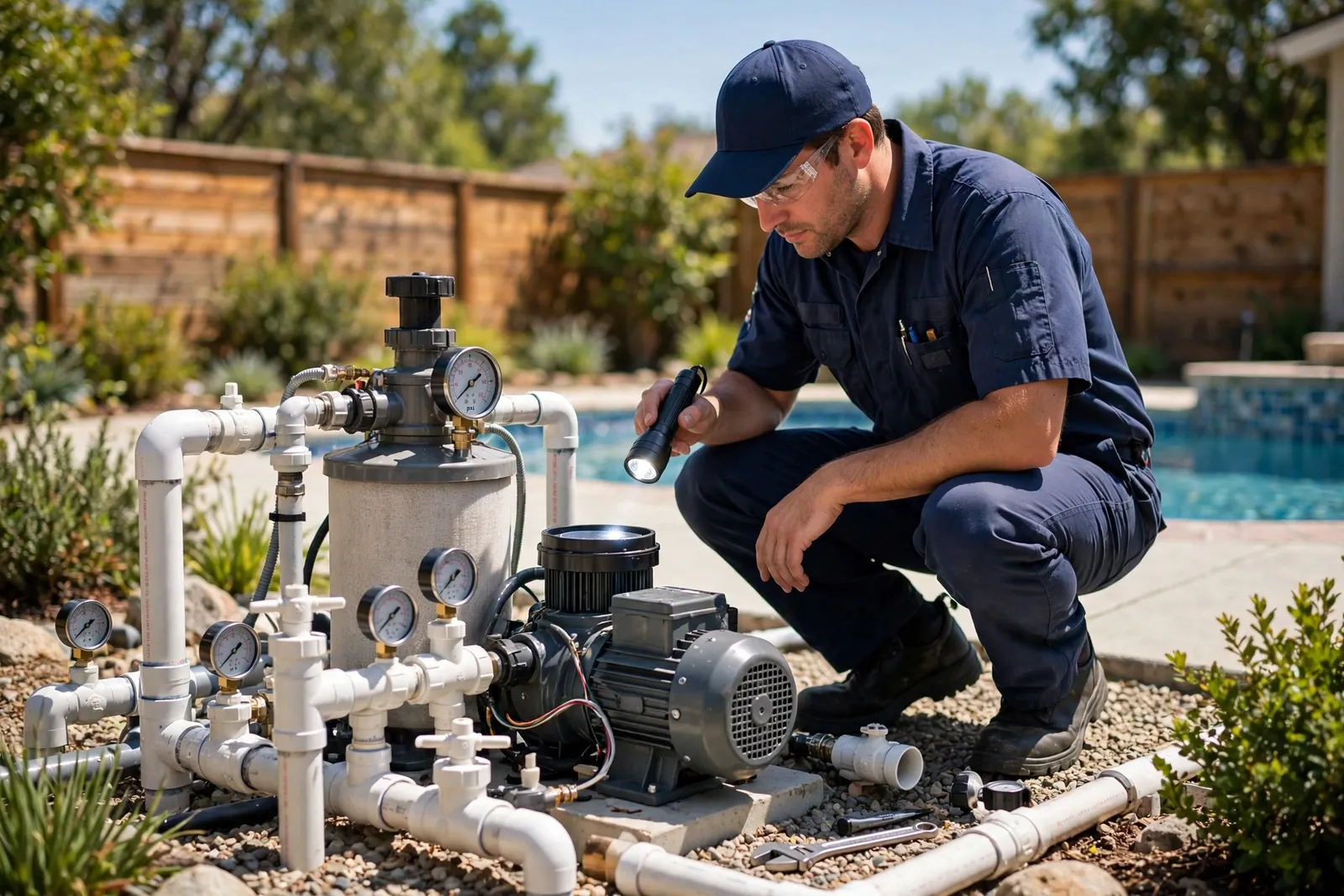
Whittier Pool Leak Specialists
Pool Leak Detection Whittier, CA
A pool that drops water every day isn't just evaporation — it's a leak. Our pool leak detection Whittier, CA process starts with the bucket test, then moves to dye testing and pressure testing of each line, so the repair targets the real break instead of a guess.
- Bucket test first — we confirm it's a real leak before testing begins
- Dye and pressure testing pinpoints the exact fitting or line
- Found without draining the pool or digging up the yard to look
Evaporation or leak?
Is It Evaporation or a Real Pool Leak?
If the pool loses more water than a bucket sitting on its step, it's a leak — not the sun. Whittier gets around 278 sunny days a year with July highs near 86°F, so pools here evaporate plenty. That long evaporation season is exactly why guessing doesn't work, and why the bucket test is the first thing any honest pool tech will ask about.
The bucket test takes 24 hours and a piece of tape:
- Fill a bucket three-quarters with pool water and set it on a pool step, so the bucket sits in the pool.
- Mark the water level inside the bucket and the pool's level on the outside of the bucket. Tape works fine.
- Run the pump on its normal schedule for 24 hours.
- Compare the two marks. If both dropped the same amount, that's evaporation. If the pool dropped more, water is leaving through a leak.
One more useful run: do it once with the pump off. If the pool only loses water with the pump running, the leak is on the pressure side — returns or equipment. If it loses water either way, it's structural or on the suction side. That single detail tells us where to start testing, and it saves you paying for a blind search.
We run pool leak detection routes across Whittier — from Uptown to Friendly Hills — so if the bucket test points to a leak, see our service areas and call before it gets worse.
Usual suspects
Where Swimming Pool Leaks Actually Happen
Most pool leaks we find are at the light niche, the skimmer, a return fitting, or the equipment pad — not the pool shell itself. Shells rarely fail; penetrations and plumbing do.
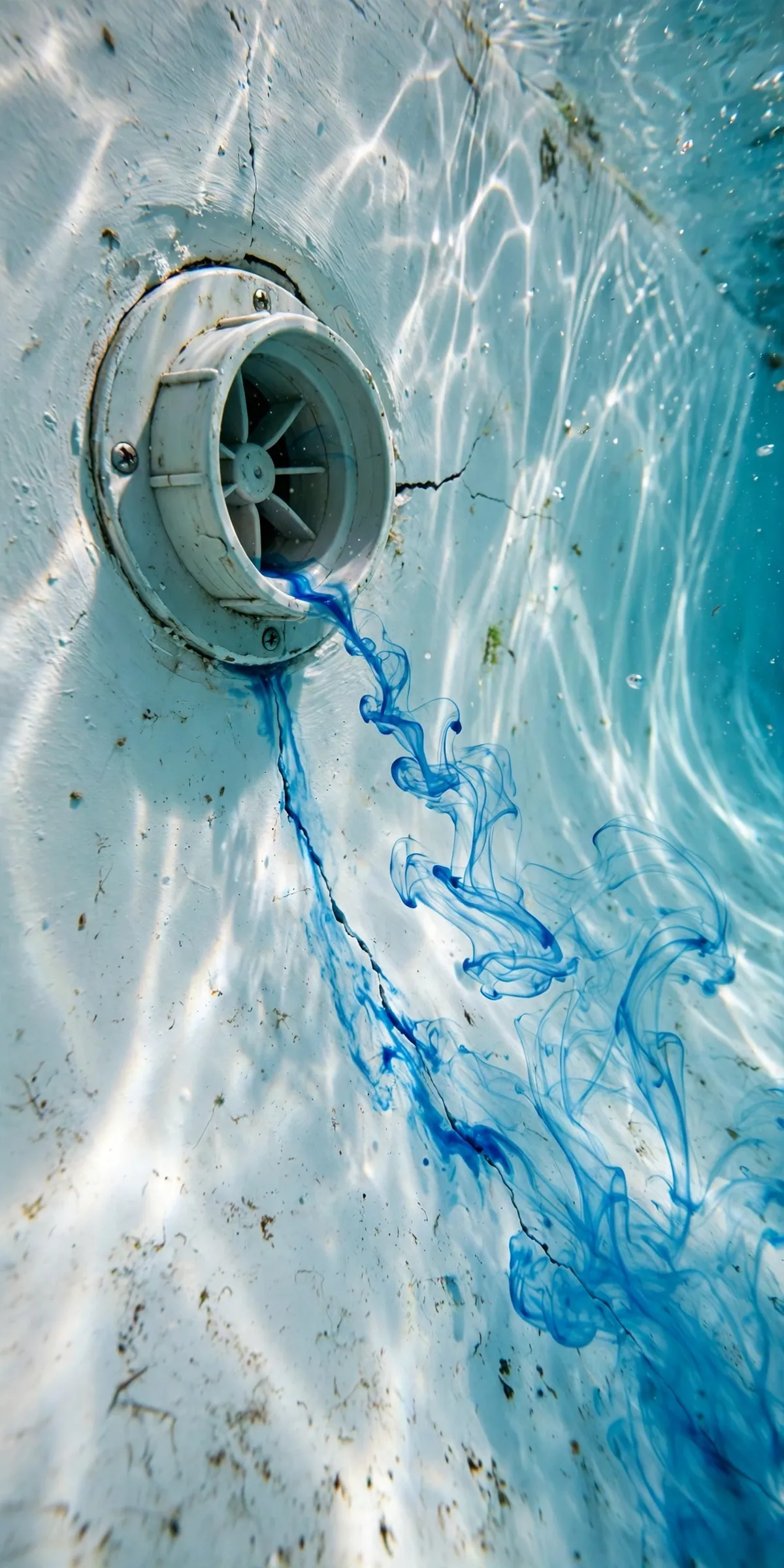
Light niches — the classic. The niche holding your pool light has a conduit running back toward the equipment. Water wicks into that conduit and travels. It is the single most common structural leak we see, across every pool type, and a dye test confirms it in minutes.
Skimmer throat. Where the skimmer meets the pool wall, the seal flexes with every temperature swing. In Whittier heat that joint works hard year after year, and separation here shows up as a steady drop at the waterline.
Returns and main drain. Return fittings crack with age, and main drain sumps can shift. Both are dye-testable with the pump off — quick to check, quick to rule out.
Buried plumbing. Suction and return lines run underground from the pool to the pad. Parts of Whittier sit on potentially expansive soils that shrink through nine dry months and swell with winter rain — decades of that cycle work buried lines loose at the joints. Older pools with original plumbing feel it first, which is why so many 1950s–1970s Whittier pools develop line leaks at a similar age.
The equipment pad. Pumps, filters, heaters, valves — seals and gaskets wear out, and Whittier's hard water, typically 10–15 grains per gallon depending on your provider and zone, leaves scale on heater elements and shortens seal life. A burst line at the pad can dump water fast — that's an emergency leak repair call, not a bucket-test situation.
Surface type changes where we look first. Vinyl liners tear at seams and steps; gunite pools crack plaster and weep at fittings; fiberglass shells almost never leak — with fiberglass, it's the fittings and plumbing every time.
How it works
How Professional Pool Leak Detection Works
We isolate, then we test. Each line gets pressure-tested on its own, structural suspects get dye-tested, and buried lines get listened to — the process rules areas out until only the leak is left.
1. Confirm the leak. Your bucket test results, plus our own water-level check on arrival. There is no point pressure-testing a pool that's just evaporating.
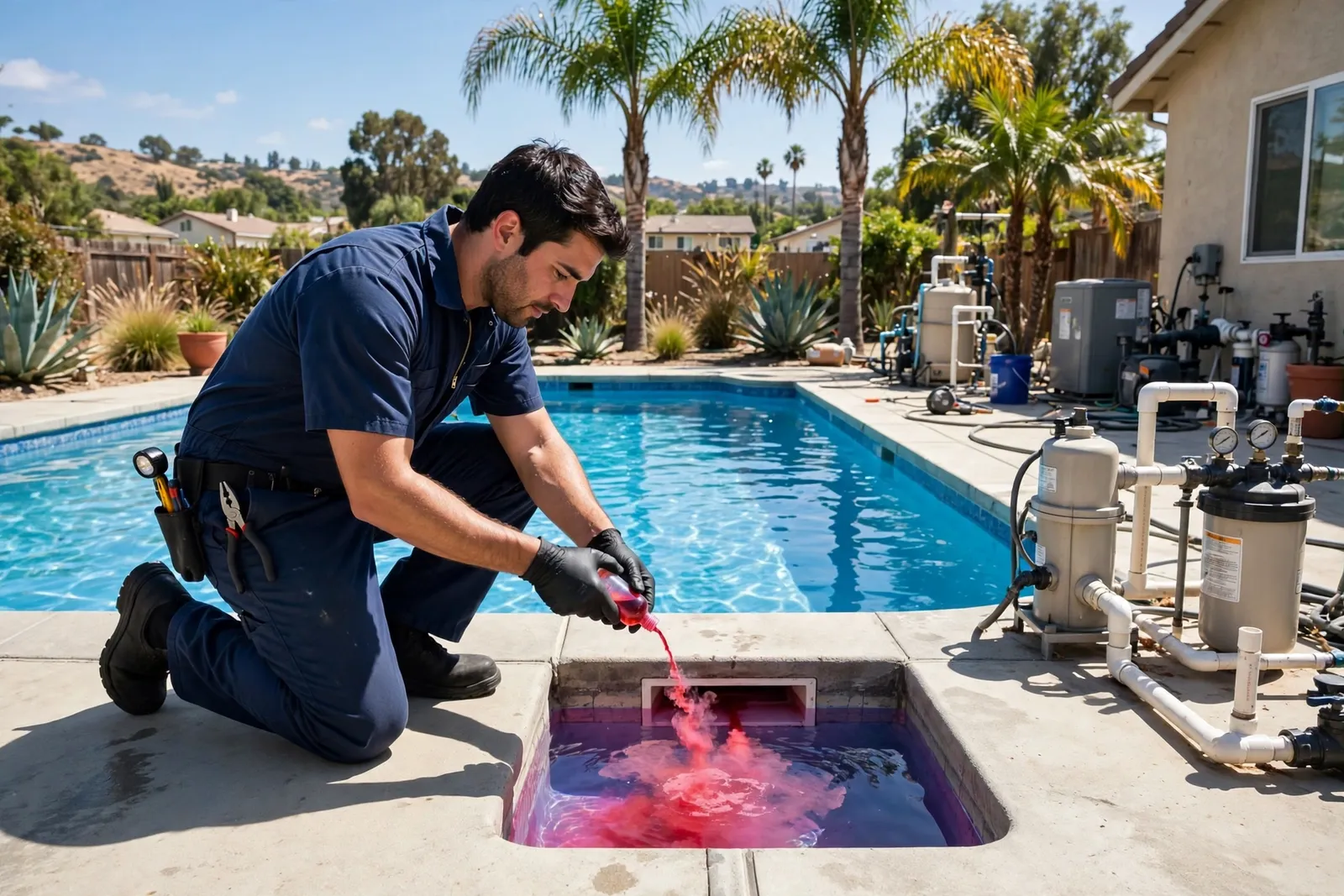
2. Dye-test the structure. Pump off, water still. Dye goes to the skimmer, the returns, the light niches, and the main drain — anywhere it pulls steadily inward, water is getting out. This step alone finds most structural leaks.
3. Pressure-test each line. Skimmer line, main drain line, return lines — plugged and pressurized one at a time. The line that won't hold pressure is the line with the break. No guessing, no digging to look.
4. Listen along the bad line. Acoustic equipment pinpoints the break along the pipe run — the same approach used in slab leak detection, adapted for pool plumbing. You dig once, at the marked spot.
5. Check the pad. Pump seals, filter gaskets, heater connections, and valves get inspected and pressure-checked while we're there, since pad leaks are the cheapest to fix and the easiest to miss.
Common questions
Pool Leak FAQs
Run the bucket test. Set a bucket on a pool step, fill it to match the pool's water level, and mark both. After 24 hours with the pump running normally, compare: if the pool dropped more than the bucket, water is leaving through a leak, not the air. In Whittier's summer heat some evaporation is normal, which is exactly why the test matters — it separates normal loss from a real leak.
Light niches and their conduits, the skimmer throat where it meets the pool wall, return fittings, and the equipment pad — pump seals, filter gaskets, and heater connections. Underground, the suction and return lines are the suspects, especially in older Whittier pools where decades of soil movement have worked on buried plumbing.
With the pump off and the water still, the technician releases a small puff of dye from a syringe near a suspected spot — a light niche, a return, a skimmer seam. If there is a leak, the dye gets pulled steadily toward it, tracing the exact path water takes out. No leak, and the dye just hangs in the water. It is simple, visual, and conclusive for structural leaks.
Yes. Each line — skimmer, main drain, returns — gets plugged and pressure-tested individually, which tells us exactly which line is losing pressure. From there, acoustic listening pinpoints the break along the pipe run, the same way it works for a slab leak under a house. You dig once, at the marked spot.
Professional pool leak detection in the Whittier area typically runs $250–$500 depending on pool size and how many lines need pressure testing. Repairs are quoted separately after the leak is found — a skimmer or fitting repair is on the lower end, while excavating and replacing a section of buried line costs more. You approve the price before any repair work starts.
It can. A steady leak saturates the surrounding soil, and parts of Whittier sit on potentially expansive soils that swell when wet and shrink when dry — that movement stresses everything nearby, including buried lines and nearby slabs. A leak left running for a season can also undermine decking and wash out soil under concrete. Finding it early is always the cheaper path.
Losing Pool Water Every Day?
Pool leak detection Whittier, CA — we find it, mark it, and price the fix up front. Call (562) 450-1003 or request service online.