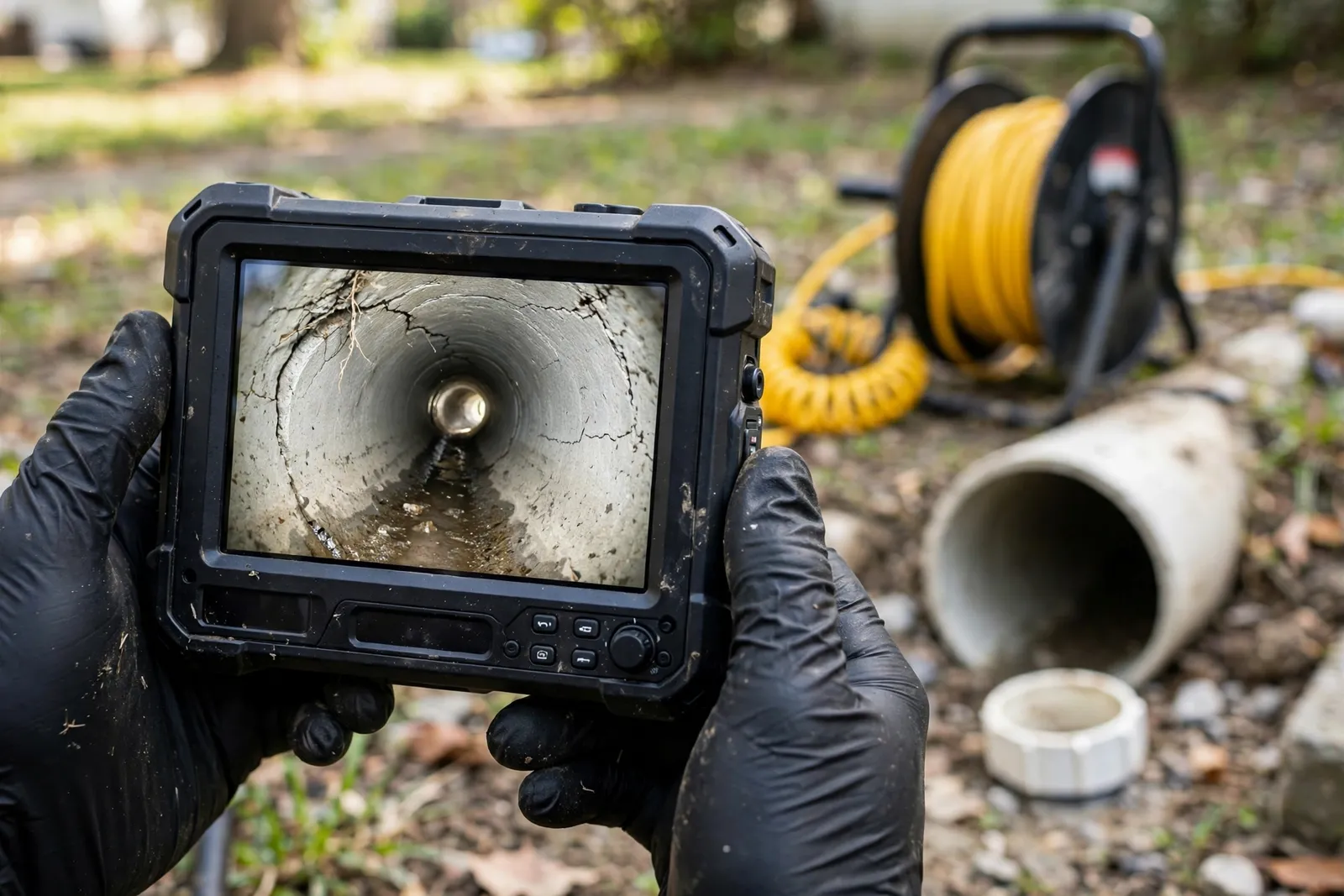
Whittier Sewer Lateral Specialists
Sewer Line Leak Detection Whittier, CA
Your sewer lateral is the buried pipe carrying everything from your house to the city sewer main — and when it cracks, shifts, or fills with roots, the damage hides underground for years. Sewer line leak detection Whittier, CA homeowners call on starts with a camera, not a shovel: we see the break, measure its depth, and mark its location before anyone digs.
- Camera shows the exact break — no exploratory digging
- Line path located and depth measured for accurate pricing
- Video file and written findings yours to keep
How it works
How a Sewer Camera Finds the Break Without Digging
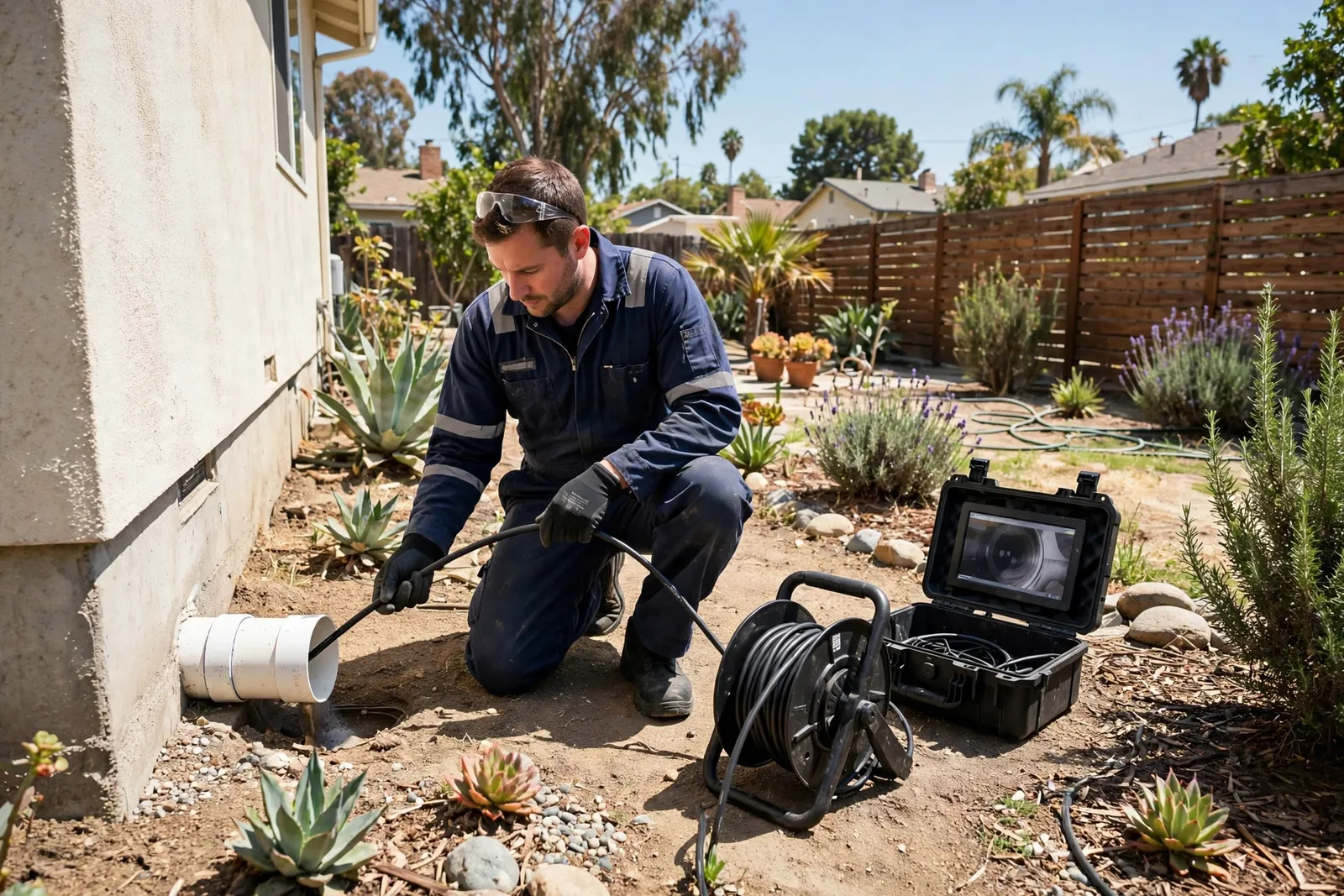
A sewer lateral is the buried pipe — usually four inches in diameter — that runs from your house to the city sewer main under the street. A camera inspection is the only way to see inside it without excavating, and one visit answers three questions: what is wrong, exactly where it is, and how deep.
First, the camera goes in. Through an outside cleanout — or a pulled toilet when there is no cleanout — a waterproof camera on a flexible push rod travels the full length of the lateral. The technician watches the live feed for cracks, offset joints, bellies, root intrusion, and scale, calling out each defect with its distance in feet from the entry point.
Then the line gets located. A sonde transmitter in the camera head sends a signal that a receiver above ground picks up, tracing the pipe’s exact path across the yard and measuring its depth. That surface mark — typically within inches — is what a repair crew digs to, instead of trenching the whole run on a guess.
For leaks the camera cannot fully explain, dye testing confirms it. A bright, non-toxic dye flushed through the system shows up wherever wastewater is escaping — useful when a damp foundation wall or a soggy patch of lawn needs a definite yes or no.
Why Whittier laterals fail the way they do: we run camera routes across Whittier’s neighborhoods every week, and the failure patterns repeat by era. In Uptown’s pre-1940s blocks and the 1950s–70s tracts of Friendly Hills, Murphy Ranch, and Leffingwell Ranch, laterals are often clay or cast iron — typical materials for their era, and both are known to crack and invite root intrusion as they age, a pattern documented across older San Gabriel Valley neighborhoods with mature landscaping. Underneath, the Puente Hills clay runs its annual shrink-swell cycle, working buried joints loose a fraction at a time. And any lateral laid before October 1987 has already ridden out magnitude-5.9 shaking that broke water and gas mains across the city — buried joints from that era earn a close look on camera.
One thing the camera rules out fast: supply-side trouble. A hot spot on the floor or the sound of running water with everything off points to a pressurized line under the slab — that calls for slab leak detection, a different visit with different equipment.
Reading the camera
What the Camera Findings Mean for Your Repair
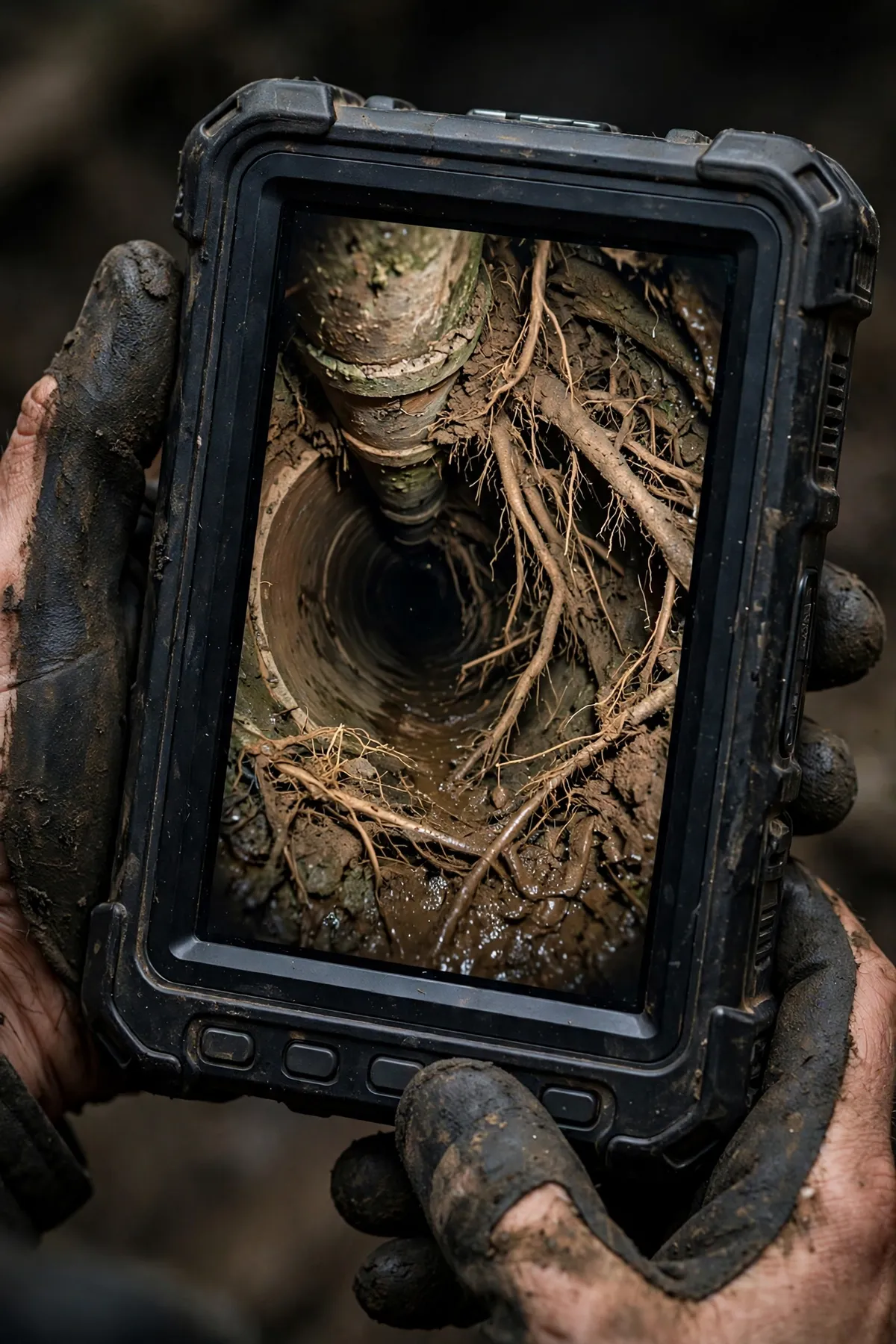
Not every defect means digging up the yard. Here is how a technician reads what the camera shows — and what each finding usually points to.
A spot repair usually handles it
- Single crack with the rest of the line sound
- One offset joint catching debris
- Root intrusion at a single joint, pipe wall intact
- Light scale buildup that jets clear
Points toward replacement
- Multiple cracks or breaks along the run
- A belly holding standing water
- Heavy root mass through long sections
- Collapsed or back-pitched pipe
Honest guidance: a camera inspection is diagnosis, not a sales pitch. You get the video, the footage count at every defect, and the located depth — then a repair price for the option that fits what the pipe actually shows. If a lateral is sound apart from one bad joint, we say so. And if sewage is actively backing up into the house, don’t wait for a scheduled visit — emergency leak repair is the call to make.
Common questions
Sewer Line FAQs
Several drains slowing down at once, sewage odors inside the house or out in the yard, gurgling toilets, an unusually lush or soggy patch of lawn, and moisture along the foundation. One slow drain is usually a local clog — when the whole house drains slowly, the problem is in the lateral.
A waterproof camera on a flexible rod goes in through an outside cleanout — or a pulled toilet when there is no cleanout. The technician watches the live feed for cracks, offsets, bellies, and root intrusion while a sonde in the camera head lets a locator above ground trace the pipe's path and depth. You get the video file and a written report of every defect with its distance from the entry point.
Yes. The camera shows the defect on screen with a footage counter, and the locator pinpoints that spot on the surface within inches, along with how deep it is. That is how a repair gets priced before any excavation — the digging happens once, exactly over the break.
A crack is a split in the pipe wall that leaks wastewater into the soil. An offset is a joint that has shifted so the pipe ends no longer line up, catching paper and waste. A belly is a sagging section that holds standing water instead of draining. Cracks and single offsets are often spot-repair candidates; bellies and multiple offsets usually point toward replacement.
A camera inspection of a residential lateral in the Whittier area typically runs $200–$450 depending on access and line length. If a repair is needed, a single spot repair often falls in the $1,500–$4,000 range, while trenchless or full replacement runs higher depending on depth, length, and whether street or sidewalk work is involved. Detection is always priced separately and approved before the visit.
They exploit weaknesses rather than breaking sound pipe. Roots find the moisture at a loose clay joint or a hairline crack, grow in, and over seasons turn into a mass that blocks flow and widens the opening. In Whittier's older neighborhoods with mature landscaping, root intrusion is one of the most common things the camera finds — especially in clay and cast-iron laterals from the 1940s through the 1970s.
Sewage Smell or a Soggy Patch in the Yard?
Get the lateral camera-checked before a small break becomes a big dig. Sewer inspection in Whittier — line located, depth measured, priced up front.