Whittier Commercial Leak Specialists
Commercial Leak Detection Whittier, CA
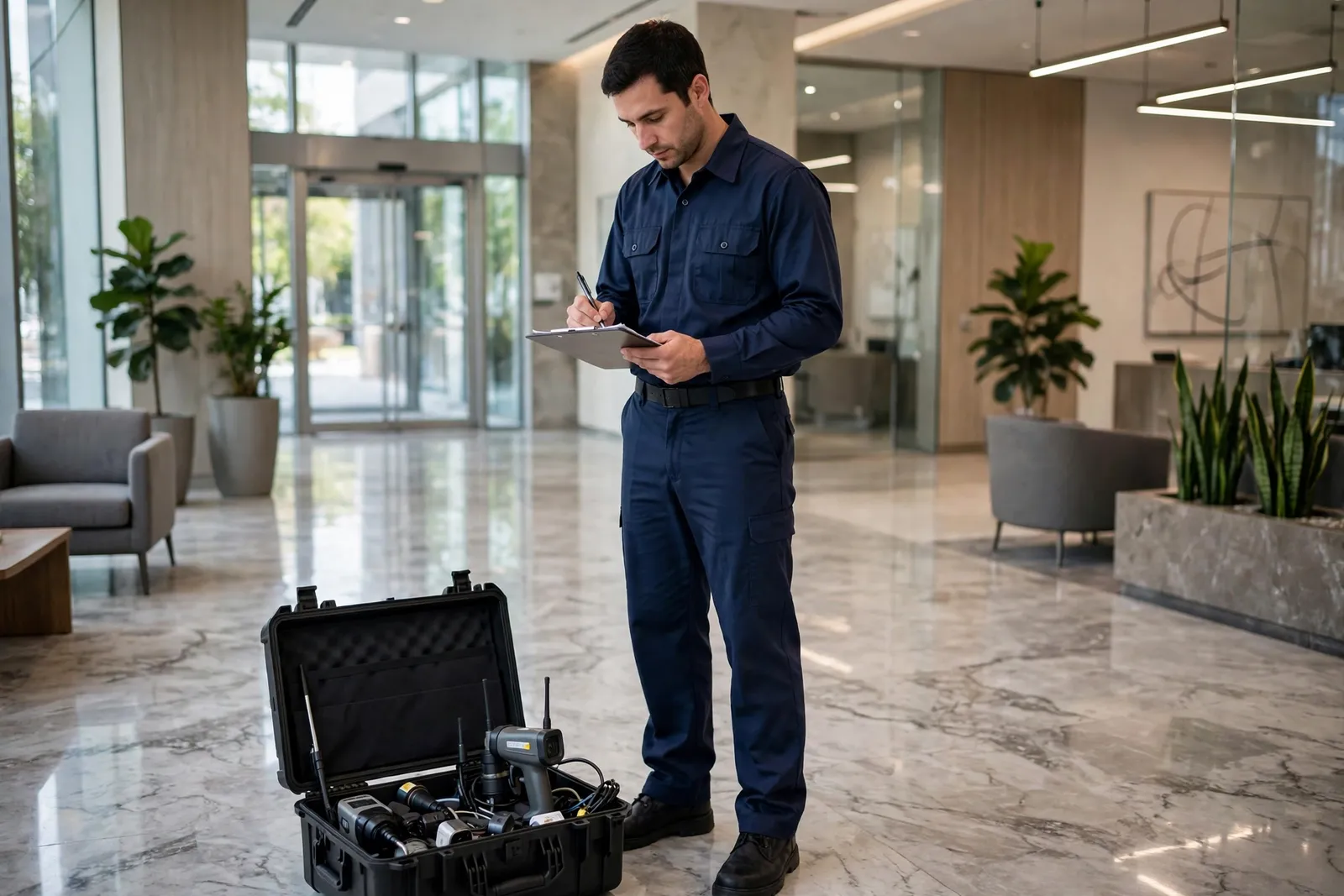
A hidden leak in a commercial building costs more than the water it wastes — it lands on the utility bill, in tenant complaints, and sometimes in a liability claim. We bring commercial leak detection Whittier property managers can schedule around their tenants — evenings and weekends included — pinpointing the source with acoustic listening and thermal imaging while your business stays open.
- After-hours and weekend scheduling — zero lost business hours
- Restrooms, kitchens, irrigation, risers, and slab lines checked
- Written findings with photos for managers and insurers
Who we serve
Commercial Properties We Work In
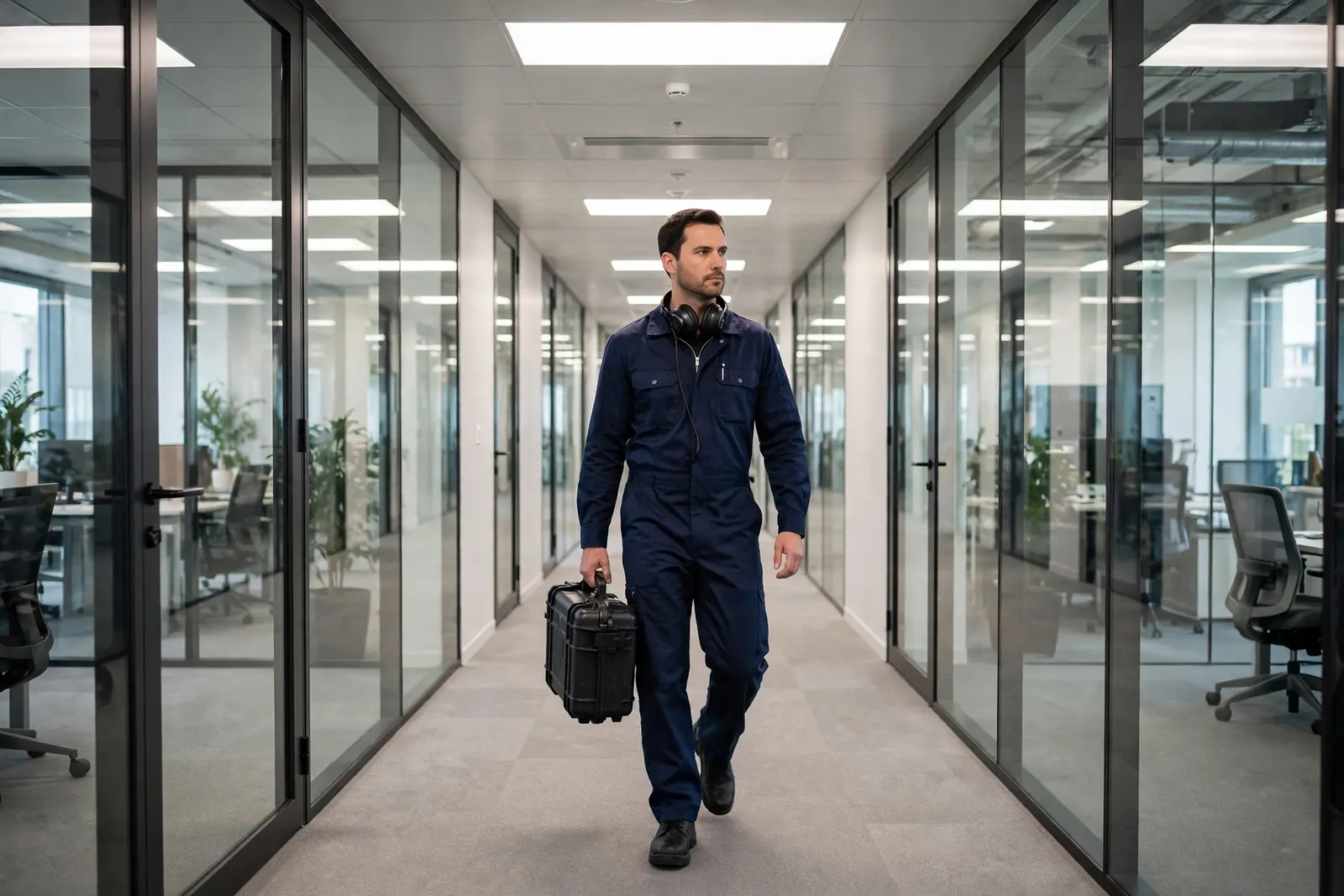
A leak in a business is not just a bigger home leak — the pipe runs are longer, the roof is flatter, and the schedule belongs to your tenants and customers. We regularly work in:
- Offices — restrooms, break rooms, and HVAC condensate lines, checked without clearing the floor.
- Retail storefronts and restaurants — sales-floor, kitchen, and prep-area leaks found after hours so the doors stay open.
- Multi-tenant buildings and executive suites — a leak can surface in one unit and start in another, so we isolate zone by zone and open up only where the evidence points.
- Apartments and HOAs — common-area lines, laundry rooms, and riser stacks, with written reporting a board or owner can act on.
- Churches and schools — older buildings with aging copper and galvanized lines, surveyed while services and classes go on as usual.
Much of what we survey in Uptown Whittier is older stock — a historic commercial district in a town that is 108+ years old and Quaker-founded, where buildings still work every day with 1940s and 1950s bones: a 10,826-square-foot freestanding retail building on Bailey Street dating to 1941, a 1959 multi-tenant building on Philadelphia Street with around 30 tenants and eight rooftop HVAC units. Old membranes, old copper, dozens of penetrations — that is exactly the kind of building where a leak travels sideways and shows up rooms away from where it started. Older commercial stock is exactly why Whittier's leak detection specialists survey with cameras and acoustic tools before recommending anything.
Commercial process
How We Pinpoint Leaks Without Shutting Your Business Down
Commercial leak detection follows a different order than most people expect: we talk first, look second, and only then reach for instruments. The pros work big buildings in the same sequence — interview, interior, exterior, instruments — because the cheapest way to find a leak is to understand it before you chase it.
Step 1 — Interview. We start by talking to whoever lives with the leak: the owner, the facility manager, the tenant who spotted the stain. When did it show up — after rain, or around the clock? Hot line or cold? That history narrows the suspect list before we touch a meter.
Step 2 — Interior. Then we work from the stain backward: ceiling tiles, decking, the pattern of discoloration. As Dock Line Magazine puts it, “A commercial roof leak is rarely the brown spot on the ceiling tile” — on a flat roof, water gets in at a seam, a curb, or a drain, then travels sideways under the membrane and can surface 30 feet from where it started.
Step 3 — Exterior. Then we go up: seams, penetrations, flashing around rooftop-unit curbs, drains and scuppers, ponding water. SoCal sun is the slow killer here — years of UV and heat dry membranes, harden and crack them, and work seams loose, invisibly from the ground. The four usual culprits: failed membrane seams, flashing at rooftop-unit curbs, ponding from clogged drains, punctures from other trades walking the roof.
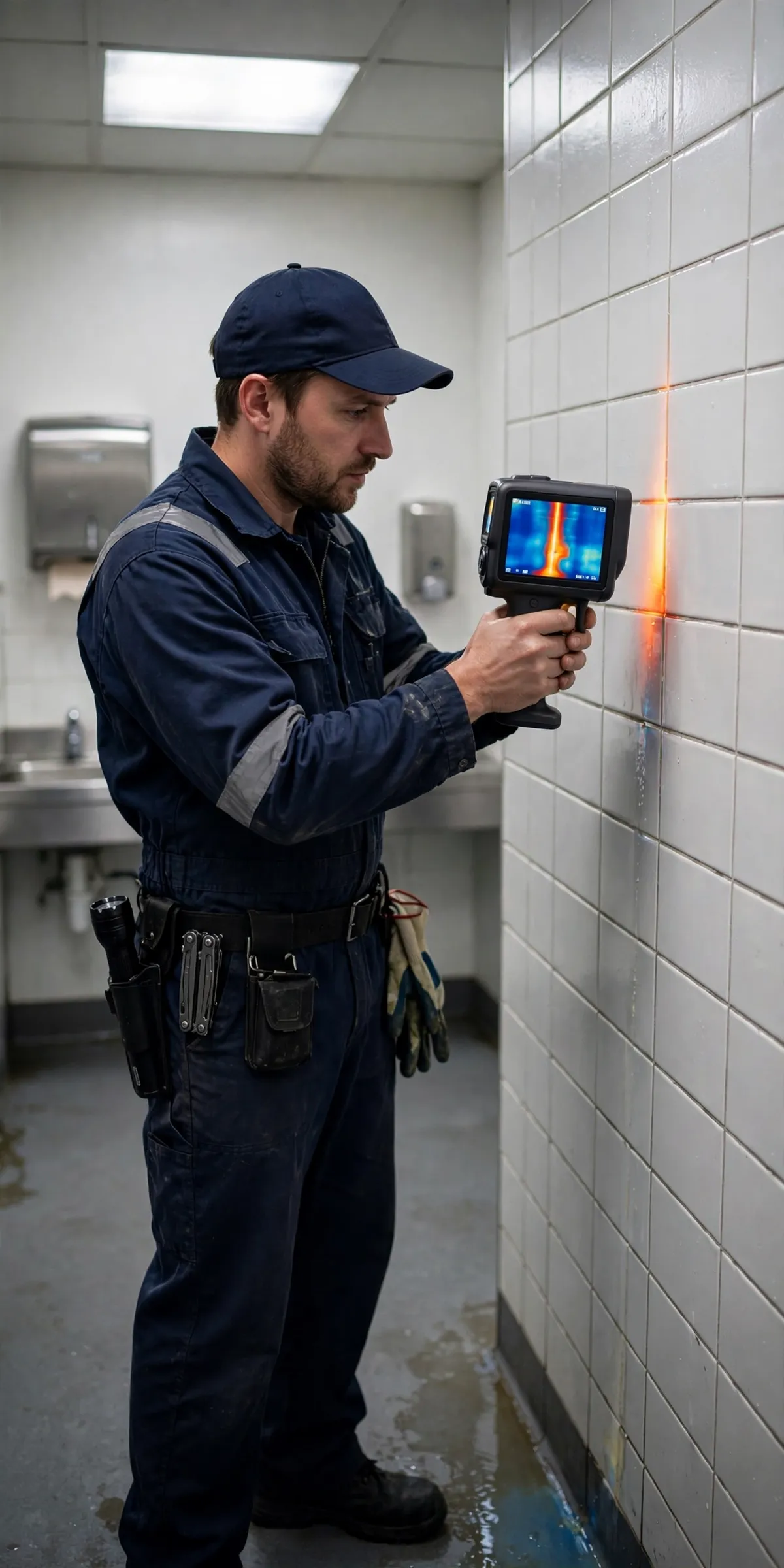
Step 4 — Instruments. Only now do the meters come out. Infrared thermography maps wet insulation across whole roof sections — best two to four hours after sunset, when wet areas read warmer than dry ones; capacitance surveys back it up by day. Electronic membrane testing (EFVM) pinpoints breaches directly — a 40–60V pulse on a wetted membrane, and the wand alarms at the breach. On large buried lines, acoustic correlators at two points up to 1,300 meters apart pinpoint the leak without breaking ground — trade press covered a Houston plant job done in three hours with pumps running. A small, targeted core sample verifies what an anomaly actually is. One boundary: around fire-line risers we check for signs of water, but we do not work on fire suppression systems — that is licensed fire-protection territory.
Why Whittier commercial buildings leak the way they do: much of the retail and office stock along Whittier Blvd and Greenleaf Ave went up decades ago — and any building standing before October 1987 rode out the Whittier Narrows earthquake, which broke water and gas mains across the area. Add hard local water — typically 10–15 grains per gallon — scaling pipe interiors and stressing joints, plus the Puente Hills clay’s annual shrink-swell cycle working buried lines, and you get the slow-developing leaks we find most often: pinholes in aging copper, tired galvanized lines, irrigation laterals cracked by ground movement. Buildings on slab foundations get the same acoustic treatment described in our slab leak detection service.
The business case
Why a Small Leak Costs a Business More Than a Home
Allianz Commercial’s 2026 analysis of 7,888 business-interruption claims puts the average BI claim near $986,000 — roughly 70% higher than the average property-damage claim. The leak is rarely the expensive part. The shutdown is.
What a hidden leak costs a business
- Water bills that climb month after month with no change in usage
- Tenant or customer complaints — and reviews that outlive the leak
- Slip-and-fall exposure from wet floors in public areas
- Mold growth inside wall cavities and above drop ceilings
- Business interruption that dwarfs the repair itself
- The extreme end, documented by Chubb: one failed valve coupling on the 16th floor of a 21-story office building — six months of interruption, $9.5 million total loss
What a detection visit gives you
- Leak located within inches — repairs open one spot, not the whole floor
- Evenings and weekends, scheduled around your business hours
- Zone-by-zone isolation, so only the affected area needs access
- Written findings with photos and readings for insurance and management
- Fast mitigation math: mitigation started within 24 hours averages $6,213, versus about 1.75× at 48 hours and 2.5× at five days — as Scott Sauerbier of RestorePro Reconstruction puts it, “Time is the most valuable asset after a water loss.”
- Survey economics: infrared roof surveys run pennies per square foot while catching problems that cost dollars per square foot to fix (Royal Roofing) — one case: a 1,200-square-foot wet area repaired for $5,400 instead of a $90,000–$119,000 tear-off
If water is already pouring — a burst supply line, a failed water heater, a riser leak — don’t wait for a scheduled visit. Our emergency leak repair runs around the clock. We cover commercial properties across the Whittier area — see our service area.
Built around your business
How Commercial Jobs Are Scheduled
Leak detection work is quiet — acoustic listening and thermal imaging don’t need jackhammers — so most of it happens while your business runs normally. When a space has to be empty, we go after hours or weekends and phase the work.
One point of contact, a written plan before we start, and findings documented for whoever needs them — owners, managers, or insurers. In a multi-tenant building we triage first — structurally affected, cosmetically affected, or just needs monitoring — so unaffected tenants aren’t displaced and affected ones get honest timelines.
| Commercial Detection | Residential Detection | |
|---|---|---|
| Scheduling | After-hours and weekends to avoid downtime | Daytime appointments |
| Scale | Larger systems, multiple zones and floors | Single-family systems |
| Multi-tenant access | Zone-by-zone — only affected spaces need access | Whole-home walk-through |
| Phasing | Work phased around operating hours | Completed in a single daytime visit |
| Documentation | Formal reports with photos for management and insurers | Written findings for the homeowner |
| Priority | Keep the business running | Keep the home livable |
Paperwork handled
Documentation for Insurance and Management
Commercial leaks usually involve more people than the one who called us — a property manager, a board, an insurer. Every commercial leak detection visit ends with a written report: what was tested, what was found, photos and readings, and next steps.
The backbone is a moisture map — a room-by-room wet/damp/dry picture from moisture meters, thermal images, and visual inspection, with date, time, zone-marked floor plans, and meter readings with units and device type. That is what adjusters expect, delivered without you having to chase it.
Our 48-hour protocol: pin down the cause of loss early, photograph the source before repair, and moisture-map at the start with daily readings through drying. A sudden burst and a slow leak sit very differently in most policies — and the difference is settled by evidence, not memory.
For multi-tenant losses, know the split before anyone argues about it: the landlord’s policy covers the building — structure, roof, common areas — plus rental-income loss. It does nothing for a tenant’s stock, equipment, or business interruption, and leasehold improvements are decided by the lease. And hard-won advice from the trade: tenants forgive the flood — what they remember is being left in the dark. A calm, dated communication log is your best defense against disputes.
Why it pays
What Commercial Leak Detection Saves a Business
For a homeowner, a leak is a repair bill. For a business, the repair bill is the smaller half: Allianz Commercial's 2026 analysis of 7,888 business-interruption claims puts the average BI claim near $986,000 — roughly 70% higher than the average property-damage claim of about $559,800 — with severity rising more than 30% a year. Restoration records show the other lever: mitigation started within 24 hours averaged $6,213; at 48 hours it ran 1.75 times that; at five days, 2.5 times. “Time is the most valuable asset after a water loss,” says RestorePro's Scott Sauerbier. That's why commercial detection is built for speed and certainty: the pro order is interview, then interior, then exterior, then instruments — tracing the stain pattern inside first, because on a flat roof water travels sideways under the membrane and the stain can sit yards from the hole. (“A commercial roof leak is rarely the brown spot on the ceiling tile,” as Dock Line Magazine puts it.)
Instruments finish it: infrared scans 2–4 hours after sunset map wet insulation across whole roof sections (best with a sunny day prior and more than a 15°F day-night differential), capacitance surveys back it up in daylight, and electronic membrane testing pinpoints the breach directly. One vendor case says what the survey buys: a 28,000-square-foot roof, a 1,200-square-foot wet area found by IR, repaired for $5,400 against a $90,000–$119,000 tear-off — roughly $100,000 saved. Pennies per square foot to survey; dollars per square foot to repair. A leak that starts in one tenant space can appear 30 feet away in another — which is why the finding, documented on a moisture map, matters as much as the fix.
What it costs
What Commercial Leak Detection Costs and What Sets It
Nationally, a specialist detection visit averages about $280 (Angi, 2026), ranging $150–$400; an infrared roof inspection runs $300–$1,500 residential, with larger commercial roofs from $2,500 — some inspectors charging $0.20–$0.50 per square foot (coohom.com). Angi's 2026 inspection breakdown: physical $75–$200, drone $150–$400, drone-mounted infrared $400–$600, thermal add-on $100–$200. National figures, not Whittier prices — the cost moves with what the building asks for. Size is the first driver: surveys price by square footage, and a 10,000-square-foot retail roof is a different night than a 300,000-square-foot facility. Access is the second: infrared works best 2–4 hours after sunset on a dry roof with low wind, so scheduling has to fit the sky, not just the calendar.
Membrane type is the third: electronic breach testing can't be used on electrically conductive membranes like black EPDM, and the low-voltage method needs a wetted surface — the right instrument for the roof decides the crew and the time. Complexity is the fourth: multi-tenant buildings get isolated zone by zone, and when a stain could be roof, HVAC, or plumbing, controlled testing rules out the impostors before anyone names a source. Core sampling — a small targeted cut to confirm what an anomaly actually is — adds certainty at the back end. You approve the price before work starts; the moisture map, readings, and marked findings are yours either way.
Why us
Why Businesses Hand Us the Detection Side
We do one thing: find the leak and document it. We don't roof, we don't repipe, and we don't sell the repair — which keeps our findings honest, because there's nothing in our report we benefit from. The method is the industry's order: interview the facility manager about timing and history, investigate the interior stain pattern, go outside to seams, penetrations, drains, and flashing, and only then deploy instruments — infrared after sunset, capacitance as the daytime backup, electronic membrane testing to pin the breach, a small core sample to confirm. Uptown Whittier is our context: a 108-plus-year-old commercial district where real stock like the 1941-built 10,826-square-foot retail building on Bailey Street and the 1959-built 8,521-square-foot multi-tenant suites on Philadelphia Street — with eight rooftop HVAC units — are exactly the aging flat roofs and multi-penetration buildings we work.
These buildings rode out the 1987 Whittier Narrows quake's $90 million of town damage, and SoCal sun has been aging their membranes ever since — UV and daily thermal cycling harden materials and open seams and penetrations slowly, invisibly from the ground. In multi-tenant buildings we triage honestly: which spaces are structurally affected, which are cosmetic, which need monitoring — so unaffected tenants aren't displaced. And the honest line we stand behind: detection ends where repair begins. Our report maps the source so owner, tenant, and insurer argue from the same evidence.
Common questions
Filing a claim? Our guide to insurance and leak detection reports walks through the 48-hour documentation protocol adjusters expect.
Commercial Leak FAQs
Yes — evenings and weekends are the standard booking for commercial work. We schedule detection for after closing or before opening, so the business doesn't have to shut down. You or a keyholder just needs to provide access.
Offices, retail storefronts, restaurants, apartment buildings, HOAs, churches, and schools — any commercial property in the Whittier area with a hidden leak. Multi-tenant buildings are common: we isolate zone by zone, so only the affected area needs access.
That's the entire point of detection-first service: acoustic listening, thermal imaging, and pressure testing locate the leak through floors, walls, and slabs — no exploratory demolition. Anything opened afterward is a small marked spot for the repair itself, and you approve it first.
In the pro order: interview, interior, exterior, instruments. We talk to the facility manager first — when the leak shows, whether it follows rain — then trace the stain pattern inside: on a flat roof water travels sideways under the membrane, so the stain can be yards from the hole. Then we check seams, penetrations, flashing, drains. Instruments come last: infrared scans after sunset map wet insulation, capacitance surveys back it up in daylight, and electronic membrane testing pinpoints the breach — verified with a small core sample.
Nationally, a specialist detection visit averages $280, ranging $150–$400 (Angi, 2026), and a drone-mounted infrared inspection runs $400–$600. Larger commercial roof surveys start around $2,500, some inspectors charging $0.20–$0.50 per square foot (coohom.com). Your quote depends on building size, access, and zones to isolate; you approve the price before work starts.
Written findings with the leak location marked and photographed, the methods used, and meter and pressure readings — plus a moisture map showing wet, damp, and dry zones on the floor plan. We photograph the source before repair: a sudden burst and a slow leak sit very differently in most policies, and the difference is settled by evidence. It gives your adjuster something concrete instead of a verbal description.
Liability follows the source, which is exactly why pinpointing it matters before anyone pays. The landlord's policy covers the building — structure, roof, common areas — plus rental-income loss; it does nothing for a tenant's stock, equipment, or business interruption, and leasehold improvements are decided by the lease. Our leak detection report maps the source so owner, tenant, and insurer are all arguing from the same evidence.
A sudden jump with no change in usage is the most common sign. First check the obvious: running toilets, irrigation stuck on, a hose bib left open. If none of those explain it, read your meter with everything off — if it's still moving, water is going somewhere it shouldn't. Whittier is served by several different water providers, so check your own bill to see which one meters your building.
Suspect a Leak at Your Business?
Hidden water costs Whittier businesses every month it runs. Get business leak detection on your schedule — located within inches, documented for your insurer, priced up front.