Whittier Slab Leak Specialists
Slab Leak Detection Whittier, CA
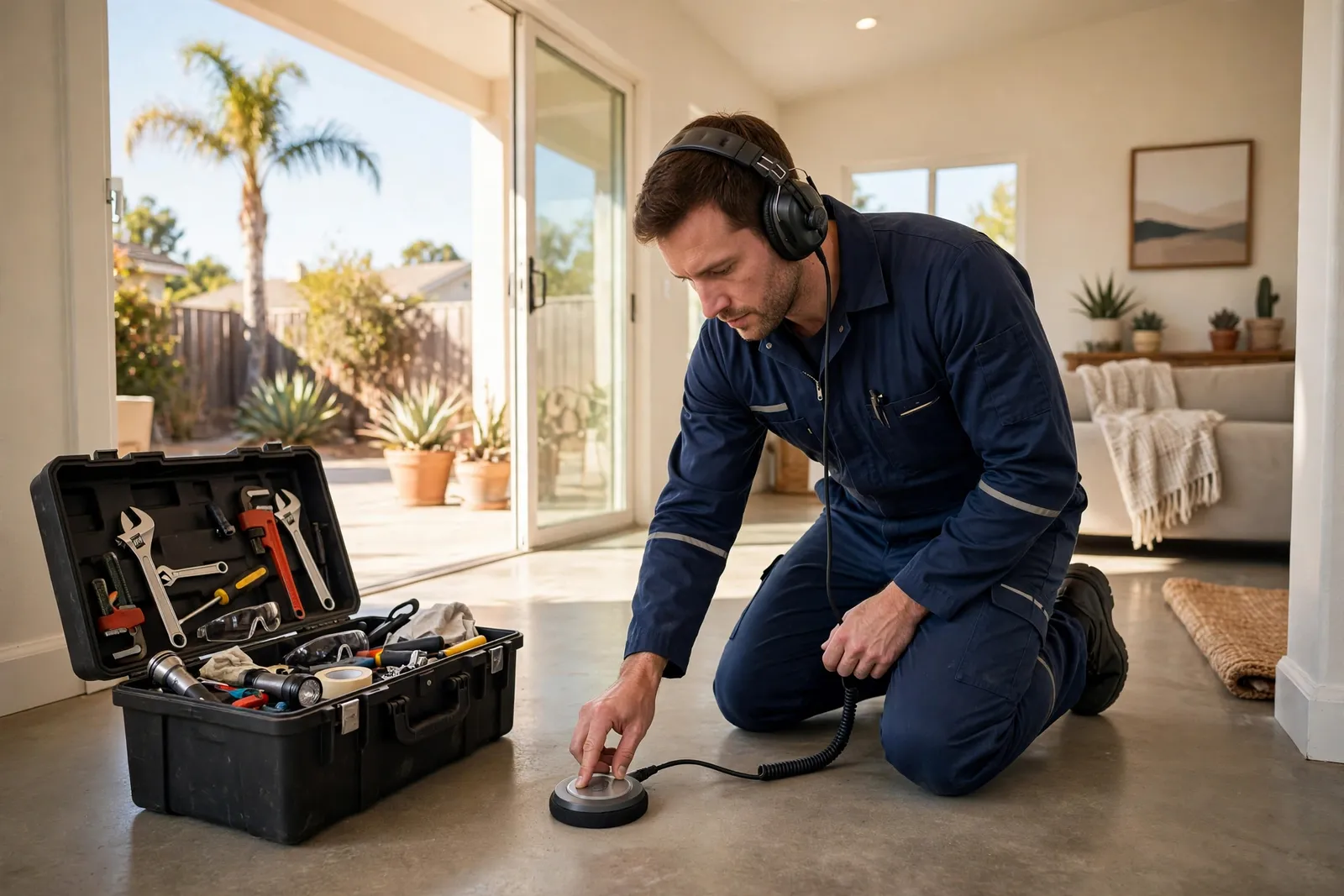
A leak under your concrete slab is the last place you want guesswork. Our slab leak detection Whittier, CA uses acoustic ground microphones and thermal imaging to pinpoint the break within inches — so the only concrete opened is a small, surgical square. It is the same Whittier leak detection approach we use on every job: find it first, open only what must be opened.
- Located within inches — no exploratory jackhammering
- Hot vs. cold vs. drain line identified first
- Spot repair and reroute options priced up front
The basics
What Is a Slab Leak?
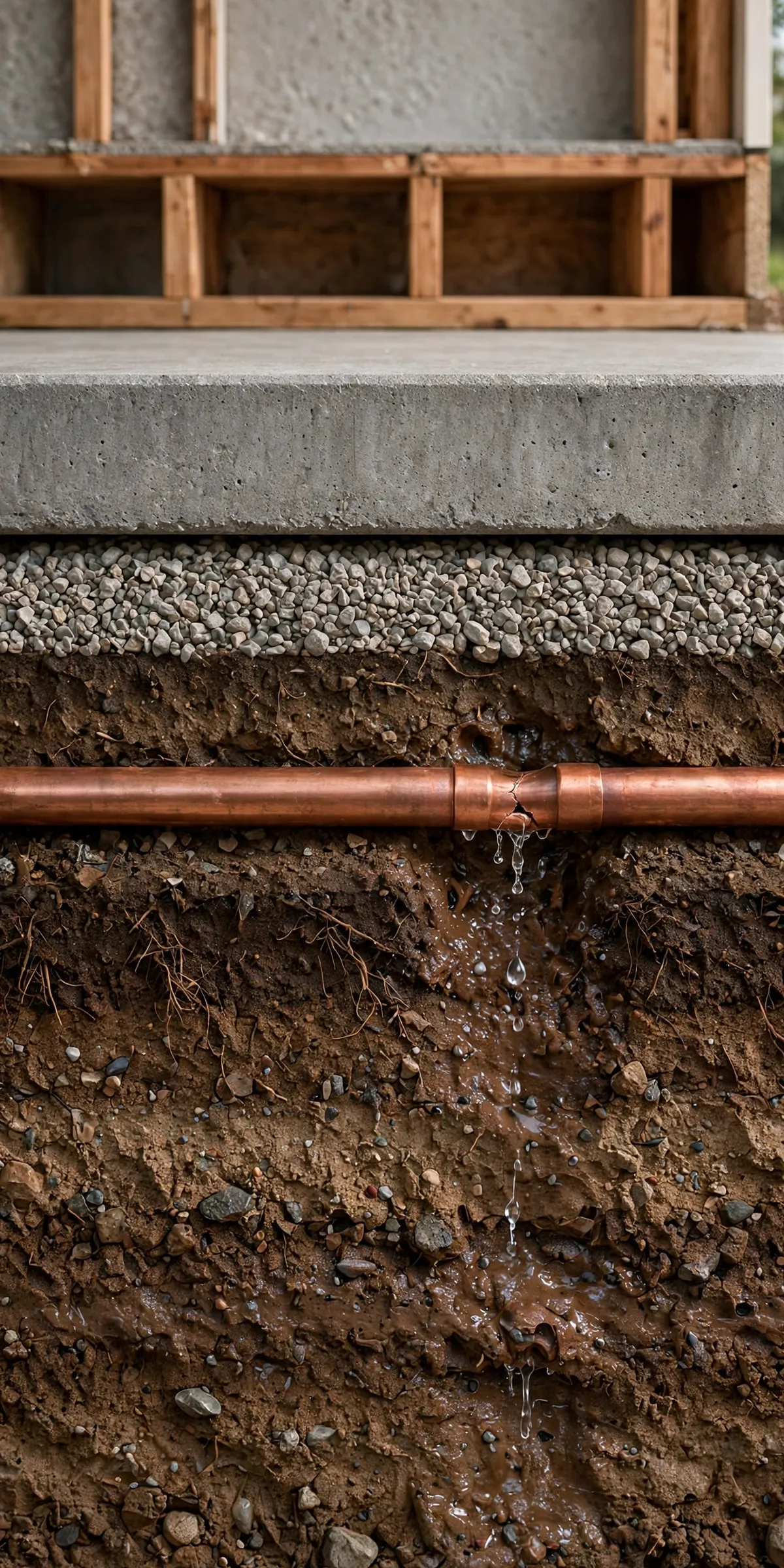
A slab leak is a water line failing underneath your home’s concrete foundation — usually a pressurized supply line, sometimes a drain line — with a break you can’t see because it sits buried under inches of concrete and soil. We find that break without tearing up the house to do it.
Around here, it’s mostly an age-of-pipe story. Most Whittier tracts went up in the 1950s through the 1970s with copper supply lines run right under the slab — much of it laid bare in concrete, where lime in the mix attacks the metal from outside while mineral-heavy San Gabriel Valley water scales it from inside. Decades of that, plus the Puente Hills clay swelling and shrinking every year, wear those lines thin until a pinhole opens — the classic case for a detection visit. One 30-year plumber puts it vividly: thin Type M copper pinholes “way too many times.” That is a big part of why older homes leak more often than newer ones.
There’s also a Whittier-specific footnote: the M5.9 Whittier Narrows earthquake of October 1, 1987 broke water and gas mains citywide, with over 1,000 gas leaks reported. No published data measures what that morning did to residential copper under slabs: four decades of post-quake shifting on stressed lines is a plausible mechanism, not a measured statistic.
That’s why fast detection matters: a pressurized line feeds water into the soil day and night — eroding ground, stressing the slab, and feeding mold inside walls.
Know the signs
Signs You May Have a Slab Leak
The pipe is buried, so a slab leak rarely announces itself directly — watch for what it does to your home and your bills:
- Your water bill jumps with no change in usage — the classic first clue. (Very small leaks may barely move an older meter.)
- Warm or damp spots on the floor, especially over a hot-water line — hot-side lines fail first, so a warm patch of tile is worth taking seriously.
- The sound of running water when every fixture is off.
- Low water pressure — water escaping underground never reaches your taps at full force.
- Moisture, mildew, or buckling near flooring, baseboards, or along the foundation edge.
Any one of these is worth a professional detection visit — slab leaks don’t fix themselves, and the water damage compounds daily.
How it works
How Slab Leak Detection Finds the Break Without Demolition
Because the break is buried, detection is all about listening and measuring — not digging. Here’s the sequence a proper visit follows in a Whittier home.
First, isolate the line. Static pressure tests on the hot side, cold side, and fixture branches reveal which line is losing pressure. Contractor Magazine’s slab-leak guide puts it bluntly: every minute spent isolating is a minute you’re not sweeping the whole slab with a microphone.
Then, listen through the slab. An acoustic ground microphone amplifies the hiss of pressurized water escaping the pipe. Pressurizing the isolated line first makes the signal louder; the technician sweeps a floor grid and the sound peaks directly over the break — typically within inches. Thermal imaging backs it up on hot lines, showing the warm plume through the concrete. (Carpet and pad fight the microphone; hard flooring transmits sound well — one more reason we never trust a single method.)
For the quiet ones, tracer gas. Pinhole leaks in copper sometimes barely whisper, so we charge the isolated line with a safe hydrogen-nitrogen forming gas and sniff where it surfaces — gas can reach the surface from five feet down in about an hour. It’s slower to set up, but where acoustic struggles, tracer gas earns its place in the detection toolkit: one trade-press crew pinpointed four separate leaks through concrete between 6 PM and 11 PM.
Then the step some crews skip: line tracing. We trace the actual pipe route under the slab — no trusting old as-builts — and map the moisture footprint. When the acoustic peak, the thermal plume, and the known pipe route agree, we mark the spot: no single method is right for every leak, so we confirm with a second method before marking a spot.
The result of a proper detection visit: an X marks the spot on your floor, written findings for your insurer, and a repair price — before any concrete is touched. As hj, a master plumber on the Terry Love forums, puts it: you need a professional leak detector company, NOT a plumber who advertises “leak detection.” For a side-by-side of the three main options — spot repair, reroute, and epoxy lining — with published cost ranges, see our slab leak repair options guide.
Why Whittier slabs fail the way they do: 1950s–80s tracts built slab-on-grade, copper lines run underneath, and Puente Hills clay cycling underfoot every year.
How we find it
Slab Leak Detection Methods Compared
The rule for detection work, per Contractor Magazine’s slab-leak guide: no single method is right for every leak, so we confirm with a second before marking the spot. Each method answers a different question:
| Method | What it does | When it is used |
|---|---|---|
| Acoustic listening | Ground microphones pick up the sound of pressurized water escaping a pipe | Pinpointing the leak's position through concrete |
| Thermal imaging | Cameras spot surface temperature patterns from leaking hot water | Hot-line leaks warming the slab above them |
| Pressure testing | Checks whether a line holds pressure or is losing water | Confirming which line — hot, cold, or drain — has failed |
| Tracer gas | A safe gas is pushed into the line and sniffed out at the surface | Pinhole leaks too quiet for acoustic equipment alone |
| Moisture mapping | Meters measure moisture in flooring, walls, and soil | Showing how far the water has already traveled |
| Line tracing | Electronic equipment maps the pipe’s actual route under the slab | Before marking — so we’re not trusting old as-builts or guesses |
Not every method suits every leak — the right detection tools depend on what the inspection shows.
Know the difference
Slab Leak Detection vs. Slab Leak Repair
Slab leak detection and slab leak repair are two different jobs: detection answers where the leak is; repair fixes it. Knowing which one you’re buying keeps a diagnostic visit from turning into a plumber cutting concrete on a hunch.
| Slab Leak Detection | Slab Leak Repair | |
|---|---|---|
| Goal | Find the leak's exact location | Fix the leak for good |
| How | Diagnostic testing — no demolition | Targeted opening, then pipe repair or reroute |
| You get | Marked location, written findings, repair options | Completed repair and a restored surface |
| When | First — before anyone cuts concrete | After detection, with your approval |
| Typical cost | One flat visit fee — nationally, detection averages about $280 (Angi, 2026) | Quoted by scope — nationally, repairs average $2,280 including detection, typically $630–$4,400 (Angi, 2026) |
Repair options
After Detection: Spot Repair vs. Reroute
Finding the leak is half the job. The other half is choosing the right fix — and in Whittier’s aging pipe systems, that choice matters.
Spot repair — when it fits
- Single pinhole leak, rest of the line tests sound
- Small slab opening at the marked spot, pipe section replaced
- Concrete patched back; usually a one-day job
- Lower upfront cost than a reroute
Reroute — when the pipe is done
- Multiple weak points or paper-thin copper throughout
- Old line abandoned under the slab; new PEX/copper run overhead
- No slab demolition at all
- Ends the cycle of repeat slab leaks on that line
For budgeting, Angi’s 2026 national figures put pinhole-leak repairs at $150–$800 and slab reroutes at $600–$4,000, with larger reroutes at $4,000–$15,000 — and detection alone typically $150–$600. Those are national ranges, not Whittier prices. Delay has its own math: once mold remediation enters the picture, California jobs average $1,500–$6,000.
Honest guidance: one slab leak in a Whittier home often predicts a second on the same aging line. One homeowner rerouted around a hot-side slab leak — then a second leak appeared a month later in the same area: the same underlying corrosion, not one leak causing the other. Every slab leak detection visit includes a whole-line pressure test, so we tell you straight whether a spot repair is smart money or just the first of several.
Why it pays
Why Professional Pinpointing Beats Breaking Concrete Blind
Every slab leak visit starts with one decision: pinpoint the break, or start breaking the floor and hope. Contractor Magazine's trade guide to slab leaks puts the pro rule plainly: isolate the line first, then confirm with two methods — because, in their words, “No single detection method is right for every leak, so we confirm with a second before marking a spot.” That's the whole difference. A ground microphone hears the hiss of pressurized water through the slab and gets us within inches; where sound struggles — plastic lines, low pressure — tracer gas (5% hydrogen / 95% nitrogen) migrates up through the concrete and finishes the job; thermal imaging narrows hot-side leaks fast. We also trace the actual pipe route rather than trusting old as-builts, so when three signals agree, we mark one spot and you cut once. One trade-press case says it best: technicians charged tracer gas through concrete in the evening and had four separate leaks pinpointed by 11 PM — the next day's digs found exactly four leaks at the marks.
The math favors the visit too. Nationally, specialist detection averages about $280 (Angi, 2026), against an average $2,280 all-in repair — and detection plus non-invasive repair typically lands $2,000–$7,500, below traditional cut-and-repair. Delay is what gets expensive: minor slab repairs run $600–$4,000 nationally, but once mold remediation enters — California jobs average $1,500–$6,000 — delayed leaks push into five figures. Our written report doubles as insurance evidence: sudden-versus-gradual is where claims get disputed, and the detection report is usually the only third-party documentation of how the leak started.
What it costs
What Moves Detection Visit Costs Up or Down
Nationally, a stand-alone detection visit runs $150–$600 (trade-marketed 2026 breakdown) to $150–$500 (a Las Vegas market guide), with Angi's 2026 national average at $280 — national ranges, not Whittier prices. Here's what slides a job up or down inside that range. Access matters first: carpet and thick pad fight the acoustic microphone, while hard flooring transmits sound well — the surface over the slab changes how long the sweep takes. Hot-side versus cold-side matters too: thermal imaging narrows hot-water leaks fast, but cold-side leaks give a weaker signature, so a cold line often needs the second method (tracer gas, which is slower to set up) to reach the same certainty. Depth and soil play a role: gas reaches the surface from about five feet of concrete in roughly an hour, but deeper or denser cover adds waiting time.
Finding more than one leak adds steps — as in the trade-press case where four leaks showed up in one slab — and a whole-line pressure test, which we run on every visit, adds time but tells you whether a spot repair is smart money or just the first of several. What doesn't drive the cost up is guessing: the whole point of the two-method confirmation is that we mark one spot, not several. You approve your price before we start, and the written findings — method, location, readings — come with it either way.
Why us
Why Whittier's Aging Slabs Are Our Home Turf
We're detection specialists, not a repair crew that happens to own a microphone. A master plumber on the Terry Love forums says it best: “You need a professional leak detector company, NOT a plumber who advertises leak detection.” We find it, mark it, document it — and we don't sell you the repair, which keeps our findings honest. Whittier's housing is our context every day: the 1950s–70s tracts are overwhelmingly slab-on-grade, with copper and galvanized lines now 50–70 years old — and bare copper in concrete reacts with the lime in the mix, so 1960s slab homes “would fail 20 years plus,” as one pro puts it. Hot-side lines go first — thermal expansion cycles stress them, and trade consensus plus peer-reviewed corrosion research both point the same way.
The local wrinkles matter too: the M5.9 Whittier Narrows quake of October 1, 1987 brought Mercalli VIII shaking and broke water and gas mains citywide, with over 1,000 gas leaks; four decades of post-quake shifting on aging pipe is a plausible mechanism we keep in mind, not a statistic we quote. Expansive Puente Hills clay swells and shrinks with the wet winters and dry summers, tugging buried lines year after year. And an honest line we stand behind: detection is not repair. We pressure-test the whole line and tell you whether a spot repair or a reroute is the smart move — but the repair decision, and the price, stay yours.
Who this helps
Who calls about a slab leak, and what do they need from the visit?
The signs look the same across Whittier — a warm patch of tile, the sound of running water with every fixture off, a water bill that jumped for no reason. Who is calling, though, changes what the visit has to deliver. A homeowner needs the break marked within inches. A landlord needs proof before approving a repair. A buyer or seller needs findings in writing. We run the same layered process for all three — isolate the line, listen with a ground microphone, confirm with a second method, and pressure-test the whole line — and the written report is yours either way.
Detection vs. repair — the national scale (Angi, 2026)
- Owners of Whittier’s older slab homes. Most tracts here went up in the 1950s–1970s with copper run bare under the slab, and those lines are now 50–70 years old — hot-side lines usually fail first. What you need is the break pinpointed through the concrete, not a floor opened on a hunch, and a straight answer from the whole-line pressure test: one pinhole worth a spot repair, or paper-thin copper that makes a reroute the smarter money.
- Landlords and property managers. You usually hear about it secondhand — a tenant reports a warm floor spot, or the water bill on the rental jumps and the tenant wants to know why. You can’t watch the symptoms yourself, so the visit has to produce evidence: the leak’s location marked, the line’s condition pressure-tested, and written findings you can use to scope a repair, get real quotes, and show the tenant the problem is being handled.
- Buyers and sellers. A slab leak found during escrow — or even suspected — turns into a negotiation over guesses. Detection replaces the guess with a marked location, a tested line, and a written report both sides can price from: a single pinhole is one conversation, a corroded line headed for a reroute is another. Sellers call us before listing for the same reason — a documented, tested slab is one less unknown a buyer can discount for.
Whoever you are on that list, nothing gets opened until the spot is marked and you’ve seen the findings. Call Whittier Leak Detection Pros at (562) 450-1003 and we’ll tell you what your slab is actually doing.
Common questions
Not every leak is under the slab — some hide inside walls and under floors. Here is how hidden wall and floor leak detection works.
Slab Leak FAQs
Hot spots on the floor — especially warm tile, since hot-side lines fail first — the sound of running water with every fixture off, an unexplained jump in your water bill, and damp or warped flooring. In Whittier’s 1950s–1970s homes, these signs mean it’s time for slab leak detection. See all 7 warning signs in detail.
Very accurate as a layered process: a ground microphone isolates a pressurized leak to within inches — close enough for a small surgical opening, not a trench. But per Contractor Magazine’s slab-leak guide, no single method is right for every leak — so proper slab leak detection confirms with a second method before marking the spot.
That’s the entire point of professional slab leak detection: acoustic listening, thermal imaging, pressure testing, tracer gas, and line tracing all work through the slab — concrete is only opened once, at the marked spot, for the repair.
It depends on the pipe’s condition. A single pinhole in an otherwise sound line gets a spot repair through a small slab opening. But with multiple weak points — common in 50-plus-year-old copper — rerouting overhead often ends the cycle: one homeowner rerouted around a hot-side leak, only to get a second leak a month later in the same corroded line. During slab leak detection we pressure-test the whole line and price both options so you decide with real numbers.
Nationally, slab leak detection averages about $280 (Angi, 2026), with stand-alone visits typically $150–$600. Repairs are separate: Angi reports $2,280 on average including detection, typically $630–$4,400 — pinhole fixes $150–$800, slab reroutes $600–$4,000. Those are national ranges, not Whittier prices — you always approve your price before any work starts.
Yes. A pressurized supply leak erodes the soil under the slab, leading to settling and cracking — and in Whittier’s expansive Puente Hills clay, saturated soil swells and shifts too. The longer it runs, the more the repair costs — early slab leak detection is always cheaper.
Often partly: standard HO-3 policies typically pay to tear out and access the slab if the cause was sudden and accidental — but not to repair the leaking pipe itself. Because most slab leaks develop slowly, sudden-versus-gradual is where claims get disputed — and our written slab leak detection report becomes the key evidence. Ask your agent about the Foundation Water Coverage endorsement, sold in California as an add-on, which can extend coverage to the pipe repair itself. Note: standard policies don’t cover earthquake damage.
Plausibly, it contributed. The M5.9 quake on October 1, 1987 — Mercalli VIII shaking in Whittier — broke water and gas mains citywide, with over 1,000 gas leaks reported. No published study has measured what that morning did to residential copper under slabs — four decades of post-quake shifting is a plausible mechanism, not a statistic. If you own an older Whittier home and notice the signs above, a slab leak detection visit will tell you for sure. Note: standard policies exclude earthquake damage, so a quake-linked failure needs separate earthquake coverage.
Think You Have a Slab Leak?
Get it pinpointed before it gets expensive. Slab leak detection in Whittier, CA — located within inches, priced up front.