Slab Leaks
Pinpoint leaks under your concrete slab with acoustic listening and thermal imaging — no jackhammer guesswork, no exploratory holes.
Slab Leak Detection in Whittier, CA →ZIPs 90603, 90604 — East Whittier
East Whittier's post-war tracts are slab-leak country — 1950s–70s copper lines under concrete, now at the end of their lifespan. Our leak detection in East Whittier, CA pinpoints those leaks within inches, so repairs stay surgical.
Local focus
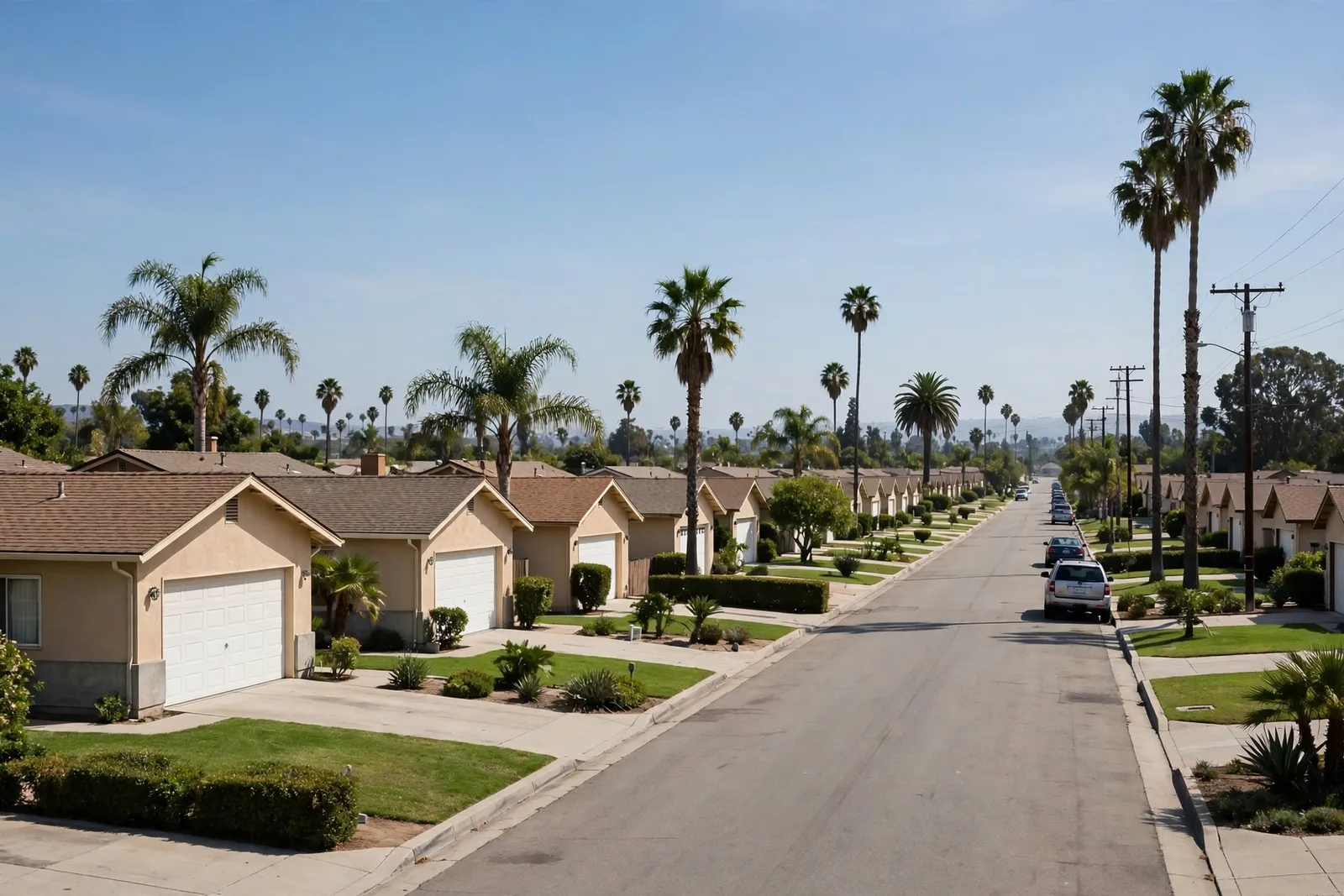
Drive through East Whittier and you are looking at thousands of mid-century homes built on the same playbook: concrete slab, copper supply lines underneath, ranch homes put up between the 1950s and 1970s. Sixty-plus years later, those lines are failing on schedule — pinhole leaks, one house after another, street after street.
We know this side of Whittier block by block. East Whittier — the neighborhoods east of College Avenue, roughly from Whittier Boulevard down to Mulberry, between Gunn and First Avenue — was its own agricultural community before the postwar boom. Citrus groves came down; tracts went up, fast. The eastern reaches toward Friendly Hills and Leffingwell Ranch filled in during the 1950s and 1960s with ramblers: gabled roofs, attached garages, 1,000 to 2,000 square feet on lots of 6,000 to 7,000 square feet, set along wide streets near Parnell Park and Whittwood.
The good news about tract homes: the floor plans repeat, so the pipe runs are predictable. We know where the lines run in the common East Whittier layouts, which shortens every detection visit. The bad news: once one pinhole appears, the whole line is thinning. A second leak on the same run is a matter of time, not chance. That is why our visits here always pair detection with a full-line pressure test — one sound break gets a spot repair; a line that is thin throughout gets a reroute, and we will tell you straight that another patch is just renting time.
Slab leak detection and emergency leak repair cover all of East Whittier — ZIPs 90603 and 90604 — with same-day response.

Why it happens here
Most of Whittier’s housing was built before 1970 — 82.4 percent of it, per the Southern California Association of Governments. In East Whittier that means your water lines are almost certainly copper run under the slab in the 1950s–60s, with some 1940s-era galvanized steel mixed in. Galvanized pipe corrodes from the inside out in about 40 to 50 years; Whittier’s original lines are at or past that point now.
Then there is our water. Whittier’s tap water tests around 15 grains per gallon — the Water Quality Association classifies anything above 10.5 grains as “very hard.” Hard water plus chloramine disinfectant is the exact recipe for copper pinhole leaks — at roughly double the moderately-hard ideal, our water eats pinholes through copper from the inside out.
Add the ground and the history. The Puente Hills clay under East Whittier heaves and settles with every wet-dry cycle, and sixty years of that movement flexes buried lines. And the M5.9 Whittier Narrows earthquake of October 1, 1987 shifted buried copper joints and cracked cast iron across the area — pipes that survived ’87 have been degrading for the 38-plus years since.
It is the combination that gets you: sixty-year-old copper, very hard water, moving soil, and an earthquake’s legacy. That is why this is not bad luck — it is chemistry and time. And it answers to the right instruments — modern leak detection gear, not a guess and a jackhammer.
How we work
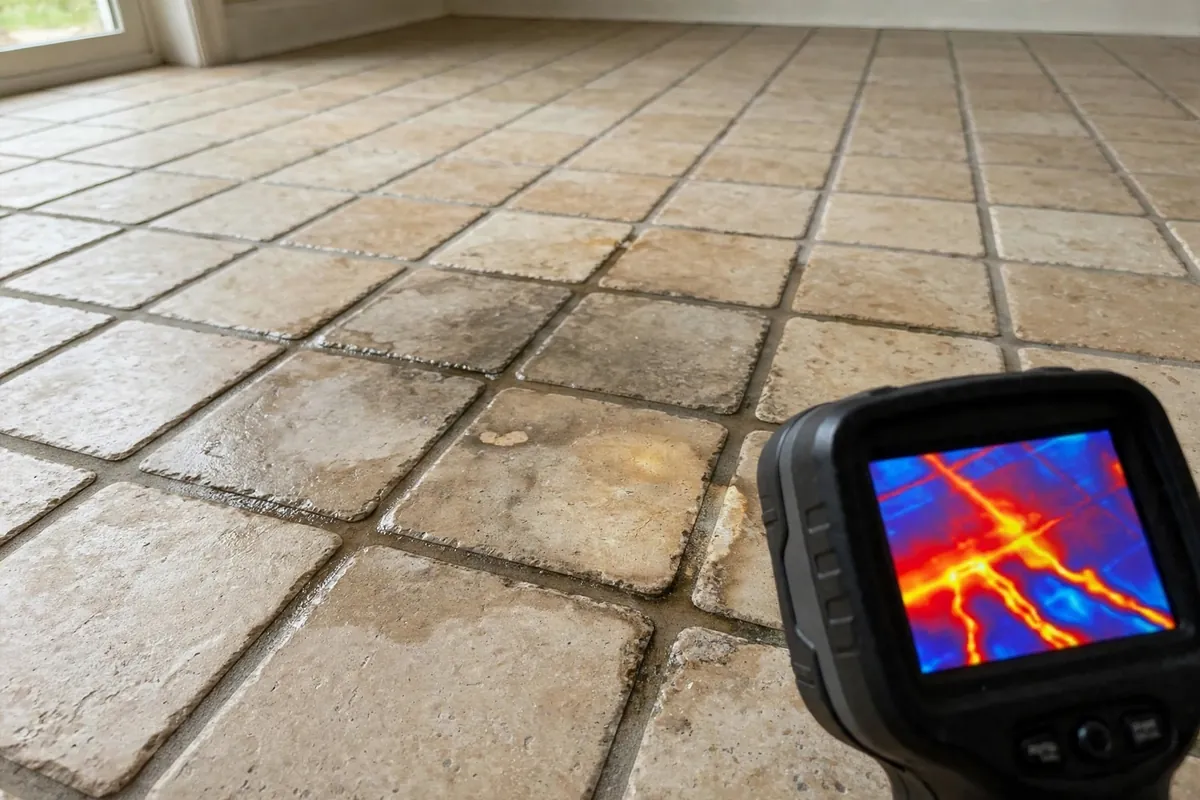
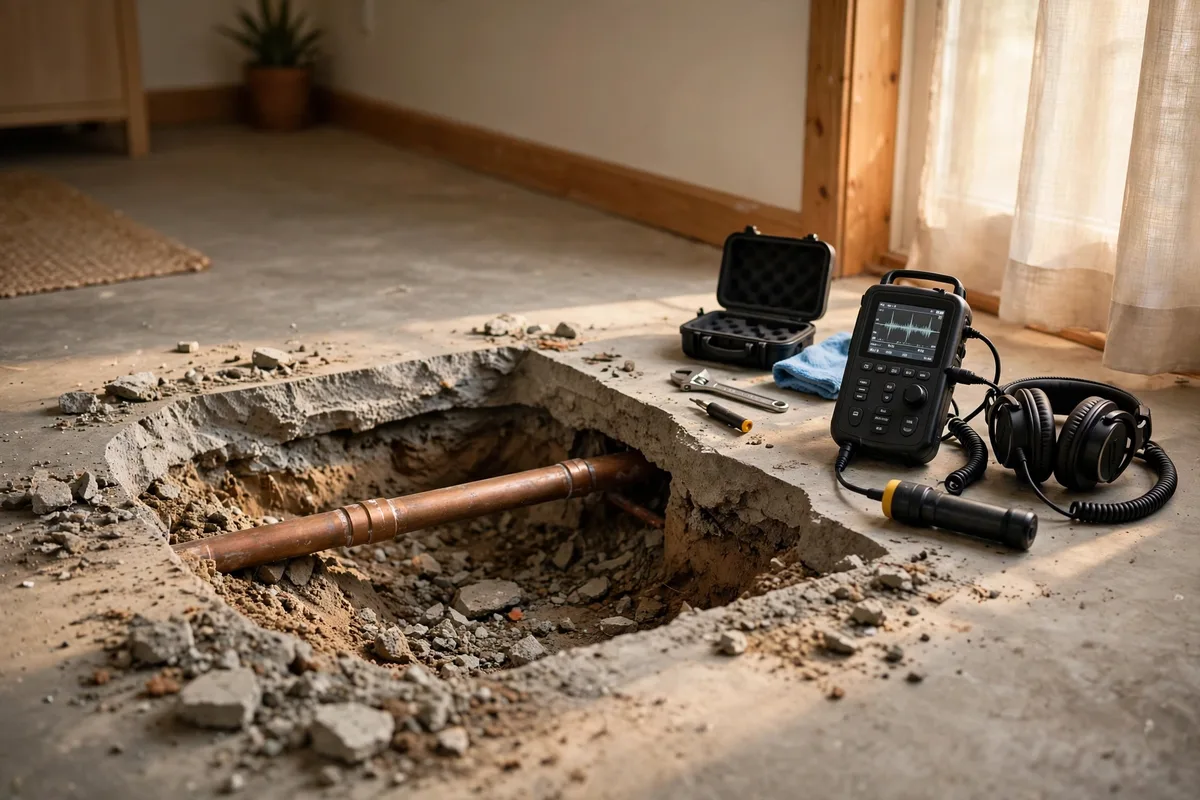
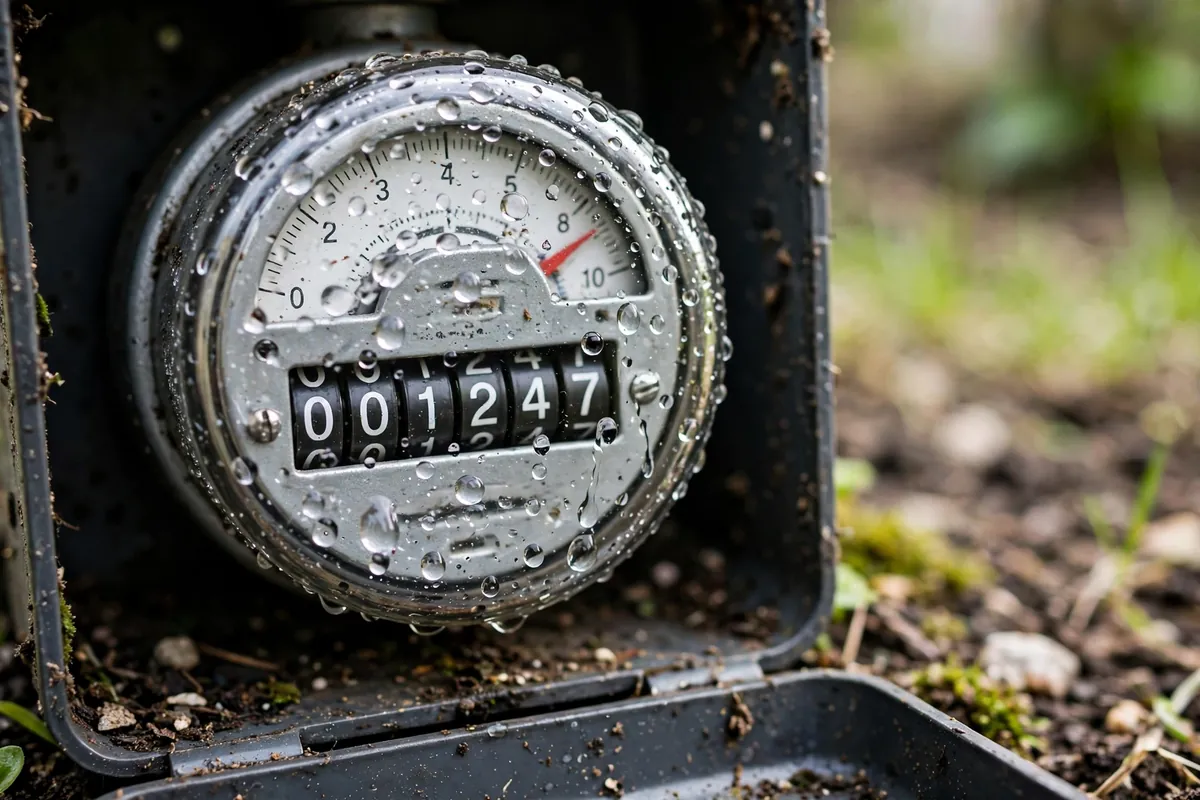
Detection and repair are two different jobs: we find the leak precisely so the repair stays surgical. Every leak detection visit in East Whittier runs the same pro sequence — a meter check first, then acoustic listening (leaks ring at 500 to 1,500 Hz on metal lines), thermal imaging (hidden water shows as 3–6°F surface temperature gradients), and moisture-meter mapping to pin the break, usually within about a meter.
Every step is non-invasive — nothing gets cut until the leak’s location is known. The repair itself is the plumber’s call: a spot repair, an under-slab fix to code, or abandoning the bad section and rerouting overhead — often less messy than chasing one break through concrete. The one rule that never changes: pinpoint first, break floor second. That is the whole idea behind electronic leak detection — the cheapest dollar in any leak job is the one spent finding the leak.
One honest note: a hot line leaking under your slab also runs up your water bill — Southern California utilities bill in increasing tiers.
What we do
Pinpoint leaks under your concrete slab with acoustic listening and thermal imaging — no jackhammer guesswork, no exploratory holes.
Slab Leak Detection in Whittier, CA →Burst pipe, major leak, water where it should not be — fast response across Whittier, day or night.
Emergency Leak Repair in Whittier, CA →Find leaks in the buried line from your meter to the house — acoustic tracing pinpoints it before anyone digs.
Water Line Leak Detection in Whittier, CA →Losing more water than the Whittier sun explains? Dye testing and pressure checks find pool and spa leaks fast.
Pool & Spa Leak Detection in Whittier, CA →Camera inspection locates breaks, offsets, and root intrusion in your sewer lateral — no guesswork, no trench first.
Sewer Line Leak Detection in Whittier, CA →After-hours service for offices, retail, restaurants, and HOAs — with documentation your insurer accepts.
Commercial Leak Detection in Whittier, CA →Pinpoint lateral lines, valves, and sprinkler head leaks with pressure testing and acoustic location — no digging.
Irrigation Leak Detection in Whittier, CA →Acoustic listening, thermal imaging, tracer gas, and pressure testing find hidden leaks without demolition.
Electronic Leak Detection in Whittier, CA →Combustible gas sniffers, pressure testing, and line tracing pinpoint the leak fast — plus what to do the moment you smell gas.
Gas Leak Detection in Whittier, CA →Warning signs
With slab-on-grade ranch homes, there is no basement to catch the water — a leak announces itself sideways. Watch for these:
One sign alone can be nothing; two together are worth a call. A meter check tells the truth in about five minutes — and if it points to a water line leak between the meter and the house, we trace that too.
The math
National numbers, honestly framed — not Whittier prices, because nobody can quote yours without seeing your home. Slab leak detection averages about $280 nationally (Angi 2026; the typical range runs $150–$600 depending on the methods needed). A slab leak repair averages about $2,280 nationally, including detection (typically $630–$4,400). That is roughly an eight-to-one ratio: the finding is the cheapest part of the job. That is the whole argument for professional leak detection East Whittier homeowners rely on: find it for an eighth of the repair cost, before anything gets cut.
The expensive part is waiting. Water damage accounts for 22.6% of all homeowners insurance claims, averaging about $15,400 per claim (Insurance Information Institute). And FEMA’s math is sobering: one inch of water in a home can cause roughly $25,000 in damage. A slow under-slab leak never floods your kitchen — it just quietly builds toward those same numbers over months. A single leak detection visit finds it in one afternoon. That is the entire pitch.
From the blog
Straight answers on costs, warning signs, and finding hidden leaks — from our leak detection Whittier team.
Common questions
East Whittier’s post-war tracts were built fast in the 1950s–1970s with copper supply lines run directly under concrete slabs. Sixty-plus years of very hard water, Puente Hills clay movement, and thermal cycling have worn those lines thin — and many still carry plumbing that survived the 1987 Whittier Narrows quake. Pinhole slab leaks are the predictable end of that lifespan, which is why detection-first beats jackhammer-first here — a professional leak detection visit pins the break before anything is cut.
Probably, on the same aging line. Each pinhole means the copper is thinning everywhere, not just at the break. After a second leak, a full-line pressure test usually settles it: rerouting the bad section overhead ends the cycle, while another spot repair just resets the clock. We will show you the test numbers either way.
Nationally, detection visits run $150–$600 depending on the methods needed, with slab leak detection averaging about $280 (Angi 2026). We price every visit up front after seeing what is involved — tract homes are usually straightforward, since repeating floor plans mean we know where the lines run.
We never cut blind. Every visit runs a pro sequence: a meter check to confirm the leak, acoustic listening for the leak’s signature frequencies, thermal imaging to spot the temperature trail, and moisture-meter mapping to pin the break — usually within about a meter. Nothing gets cut until the location is known; only then does the repair become the question.
A warm spot on the floor, a water bill that climbs or jumps, the sound of running water with everything off, damp carpet or a musty smell near the slab edge, and the water heater running longer than it used to. One sign alone can be nothing — two together are worth a leak detection call.
Yes — a hot-side slab leak runs 24 hours a day, and Southern California utilities bill in increasing tiers, so a leak pushes you into pricier water on top of the wasted gallons. We cannot quote Whittier’s exact current tier rates, but the mechanism is real: many homeowners notice the bill before they ever notice the water.
Sudden, accidental damage is often covered; gradual seepage and wear-and-tear are typically excluded — which is why a documented detection report matters: it shows when the leak was found. Water damage is 22.6% of all homeowners claims, averaging about $15,400 (Insurance Information Institute) — so check your policy’s water-damage language before you need it.
Yes — we cover all of Whittier and southeast LA County. Beyond East Whittier (ZIPs 90603 and 90604), we also serve Uptown Whittier, South Whittier, Friendly Hills, Murphy Ranch, and College Hills — see all Whittier service areas.
Acoustic + thermal detection for East Whittier tracts — located within inches, priced up front.