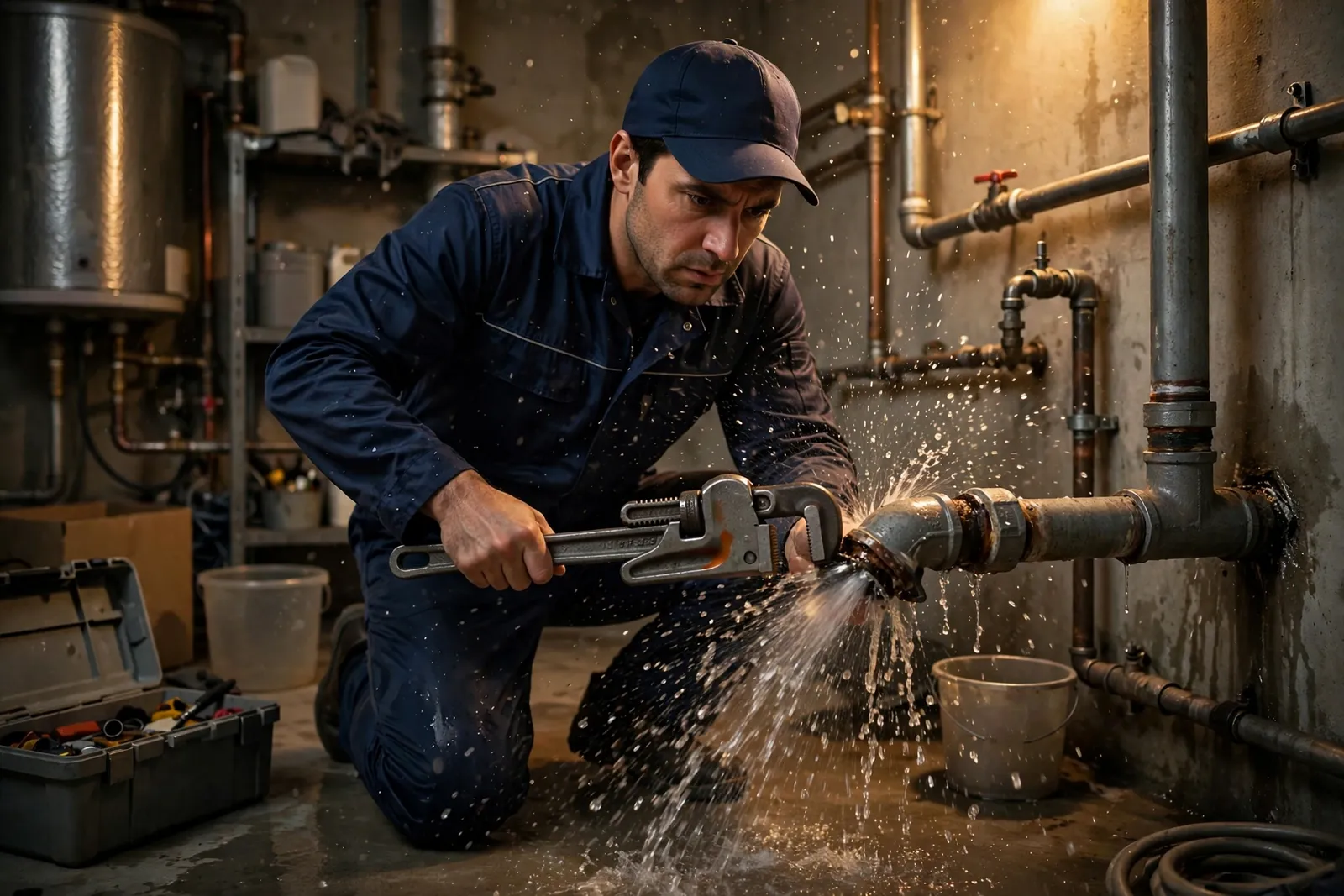
Burst Supply Lines
The big one — pressurized water flooding fast. Stop the flow, repair or cap the line, dry-out guidance.
24/7 Emergency Response — All 10 Whittier ZIPs
Burst pipe? Water pouring where it should not be? Our emergency leak repair in Whittier, CA stops the water first and asks questions later — fast dispatch across Whittier, day or night, weekends and holidays. Once the water is stopped, our leak detection in Whittier team pinpoints the break before any permanent repair begins.
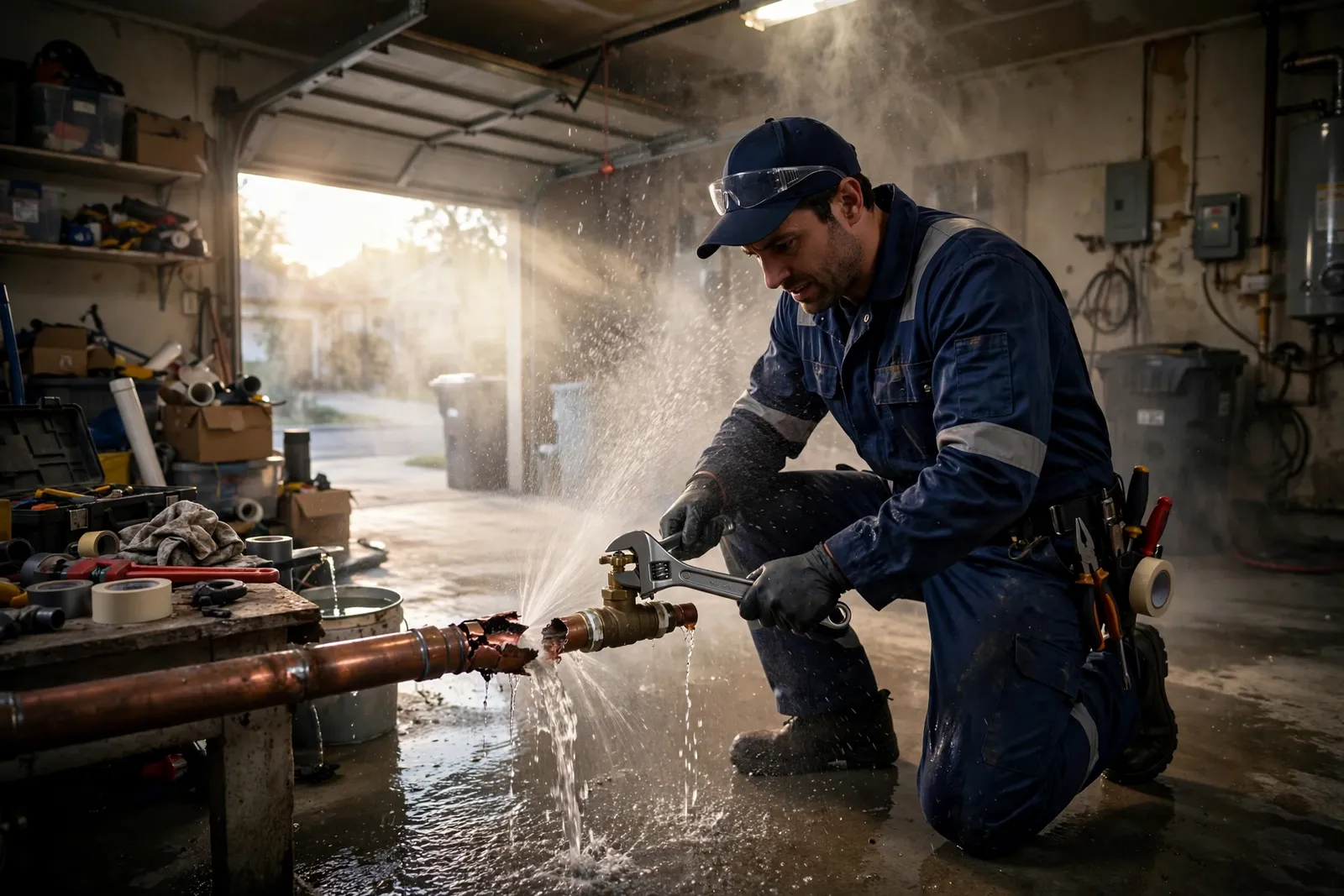
Is it an emergency?
Not every leak needs a 2 a.m. call — but some cannot wait for morning. The pros’ one-line rule (Legacy Plumbing of Sacramento): if water is actively damaging your home, or a failure threatens health or safety, treat it as an emergency and call now.
What can usually wait until morning: a dripping faucet when other fixtures work, a running toilet when another bathroom is available, a minor leak you can fully stop at a fixture valve — provided you can safely isolate it and still have running water and working drains elsewhere.
Not sure which list you are on? Call anyway — a two-minute conversation costs nothing, while a burst line left running overnight costs thousands. If it can wait, we will tell you honestly and book a regular leak detection visit.
What to do now
When pressurized water is flowing where it should not, speed beats everything. Do these three things before you even finish reading this page.
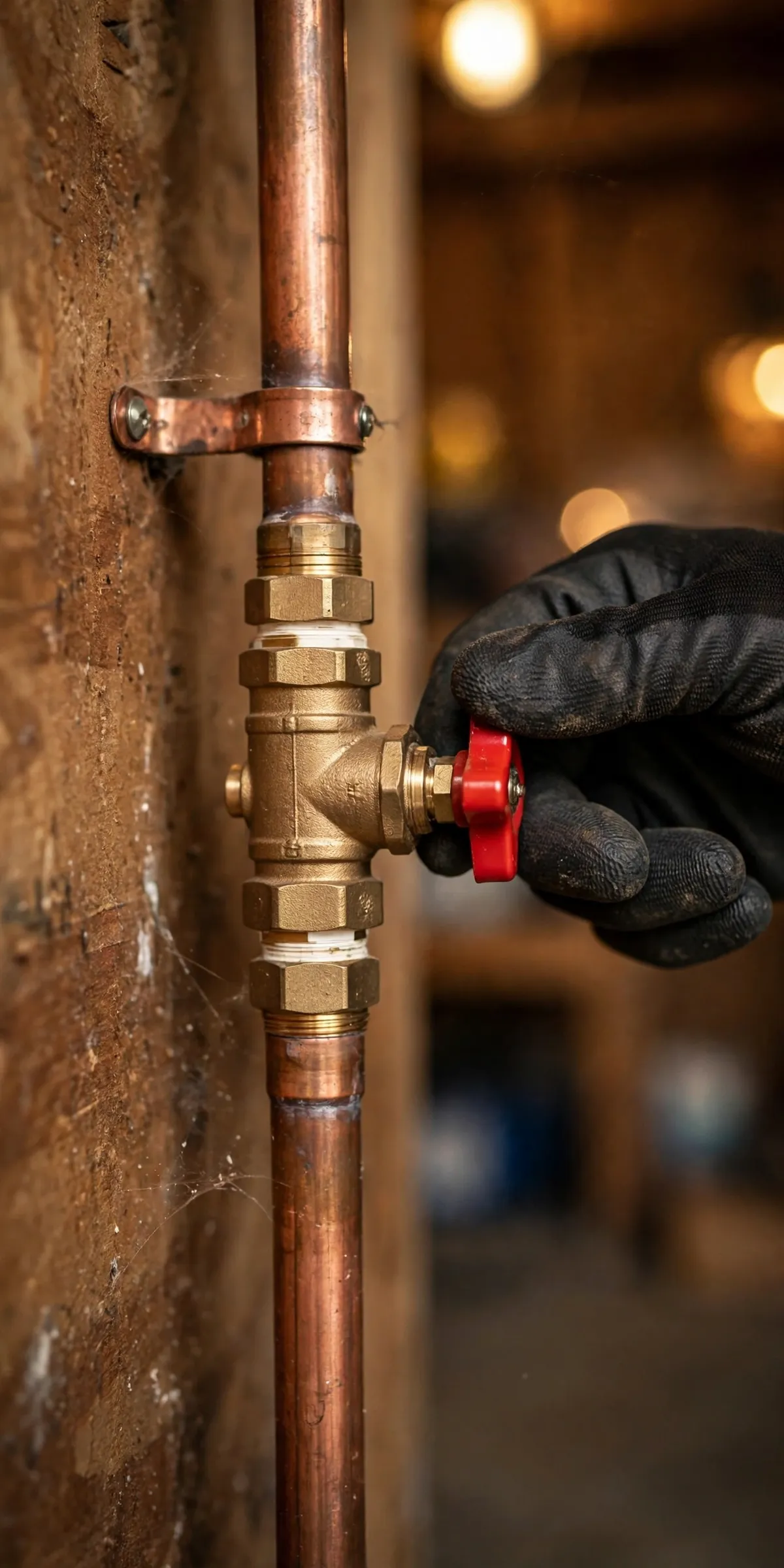
In Whittier homes it is usually along an exterior wall, near the water meter, in the garage, or in a ground box near the street. Turn it clockwise until fully closed — and if the valve is stuck, do not force it; plumber Mark Snell warns forcing it can break the valve and make everything worse.
Only if water is near electricity: flip the main breaker or the affected-area breakers — never walk through standing water to reach the panel. Gas water heater? Turn the knob to "Pilot" or "Off." Electric? Switch off its breaker — a heater running on an empty tank burns out fast.
(562) 450-1003 — tell us what is happening and where. We dispatch across Whittier with the parts to stop the leak on arrival, then quote the permanent fix on site.
While you wait: open hot and cold taps to drain remaining water and relieve pressure — plumbing expert Matt Kunz's advice — flush toilets to clear their tanks, bucket under a bulging ceiling, and photograph everything before cleanup for your insurer. (Smell gas? Get out first, call 911 from outside.)
Why minutes matter
The clock starts when the material gets wet, not when you notice it — in a slow leak, the wetting may have started far earlier.
One honest caveat: that window is a reason to act fast, not a promise — mold can start sooner. Use moisture readings, not the calendar. And remember PuroClean's point: repairing the pipe stops additional water, not moisture already inside your walls, floors, and ceilings — our emergency leak detection visit tells you what got wet and what needs drying.
What it costs
National 2026 data (AllBetter): a typical emergency visit runs $150–$500 for the service call plus $100–$200/hour labor — $300–$800+ total. After-hours calls run roughly 1.5–3x standard pricing.
AllBetter documented a Houston homeowner whose supply line split at 3 a.m. — a $1,100 invoice ($250 call fee, $175/hour with a 2-hour minimum, an $85 part, and a $415 after-hours premium) versus $125–$200 in business hours.
The good news: if you know where your main shutoff is and can stop the water yourself, a 2 a.m. emergency becomes a scheduled morning visit. The cost of doing nothing dwarfs it — the average water-damage insurance claim exceeds $12,000 (national figures, not Whittier quotes; your emergency leak detection price is always quoted on site).
What we handle
The big one — pressurized water flooding fast. Stop the flow, repair or cap the line, dry-out guidance.
Water through ceilings, walls, or floors that will not wait for business hours.
Tank rupture or major valve failure dumping water into the garage or utility area.
Sewage coming up instead of going down — a health hazard that jumps the queue, every time.
Not sure it is an emergency? Call anyway. A two-minute conversation costs nothing; a burst line left running overnight costs thousands. If it can wait, we will tell you so honestly — and book you a regular visit.
What sits behind most Whittier emergencies: pinhole leaks letting go after decades of hard-water scaling, pre-1987 supply joints giving up, and — in established neighborhoods with mature landscaping — tree root intrusion cracking older lines. If your home still runs original 1950s–70s plumbing, ask for a full-line pressure test during the visit, so the next weak point does not become the next midnight call. Once the water is stopped, the permanent repair choice matters — our slab leak repair options compared walks through spot repair, reroute, and epoxy lining with published ranges.
Whittier does not get frozen bursts — it gets aging pipes and earthquakes. Much of our housing stock dates to the 1950s–70s: copper and galvanized supply lines under slab and in walls, hard water, and expansive Puente Hills clay soil — and copper pinholes in slab homes can travel along the foundation before surfacing, so the water you see may have started feet away. Then there is the quake factor: the 1987 Whittier Narrows earthquake (M5.9, October 1, 7:42 a.m.) ruptured water and gas lines across the region and caused more than 1,000 gas leaks — many leading to fires. Two takeaways: California law requires every residential water heater to be braced, anchored, or strapped (upper and lower third) so it cannot tip or slide in a quake — a loose 500+ lb tank can snap a gas line or flood a garage. And standard homeowners policies exclude earth movement, so quake-caused leak damage needs separate earthquake coverage. For gas emergencies the steps are different — leave first, then call — as our gas leak safety steps guide explains.
What to expect
An emergency call has one priority order — stop the damage first, diagnose second, fix third:
One honest boundary: an emergency visit stops the water and repairs the failure — it is not the full restoration.
Which service do you need?
Not sure which one to book? Here is how they differ:
| Emergency Service | Scheduled Visit | |
|---|---|---|
| Best for | Burst pipes, active leaks, sewage backup | Slow drips, inspections, non-urgent finds |
| Response | Fast dispatch, day or night | Booked appointment window |
| First step | Stop the water, contain the damage | Full diagnostic workup |
| Pricing | Quoted on site before work starts | Quoted before work starts |
| Cost premium | After-hours rates — nationally about 1.5–3x standard | Standard daytime pricing |
| Not actually urgent? | We will tell you honestly and book a regular visit | You are already in the right place |
Insurance
After we stop the water, the next question is usually insurance. Here is the rule in plain English:
That is why we document everything with photos — your claim file starts strong for the sudden-versus-gradual decision.
Why call now
Legacy Plumbing's rule is the one to run your decision on: if water is actively damaging your home, or a failure threatens health or safety, treat it as an emergency and call now. The clearest emergency of all is a leak you cannot stop at any valve — every minute adds water on your floor and mold risk behind your walls. A burst pipe is always an emergency, no debate: it can dump hundreds of gallons in minutes (Rooter Man Plumbing LA), and sewage backing up into fixtures is a health hazard — the CDC notes exposure can cause serious illness.
The damage math backs the urgency. The EPA says mold can begin growing on damp surfaces within 24–48 hours of water exposure; the IICRC notes that Category 1 clean water (burst supply lines) degrades to Category 2 or 3 after about 48 hours untreated, which changes the entire restoration scope. The average water-damage insurance claim exceeds $12,000; remediation runs $1,000–$3,000 for one room and can exceed $10,000 for three (AllBetter, III). And the clock starts when the material gets wet — not when you notice. The EPA's 24–48-hour window is a reason to act fast, not a promise; mold can start sooner, so we go by moisture readings, not the calendar.
Whittier's emergency profile is aging pipes, not freeze events: 1950s–70s copper and galvanized supply lines under slab and in walls, with copper pinholes in slab homes able to travel along the foundation before surfacing (BF Plumbing Bay Area). Honest caveat: repairing a burst pipe stops additional water, but it does not remove moisture already inside walls, floors, and ceilings (PuroClean) — so our emergency visit ends with the water stopped, the leak found and marked, and a plan for the drying, not just the pipe.
The cost drivers
National 2026 figures (AllBetter), not Whittier prices: the realistic floor for any visit is $150–$250 — very few plumbing companies will roll a truck for less. A typical emergency invoice is $300–$800+ (service call $150–$500 plus $100–$200 an hour labor), with the after-hours call-out fee adding roughly $100–$300 on top (HomeAdvisor/Angi via PuroClean) and after-hours pricing running about 1.5–3x standard. The 3 a.m. Houston case AllBetter documented — $1,100 versus $125–$200 for the same repair in business hours — is what that premium looks like in one invoice.
What pushes the invoice up: dispatch in the middle of the night; water still flowing on arrival (more damage by the minute); difficult access — a leak under slab or behind drywall takes more detective work, which is exactly where detection earns its keep by keeping the repair opening to one; and damage spread across multiple rooms, where remediation runs $1,000–$3,000 a room and three rooms can exceed $10,000. What brings it down: you stopped the water yourself — AllBetter's trade guidance is that a known main-shutoff location turns a 2 a.m. emergency into a scheduled morning visit, saving $300–$800 in premiums; a single fixture valve that holds; small fixes we can complete in the same visit; and a leak detected and marked first, so the repair is one opening, not exploratory demolition.
The detection-first logic, plainly: an emergency detection visit that stops the water and marks the leak within inches is the cheapest line on the invoice — the expensive lines are water damage, mold remediation, and opening five walls to find one leak.
Why us
Our emergency method: stop the water first, stabilize, then detect. Every finding gets two-method confirmation before we mark it within inches — acoustic for pressurized supply lines, thermal for hot-side and moisture mapping, pressure and isolation testing to prove which line failed, camera for drains. We document everything with photos as we go, because your claim file starts the night of the leak: standard policies cover water damage from sudden, accidental events (usually the resulting damage, not the failed pipe itself), while gradual leaks are excluded as maintenance failures — and notify your insurer within 24–48 hours, because delays let insurers argue negligence.
Whittier specifics: the city's 1950s–70s copper and galvanized supply lines under slab and in walls are the local failure profile, on expansive Puente Hills clay that stresses buried joints — plus quake country. The 1987 Whittier Narrows earthquake took out several water and gas lines and caused over 1,000 gas leaks, many leading to fires (regional figures, well-sourced). Two practical things from that history: California law requires every residential water heater to be braced, anchored, or strapped at the upper and lower third (CPC 507.2) — a loose 500+ lb tank can snap a gas line or flood a garage; and standard homeowners policies exclude earth movement, so quake-caused leak damage needs separate earthquake coverage.
And the honest positioning: detection is not repair. We stop the water, mark the leak, document for the claim file, and quote the permanent repair on site — small fixes often finished in the same visit. If what you are looking at is not actually urgent — a stoppable drip with water and drains still working elsewhere — we will tell you so and book a regular visit. We do not invent response-time promises; our rule is detection before any opening, and the after-hours premium is the documented industry range, not something made up on the night.
Who this helps
An emergency call has one priority order: stop the damage first, diagnose second, fix third. We stop the water, find what failed, tell you what got wet and what needs drying, and give you a written price for the permanent fix before we touch it — you approve first, and small fixes are often finished in the same visit. Here is how that plays out for the three callers we hear from most.
What the after-hours premium looks like
Not sure yours counts as an emergency? Call anyway — a two-minute conversation costs nothing, and if it can wait until morning, we will say so and book a regular visit.
Common questions
Shut off the main valve — in Whittier homes it is usually along an exterior wall, near the water meter, in the garage, or in a ground box near the street. Turn it clockwise until fully closed, and never force a stuck valve. Then kill power near the water and call for emergency leak repair.
If water is actively damaging your home, or a failure threatens health or safety, call now — burst pipes, unstoppable leaks, sewage backup, gas smell, or water near the panel. A dripping faucet or a stoppable drip can wait.
Do not force it — plumber Mark Snell warns forcing a stuck valve can break it and make everything worse. Look along an exterior wall, near the meter, in the garage, or in a ground box near the street. Flooding while you look? Call (562) 450-1003 and we will talk you through it.
National 2026 data: a typical emergency plumbing visit runs $300–$800+ total, with after-hours calls at roughly 1.5–3x standard pricing — one documented 3 a.m. repair cost $1,100 versus $125–$200 in business hours.
The EPA says mold can begin growing on damp surfaces within 24–48 hours of water exposure. The clock starts when the material gets wet — and mold can start sooner, so use moisture readings, not the calendar.
Standard policies cover water damage from sudden, accidental events — burst pipes, ruptured hoses, failed water heaters — usually the resulting damage, not the failed pipe itself. Gradual leaks are typically excluded, so notify your insurer within 24–48 hours.
California law requires every residential water heater to be braced, anchored, or strapped (upper and lower third) — a loose 500+ lb tank can snap a gas line or flood a garage, and the 1987 Whittier Narrows quake caused 1,000+ gas leaks. Standard policies exclude earth movement, so quake damage needs separate earthquake coverage.
Both, in the right order. The emergency leak detection visit stops the water and stabilizes the situation first; the permanent repair is then quoted clearly, and small fixes are often completed in the same visit.
Our emergency leak team serves Whittier day and night — stop the water now, sort the rest after.