Slab Leaks
Pinpoint leaks under your concrete slab with acoustic listening and thermal imaging — no jackhammer guesswork, no exploratory holes.
Slab Leak Detection in Whittier, CA →Hadley–Greenleaf Historic District — Whittier
The Hadley-Greenleaf Historic District holds some of Whittier’s oldest plumbing — century-old galvanized and early copper under Craftsman bungalows and Spanish-style homes. Our leak detection Hadley Greenleaf service finds slab leaks and pipe leaks non-invasively — protecting original finishes while pinpointing the break within inches. It’s non-invasive leak detection built for century-old homes.

Local focus
The Hadley-Greenleaf Historic District is where Whittier’s oldest residential streets still look the way they did a century ago — well-preserved Craftsman bungalows and Spanish-style homes on tree-lined streets near Whittier Boulevard and the 605, with the district’s median home value around $708,400. Homes here date to the early 1900s, so the oldest carry original-era plumbing now past the hundred-year mark — which is why leak detection Hadley Greenleaf visits begin with listening, not cutting.
One Hadley-Greenleaf block can span five generations of plumbing: original galvanized steel from the district’s earliest decades — already corroding from the inside out — alongside early copper from mid-century updates, plus later additions and partial repipes from every era since. A thorough leak detection visit identifies which generation is failing before anyone opens a wall — that’s the discipline leak detection brings to a hundred-year-old home.
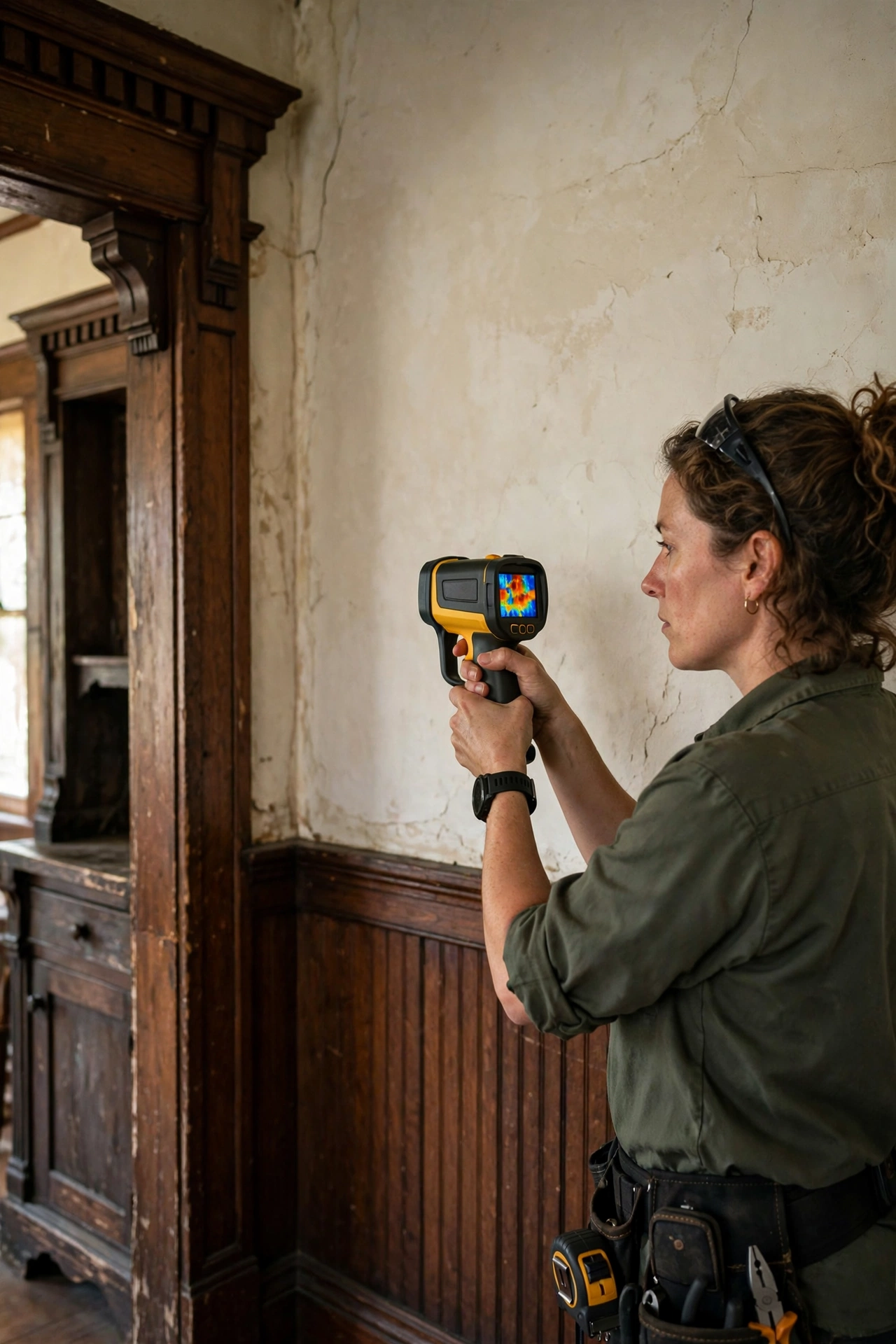
A wrong guess costs more here than anywhere in the city: original plaster, vintage tile, and old-growth hardwood can’t be bought back — and exploratory demolition destroys them for nothing. Non-invasive leak detection reads the water’s signature through plaster, tile, and concrete without touching anything.
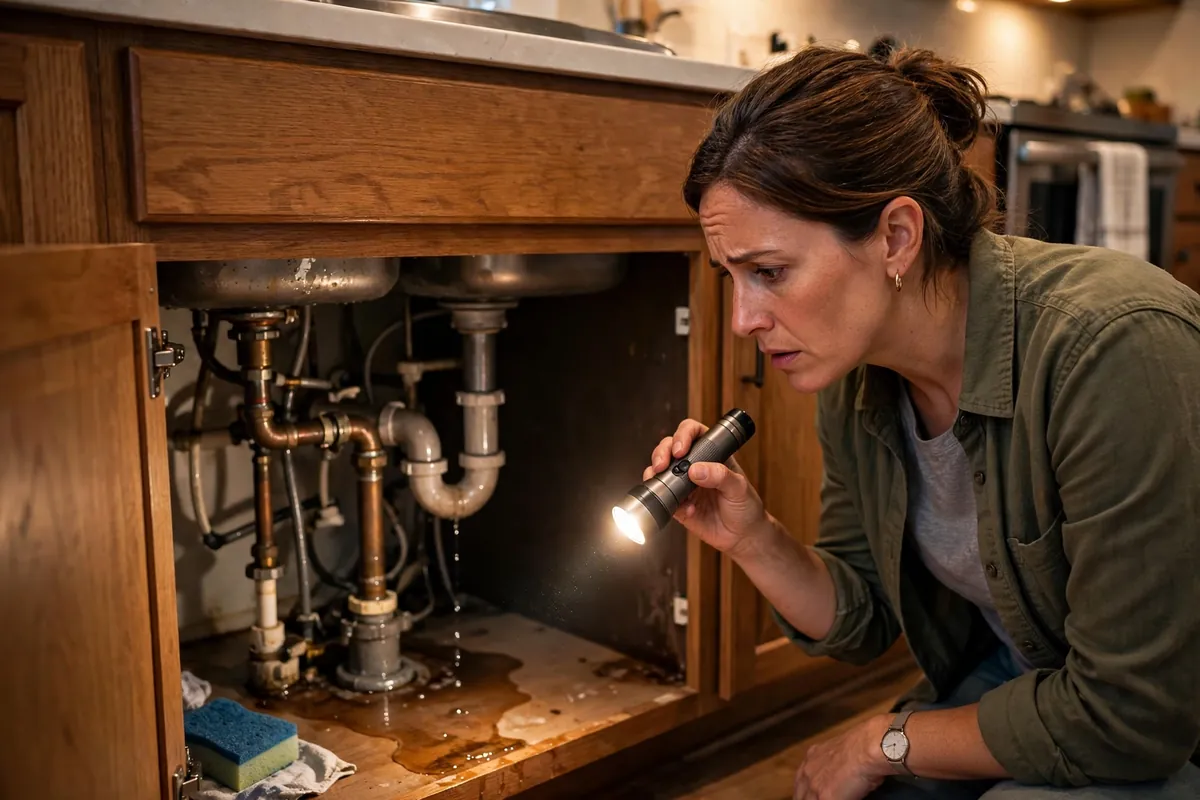
Our most common Hadley-Greenleaf calls: pinhole leaks in aging copper behind bathroom walls, slab leaks under original concrete, fixture shutoffs untouched for forty years, and damp patches where additions meet the original structure. Slab leak detection and emergency leak repair are both available across the district with same-day response.
Why leaks happen here
Whittier’s housing was overwhelmingly built before 1970 — 82.4% of the stock, per the Southern California Association of Governments’ 2019 city profile — and Hadley-Greenleaf holds the oldest of it: early-1900s construction where original plumbing has already crossed the hundred-year mark. Every pipe era the city ever used is still in the ground here.
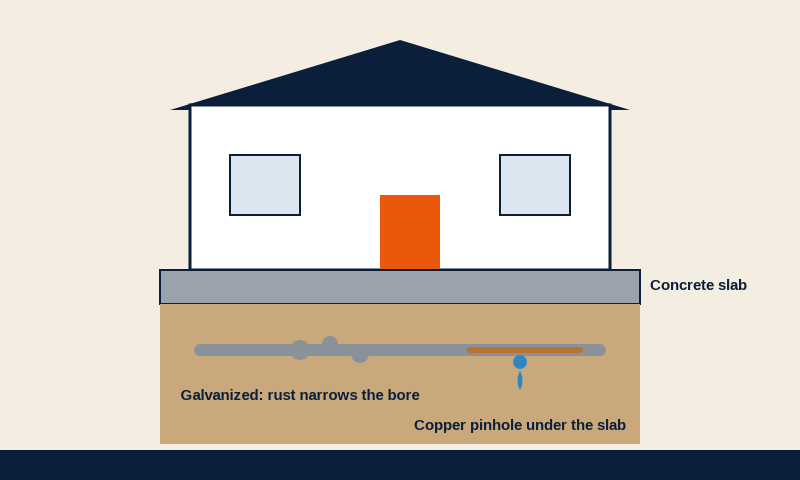
Galvanized steel supply lines, standard from the early 1900s through the 1960s, corrode from the inside out over roughly 40–50 years — the district’s original-era pipe is past double that. Early copper fails differently: Whittier’s water runs about 15 grains per gallon — “very hard” per the Water Quality Association — and hard water plus municipal chloramines pits copper from the inside until pinholes open. Cast iron drains corrode the same way, so century-old homes call for sewer line leak detection nearly as often as supply-side work.
Then there’s the earth beneath the house. The October 1987 Whittier Narrows earthquake — magnitude 5.9, with severe shaking right here in Whittier — broke water and gas mains across town and shifted buried copper joints that have been degrading ever since. Add the Puente Hills’ expansive clays, which heave and settle with wet and dry cycles and stress buried lines further.
The stakes match the age: the district’s median home value sits around $708,400, while water damage makes up 22.6% of all homeowners claims at an average of about $15,400 (Insurance Information Institute) — another reason a professional leak detection visit pays for itself here.
Our method
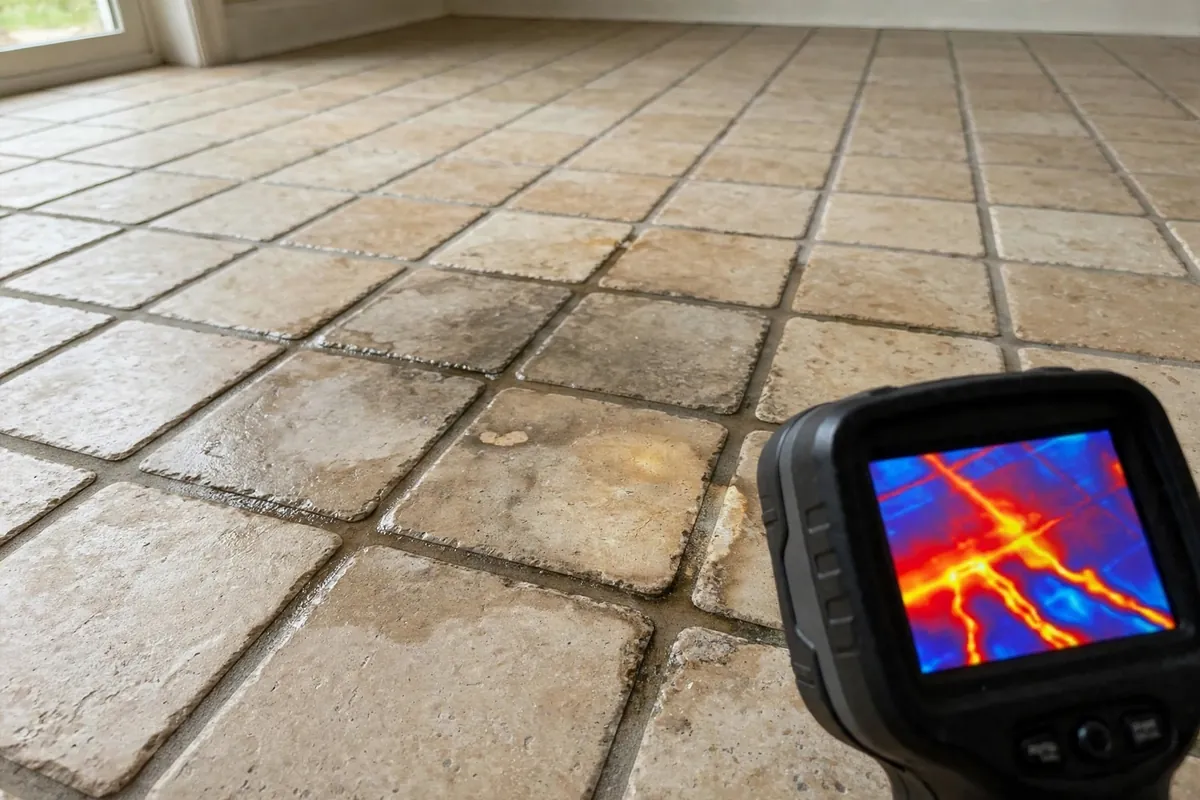
A century-old home rewards patience: prove the location first, and only then consider opening anything. On a Hadley-Greenleaf visit we follow the order the trade press lays out — Contractor Magazine is blunt about it: pinpoint the slab leak before you break the floor. That means meter testing, acoustic listening (a leak on metal pipe sounds at 500–1,500 Hz), thermal imaging that catches the 3–6°F surface gradients hidden water leaves, and moisture-meter mapping that traces the water’s route — together they narrow the break to within inches, and no part of the sequence cuts into anything.
That discipline matters most where the pipe has already outlived its design life twice over. Southern California’s homes are overwhelmingly slab-on-grade — the water lines run beneath the concrete you walk on — so a leak shows itself as a warm floor spot, a damp patch, or a bill that keeps rising, never water pooling in a basement. Our electronic leak detection instruments find the break through plaster, tile, and concrete without disturbing them. Plumbers on the Terry Love forums call slab leaks the worst kind to locate, because water follows the path of least resistance — the damage you see is rarely sitting over the break.
We’ll also say plainly where this visit stops. Detection finds the leak; a plumber does the repair — spot repair, overhead reroute, or repipe. Often the wisest repair is to abandon the failed under-slab section and reroute overhead — and that option only opens up once the exact location is known.
What we do
Pinpoint leaks under your concrete slab with acoustic listening and thermal imaging — no jackhammer guesswork, no exploratory holes.
Slab Leak Detection in Whittier, CA →Burst pipe, major leak, water where it should not be — fast response across Whittier, day or night.
Emergency Leak Repair in Whittier, CA →Find leaks in the buried line from your meter to the house — acoustic tracing pinpoints it before anyone digs.
Water Line Leak Detection in Whittier, CA →Losing more water than the Whittier sun explains? Dye testing and pressure checks find pool and spa leaks fast.
Pool & Spa Leak Detection in Whittier, CA →Camera inspection locates breaks, offsets, and root intrusion in your sewer lateral — no guesswork, no trench first.
Sewer Line Leak Detection in Whittier, CA →After-hours service for offices, retail, restaurants, and HOAs — with documentation your insurer accepts.
Commercial Leak Detection in Whittier, CA →Pinpoint lateral lines, valves, and sprinkler head leaks with pressure testing and acoustic location — no digging.
Irrigation Leak Detection in Whittier, CA →Acoustic listening, thermal imaging, tracer gas, and pressure testing find hidden leaks without demolition.
Electronic Leak Detection in Whittier, CA →Combustible gas sniffers, pressure testing, and line tracing pinpoint the leak fast — plus what to do the moment you smell gas.
Gas Leak Detection in Whittier, CA →Warning signs
Hidden leaks announce themselves sideways. A warm patch of floor usually means a hot-water line leaking beneath the slab. A bill that climbs for no reason is the classic giveaway — California’s tiered water rates turn a small leak into a large bill. Listen for water running with everything off; check baseboards and old wood for dampness. Catching these early is the entire point of detection in a historic home.
A musty smell is not something to sit on: the EPA and CDC note mold can start on wet surfaces within 24–48 hours. Spot any of these and emergency leak repair is the quick route; a standard detection visit is the thorough one.
Costs
Across the country, professional detection typically runs $150–$600, with slab leak detection averaging about $280 (2026 Angi data). Weigh that against the average slab leak repair at about $2,280, including detection (typically $630–$4,400) — roughly eight times the visit — and FEMA’s standing figure of around $25,000 in damage from a single inch of water.
The contractor cost site CostCandor puts it this way: “Paying for precise detection is usually the cheapest money in the whole project.” The math behind it: one homeowner’s widely shared story tells of an $800 fix turning into a $22,000 disaster after eighteen months of a damp patch — with the gradual-seepage claim denied outright. Standard homeowners policies typically exclude gradual leaks, while sudden, documented failures may be covered. A detection report is what turns a denial into a payable claim. A few hundred dollars for a visit beats five figures of restoration every time.
Our detection price is set before we start — no additions once the equipment is out.
Service areas
The Hadley-Greenleaf Historic District is home turf for century-old plumbing, but our leak detection coverage runs citywide — from Uptown and East Whittier to Friendly Hills, College Hills, Murphy Ranch, and South Whittier. Every neighborhood gets the same non-invasive leak detection method and up-front pricing. View all Whittier service areas →
From the blog
Straight answers on costs, warning signs, and finding hidden leaks — from our leak detection Whittier team.
Common questions
They get more pipe failures overall: the district holds Whittier’s oldest housing — homes dating to the early 1900s with original-era plumbing now past the hundred-year mark — so galvanized and early copper lines here carry more decades than anywhere else in the city. Pinhole leaks, slab leaks, and failing shutoffs are all more common here.
That is the whole reason non-invasive detection exists. Acoustic listening and thermal imaging read through floors and walls without opening anything. In Hadley-Greenleaf homes, where original plaster, vintage tile, and century-old hardwood are on the line, pinpoint accuracy matters even more — the same standard we bring to every visit in Whittier.
Countrywide, professional detection runs $150–$600 depending on the methods a home needs, and slab leak detection averages about $280 (2026 Angi data). A century-old home sometimes needs an extra step — tracing which pipe generation is actually leaking — but the price is always set before we start.
Every generation: early-1900s galvanized steel supply lines, which corrode from the inside out over about 40–50 years — the district’s original-era pipe is at double that or more; early copper, which develops pinhole leaks in hard-water systems; and cast iron drains that corrode likewise. One house can hold all three — identifying which one is leaking is a leak detection visit’s first job.
The October 1987 Whittier Narrows earthquake — magnitude 5.9, with severe shaking in Whittier — broke water and gas mains across town, with more than a thousand gas leaks reported, and shifted buried copper joints that have been degrading ever since. If your home predates 1987, a leak detection check is worth it even without symptoms.
A warm patch of floor, a bill climbing for no clear reason — tiered California rates multiply the damage — water running with everything off, damp baseboards, or a musty smell. Mold can start within 24–48 hours on wet surfaces, so a slab leak that stays wet around the clock deserves a prompt Hadley-Greenleaf detection visit.
Locating it is the job — down to the inch. Detection and repair are different trades: once we have pinned the break to within inches, a plumber handles the spot repair, overhead reroute, or repipe. Your detection report gives the plumber the exact location to work from.
Same-day service across the Hadley-Greenleaf Historic District, with 24/7 response for active leaks. Call (562) 450-1003 for an arrival window up front and the confirmed leak detection price.
Non-invasive leak detection for the district’s century-old homes — pinpointed within inches, with a written report your plumber can work from.