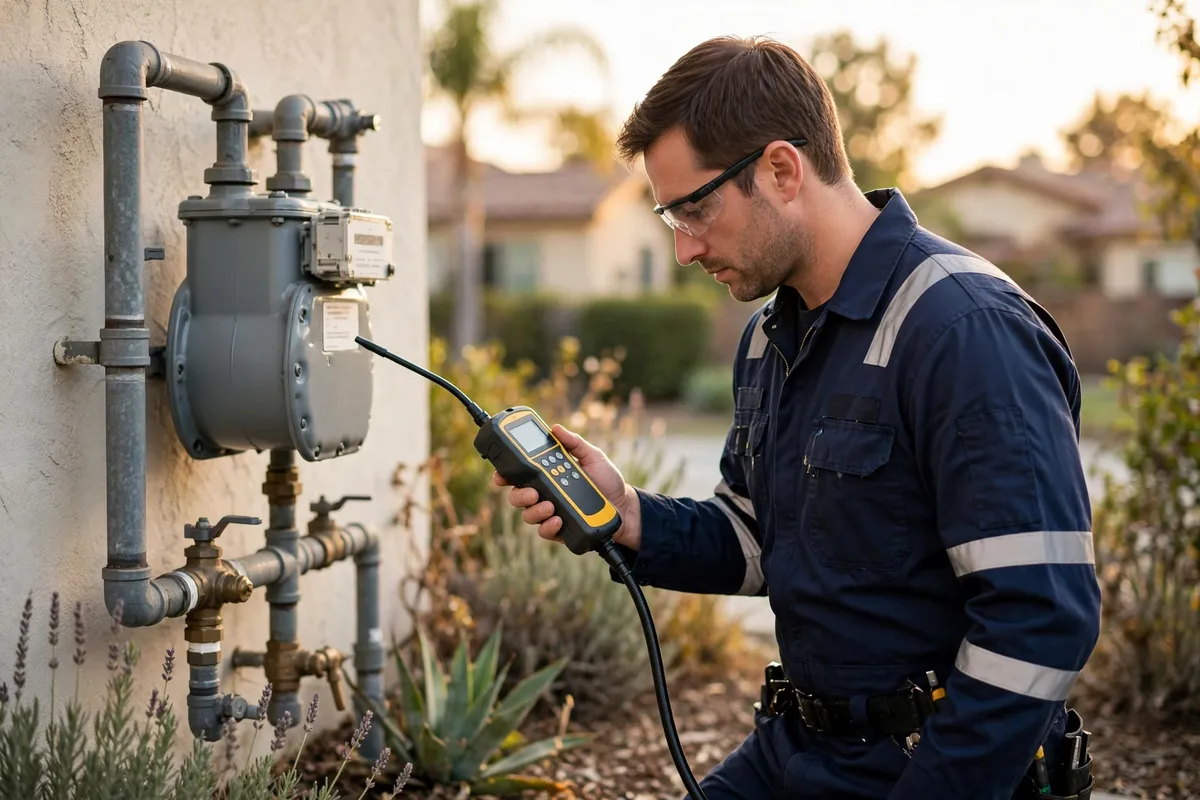
A gas leak is the one leak you never wait on. A water leak costs you money; natural gas can fill a home with an explosive mixture — and the rotten-egg smell you notice is only there because the utility adds odorant to otherwise odorless gas. We find gas leaks the way working pros do: a visual check of every accessible fitting first, then a pressure test to prove which section of pipe is failing, then an electronic sniffer and bubble solution to pinpoint the exact joint. You get a marked location and a written report — never a vague ‘somewhere in the wall.’
Smell Gas Right Now? Do This First
Do not wait to finish reading this page. If you smell gas in or around your home:
- Do not flip any switches — no lights, no garage door, no phone use inside. A spark is all it takes.
- Get everyone out of the house immediately, including pets. Leave doors open as you go if it is safe to do so.
- From a safe distance outside, call 911 and SoCalGas (1-800-427-2200).
- Do not re-enter until emergency responders or the gas utility clear the property.
Once you are safe and the immediate danger is handled, call us at (562) 450-1003 — we will pinpoint the leak location so the repair can happen fast.
Signs You May Have a Gas Leak
Most homeowners only recognize the smell — here is the full set:
- The rotten-egg smell. Natural gas is odorless; SoCalGas adds mercaptan so leaks smell like sulfur. Strong or persistent — treat it as an emergency, not a curiosity.
- Hissing, whistling, or roaring near gas lines, valves, or the meter.
- Dead or dying vegetation in a line above a buried pipe while the rest of the lawn looks healthy — escaping gas starves roots of oxygen.
- Dirt, debris, or water blown into the air from one spot in the yard.
- Houseplants dying for no reason, or a gas bill climbing with no change in usage.
- Pilot lights that will not stay lit, or flames burning weak, yellow, or flickering instead of steady blue.
- Headaches, dizziness, nausea, or fatigue that ease after you leave the house — fresh air first, investigation second. Pets too: vomiting, breathing trouble, appetite loss.
And the honest part: your nose is not a reliable instrument. Some people cannot smell the odorant at all — diminished smell, olfactory fatigue, cooking odors masking it — and in some pipe and soil conditions the odorant fades before the gas reaches you (‘odor fade’). If several signs point the same way, do not talk yourself out of it.
How Gas Leak Detection Works
We work a fixed sequence, the same one trade pros publish in their playbooks:
- Visual inspection. Every accessible fitting gets eyes first — meter, regulator, appliance connections, shut-off valves, pipe joints, outdoor runs. Worn hoses, cracked seals, loose fittings, corroded joints: that is where most leaks live.
- Pressure test — the reliability anchor. We isolate the system, pressurize it, and watch the gauge. The California Plumbing Code (CPC 1213.3) sets the inspection bar: 10 psi held for at least 15 minutes, and working pros run the same: ‘Soapy water is my way to find leak. we use 10 pounds for 10 minutes.’ One caution from those pros: test at 50 psi max — over-pressurizing can create leaks that were not there.
- Electronic sniffer. The detector senses trace gas far below your nose’s threshold as the tech scans pipe runs, joints, cabinets, and under sinks. But — as one working plumber put it in a news segment — do not rely on the sniffer alone, ‘since it doesn’t test any of the piping in your walls.’
- Bubble solution. On the joints the sniffer flags. In a pro’s live demo on a four-year-old house — pressure test on, blue solution on the furnace fitting — immediate bubbles: ‘We’re only 30 minutes into this test and we’ve already detected a danger in your home.’
- Combustion check. Steady blue burner flame, ventilation, flues. Sometimes the smell is incomplete combustion, not a pipe leak.
In short: bubble solution catches larger leaks with moderate precision; the pressure test catches moderate-to-large leaks with high precision — and proves a leak exists; the electronic sniffer catches small-to-moderate leaks with very high precision — the best follower, not the whole hunt.
Where Whittier Gas Leaks Usually Hide
Whittier’s housing stock tells the story. Much of Whittier went up in the 1950s through the 1970s, and the gas systems went in with it — original steel piping now 50 to 70 years old. Age is the quietest leak-maker there is.
- Aging steel lines. Older black-steel gas piping corrodes over decades, worst at threaded joints and where pipe meets masonry or soil.
- Appliance connectors. The flexible lines behind stoves, dryers, and water heaters work loose or crack with age — the most common indoor source we find.
- Meter riser and connections. Where the utility’s service hands off to your house piping; weather and physical stress work these fittings hard.
- Buried yard lines. Older steel runs are vulnerable to corrosion and ground movement — and Whittier’s seismic history means the ground does move.
- Abandoned or capped branches. Remodels sometimes leave old gas branches capped inside walls; a cap that was never quite tight can seep for years.
Digging near a line? Call 811 first — but 811 marks utility lines only. The line from your meter into the house is yours, and mapping it takes a private locator. SoCalGas’s rule: no damage is too small to report — even a slight gouge or dent can fail later.
The 1987 Quake Is Whittier’s Defining Gas Story
On October 1, 1987, the Whittier Narrows earthquake (M5.9) struck at 7:42 in the morning, and ground movement severed gas lines across the area — more than 1,000 gas leaks were reported, many resulting in fires. Eight people died and about 200 were injured.
The valves worked — the reset was the chaos. Seismic shut-off valves tripped as designed when lines broke; afterward, engineering write-ups noted homeowners could not restore service or relight pilots, often having turned gas off unnecessarily. The same valves performed well again in the 1994 Northridge quake, saving homes and businesses where lines had ruptured.
What about a local valve law? Los Angeles passed Ordinance 171874 requiring earthquake gas shut-off valves at sale or escrow, and Agoura Hills (2023) requires them on new gas infrastructure and bigger alterations. That is neighboring-city law — we could not find a Whittier ordinance requiring seismic valves. If your home predates modern shut-offs and you are already doing gas work, ask your licensed contractor about adding one — the device itself was reported around $200–$500 in 2001-era pricing, installation extra.
Detection First, Then Licensed Repair
Here is the line that matters: the utility owns the gas line from the street to your meter. Everything from the meter into and through your house is yours — the customer houseline. SoCalGas answers gas emergencies 24/7 — call 800-427-2200 — but the detective work on your side of the meter is on you. That is our half of the job.
California law requires a plumbing permit to install, alter, repair, or replace gas piping, and the work must be done by a licensed contractor — a C-36 plumbing license covers gas piping from the owner’s meter to structures, appliance connections, and earthquake-valve work. Unpermitted gas work can void your homeowner’s insurance and cause legal trouble at sale. We find the leak, mark it within inches, and hand you a written report; the licensed pro repairs from our mark — one small, targeted opening instead of exploratory demolition.
After the 2023 Rustic Ridge explosion in Pennsylvania that killed six — the fire marshal noted the origin home had been having hot-water-tank trouble — plumber Joshua Toy said his phone rang off the hook with water-heater calls. His line is the one to end on: ‘I think we’re safe as long as we do the proper testing and we keep up on the maintenance.’
What Your Gas Detection Visit Looks Like
Safety protocol comes before instruments: ventilation checked, no ignition sources active, and the plan set before the first reading.
The visit starts with your symptoms — where the smell is strongest, when it started, which appliances are on the system. Then the systematic sweep: meter assembly, appliance connectors, every accessible joint and fitting, each watched on the detector. If the readings point to a buried line, we trace its route and survey the surface — gas migrating up through soil peaks directly above the break. A pressure test then isolates and confirms the failing section. You get the marked location, the readings, and a written report before we leave — priced up front, before we start.
Why a Professional Sweep Beats Trusting Your Nose
Natural gas itself is odorless — the rotten-egg smell is added mercaptan, and you cannot always count on it. Some people cannot smell the odorant (diminished smell, olfactory fatigue, masking by cooking or chemical odors), and certain pipe and soil conditions cause "odor fade" — the odorant is stripped so the gas is not detectable by smell at all (utility guidance via La Habra). A professional sweep does not ask your nose to do the work. If you smell gas right now, the safety protocol at the top of this page comes first — get out and call SoCalGas at 800-427-2200 or 911 from a safe location.
The trade playbook runs in order: visual inspection of all accessible fittings — meter, regulator, appliance connections, shut-off valves, pipe joints, outdoor lines; a pressure test to confirm the leak is real and isolate main line from branch from appliance (the reliability anchor of the whole visit); an electronic sniffer sweep along runs, joints, cupboards, and under sinks; bubble solution on the suspect joints to pinpoint; and an appliance combustion check — a blue, stable burner flame — because sometimes the smell is incomplete combustion, not a pipe leak. Plumber Joshua Toy, demonstrating live on WPXI news, put it bluntly: do not rely on the sniffer alone, since it does not test any of the piping in your walls — "the pressure test for a couple hundred dollars is the way to go."
Whittier has a reason to take this seriously: the 1987 Whittier Narrows quake took out several water and gas lines and caused more than 1,000 gas leaks, many resulting in fire — and the city's 1950s–70s homes still carry original steel gas piping now 50–70 years old. SoCalGas's rule: no damage is too small to report — even a slight gouge or dent can fail later. A professional sweep marks the failing joint within inches, so the repair is one small, targeted fix — not weeks of living with a smell you cannot place.
What Moves Gas Detection and Repair Cost Up or Down
National ranges, not Whittier prices (Angi 2026): a gas-line pressure test runs $75–$500, a gas system inspection about $150, and gas leak repair runs $120–$5,000 depending on location, severity, and accessibility. A minor leak at an accessible connection — behind a stove — runs $120–$170; a plumber or gas-line specialist bills $45–$150 an hour; capping a gas line runs $75–$150, and replacing damaged pipe runs $15–$25 per linear foot.
What pushes cost up: buried yard lines or pipe behind drywall (complex repairs, plus separate drywall or landscaping reinstatement — excavation alone can push a repair to $1,500–$5,000); the permit work California requires (a plumbing permit to install, alter, repair, or replace gas piping, done by a licensed contractor — unpermitted gas work can void your homeowner's insurance); multi-branch systems that need isolation testing branch by branch; and seismic shut-off valves — the device itself was reported around $200–$500 in 2001-era pricing, installation extra. What keeps cost down: an accessible fitting the bubble solution finds in minutes, and a pressure test that proves exactly which section failed before anyone opens anything.
The California code standard for the test is a 10-psi air test held for at least 15 minutes (CPC 1213.3) — the inspection standard, for example, after a meter has been disconnected for six months or more. A working pro's rule of thumb: soapy water is how you find the leak; ten pounds for ten minutes (Terry Love forum). And the caution that goes with it: do not over-pressurize — gas lines need no more than 50 psi in testing, and one homeowner chasing a tiny leak pumped to 90 psi and created his own problem.
How We Work a Gas Leak — and Where Our Job Ends
Our gas detection visit follows the trade sequence: visual inspection of every accessible fitting — meter assembly, regulator, appliance connectors, shut-off valves, pipe joints; then the pressure test per CPC 1213.3 (10 psi for at least 15 minutes) to confirm the leak and isolate which section failed; then an electronic sniffer sweep along runs, joints, cupboards, and under sinks; bubble solution on the suspects to pinpoint the joint; and a combustion check on the appliances, because sometimes the smell is incomplete combustion, not a pipe leak. The pressure test is the anchor — the sniffer alone does not test piping inside walls — and we confirm with a second method before marking the spot within inches, with the readings in a written report.
Whittier specifics: homes here carry 50–70-year-old steel gas piping from the 1950s–70s build era, and the 1987 quake is the reason seismic shut-off valves exist in the local conversation — they tripped as designed in 1987 and performed well again in the 1994 Northridge quake; the chaos was in the reset (engineering write-ups, researchgate). One thing we checked and will state plainly: we could not find a Whittier ordinance requiring seismic valves — LA's Ordinance 171874 is neighboring-city law. Also note 811 marks utility lines only; the line from your meter into the house is yours, and mapping it takes a private locator.
Where our job ends: SoCalGas answers gas emergencies 24/7 at 800-427-2200 — the safety protocol at the top of this page is always step one. We work the homeowner's side of the meter: detect, mark, report. California law requires a plumbing permit and a licensed contractor (C-36) for gas piping work — unpermitted work can void your insurance and cause legal trouble at sale. So we hand our written finding to the licensed pro, who repairs from our mark: one small, targeted opening instead of exploratory demolition. For the full safety sequence — signs, odor fade, the pressure test, and 2026 costs — see our gas leak safety guide.
Frequently Asked Questions
Do not flip light switches, do not use your phone or any electronics inside, and do not light anything. Get everyone out of the house immediately, then call 911 and SoCalGas from a safe distance outside. Do not re-enter until emergency responders or the gas utility clear the property. Once you are safe, call us and we will pinpoint the leak location.
A fixed sequence: visual inspection of every accessible fitting, then a pressure test — the California Plumbing Code standard is 10 psi for at least 15 minutes — to prove which pipe section is failing. An electronic sniffer scans runs and joints for trace gas; bubble solution on the flagged joints pinpoints the exact fitting. Buried yard lines get line tracing first. You get a marked location and a written report, never a vague area.
A sniffer can't see inside your walls — as one working plumber put it, don't rely on it alone ‘since it doesn't test any of the piping in your walls.’ The pressure test is the reliability anchor: isolate the system, watch the gauge, and you know for certain whether a leak exists — and whether it's the main line, a branch, or an appliance. In a live demo on a four-year-old house, pressure test plus bubble solution found a leaking furnace fitting in 30 minutes.
Yes — yard service lines are a common leak source here, especially older steel lines affected by soil shifting. We trace the buried line's route electronically, then survey along it with the gas detector: leaking gas migrates upward through soil, so the surface reading peaks directly above the break. A pressure test confirms the failing section before anyone digs.
Both, on different sides of the meter. SoCalGas owns the line from the street to your meter and answers gas emergencies free, 24/7 at 800-427-2200. Everything from the meter into your house is the homeowner's piping — licensed plumbers and gas detection companies handle locating, inspecting, and repairing it. When in doubt, call the utility first: they make the scene safe, we find what failed.
No — our instruments are intrinsically safe and designed for this work, and we follow strict protocol: no ignition sources, ventilation assessed first, coordination with the gas utility when a significant leak is confirmed. If readings show an active hazardous leak, we stop, evacuate, and hand off to emergency responders — finding the leak never takes priority over your safety.
Our specialty is pinpointing the leak — the marked location and written report are yours to keep. Gas line repairs in California must be performed by a properly licensed contractor, and we coordinate with licensed pros for the repair from our marked location. Many customers have their plumber or the gas utility complete the fix using our findings.
Nationally, a gas system pressure test runs $75–$500, and repairs range from about $120 for a simple accessible fix to $5,000 for complex buried-line work (Angi, 2026) — national ranges, not Whittier quotes. Our visit is priced up front, and the written report is yours to keep.