Whittier Sewer Lateral Specialists
Sewer Line Leak Detection Whittier, CA
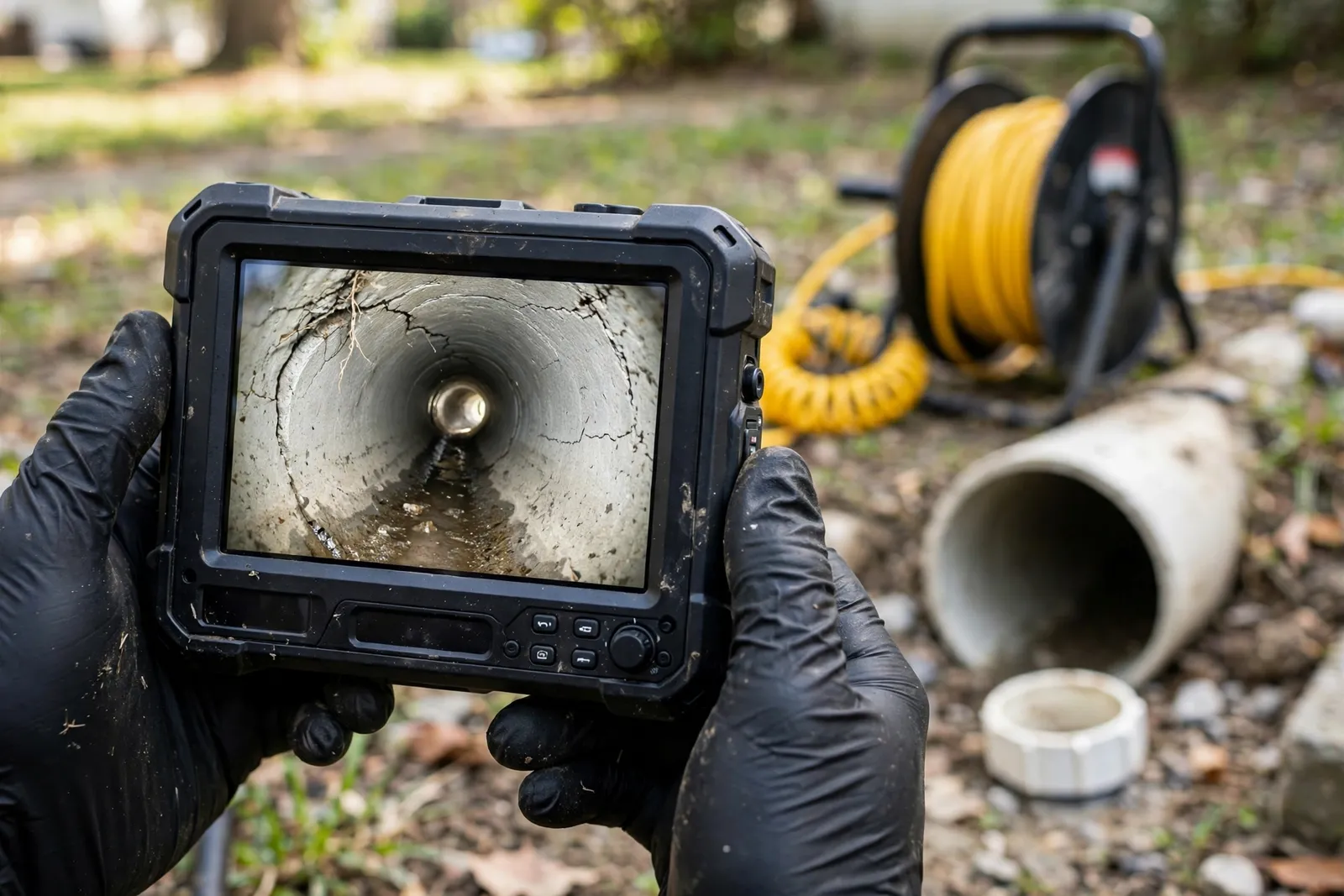
Your sewer lateral is the buried pipe carrying everything from your house to the city sewer main — and when it cracks, shifts, or fills with roots, the damage hides underground for years. Sewer line leak detection Whittier, CA homeowners call on starts with a camera, not a shovel: we see the break, measure its depth, and mark its location before anyone digs. Camera-first diagnosis is standard across our leak detection services in Whittier, so you see the break before approving any work.
- Camera shows the exact break — no exploratory digging
- Line path located and depth measured for accurate pricing
- Video file and written findings yours to keep
Know the signs
Signs of a Sewer Line Leak
Sewer problems announce themselves — just not always where you'd expect. After years of running camera routes under Whittier homes, these are the calls that keep turning out to be the lateral:
- Sewage smell in the yard, near the foundation, or coming up through drains.
- Soggy or sunken patches in the yard, especially along the line's path to the street.
- Slow drains everywhere — one slow drain is a fixture issue; all of them is a line issue.
- Gurgling sounds from toilets or drains when water runs elsewhere.
- Suspiciously lush grass in one strip of the yard — sewage is fertilizer.
One pattern worth knowing: a pro on the Terry Love plumbing forums notes that when he opens up a failing cast-iron line, the homeowner has almost always been smelling sewer odor on top of the drain complaint
How it works
How a Sewer Camera Finds the Break Without Digging
Your lateral is usually a four-inch pipe running from the house to the city main under the street — and for sewer line leak detection, a push camera is still the best way to see inside it without excavating. One visit answers the three questions that matter: what's wrong, exactly where it is, and how deep.
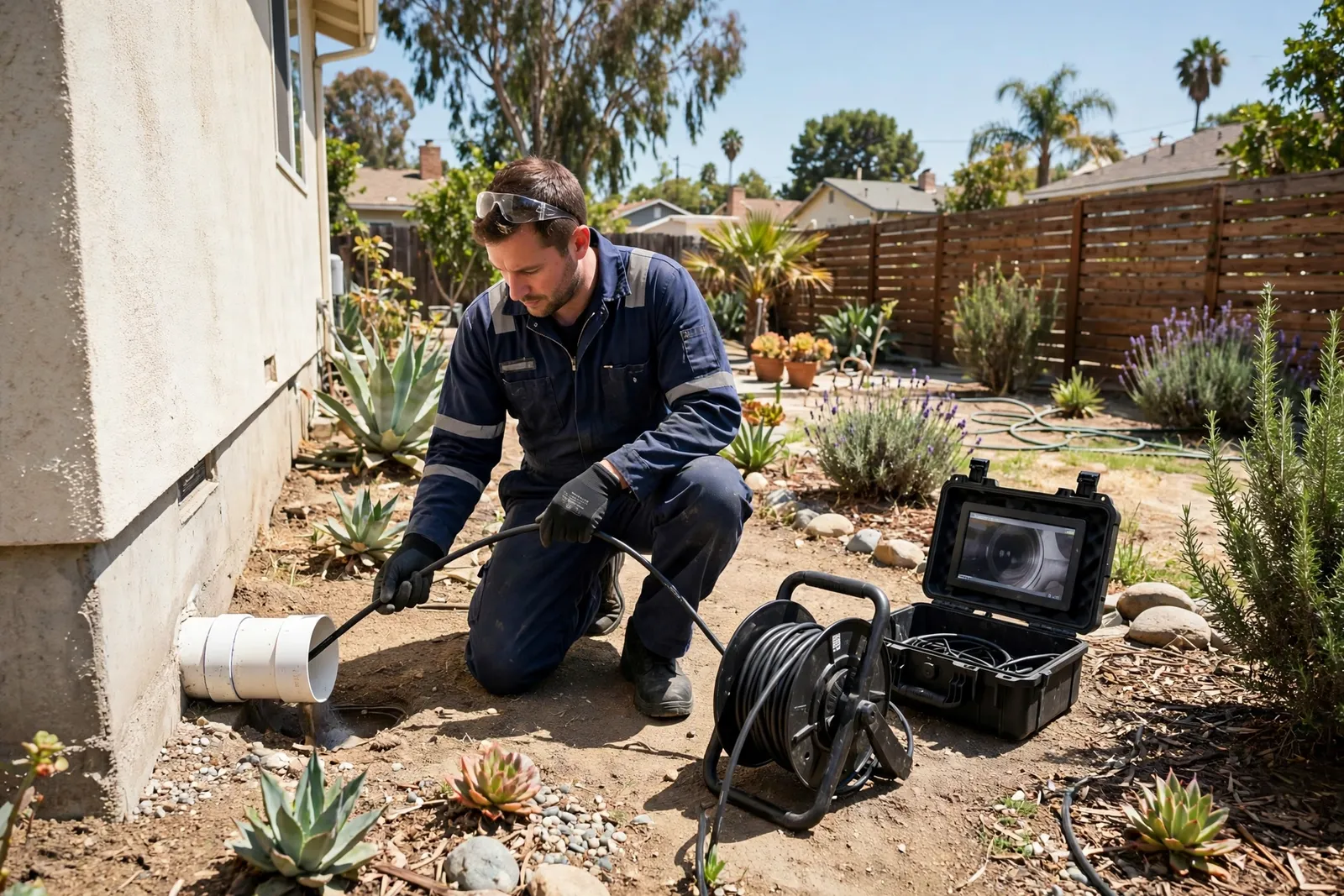
First, the camera goes in. Through an outside cleanout — or a pulled toilet when there's no cleanout — a waterproof camera on a flexible push rod travels the lateral while the technician watches the live feed for cracks, offsets, bellies, root intrusion, and corrosion, noting the footage at every defect. A transmitter (sonde) in the camera head lets a receiver above ground trace the line's path and depth, so the crew digs one targeted hole. A master plumber on the Terry Love forums puts it plainly: “If you're that worried hire a plumber with a camera snake. It will give you a view right inside the pipe.”
Here's what the camera can't do. It documents only the visible interior of the sections it reaches — it can't measure remaining pipe-wall thickness, and standing water, heavy scale, or a missing cleanout can stop it cold. Any report worth keeping says which sections it couldn't reach; ask what access point was used and where the camera stopped.
When the camera can't fully explain a leak, smoke testing earns its keep. Non-toxic smoke is blown into the drain system through a cleanout or vent and escapes wherever there's a crack, broken joint, or failed seal. It looks like theatrical fog and leaves no residue; municipalities use the same method to hunt inflow and infiltration. Dye testing backs it up: bright, non-toxic tracing dye flushed through specific fixtures confirms where water is actually going.
Why Whittier laterals fail the way they do: most homes we camera across Whittier’s neighborhoods went up in the 1950s–70s, and their pipes are 50–70+ years old. Cast iron from that era corrodes from the inside out — scaling, thinning walls, eventual collapse. Some mid-century homes got Orangeburg — a tar-impregnated fiber pipe one trade source calls “never intended as a permanent solution” — which disintegrates underground. Underneath, the Puente Hills clay swells when wet and shrinks when dry, working joints loose; plumbing-united.com's California sewer guide names expansive soil the state's top collapse cause. And any lateral laid before October 1987 has ridden out M5.9 shaking that broke water and gas mains across the city.
One thing the camera rules out fast: supply-side trouble. A hot spot on the floor or the sound of running water with everything off points to a pressurized line under the slab — that calls for slab leak detection in Whittier, CA, a different visit with different equipment.
Reading the camera
What the Camera Findings Mean for Your Repair
Not every defect means digging up the yard. Here is how a technician reads what the camera shows — and what each finding usually points to.
A spot repair usually handles it
- Single crack with the rest of the line sound
- One offset joint catching debris
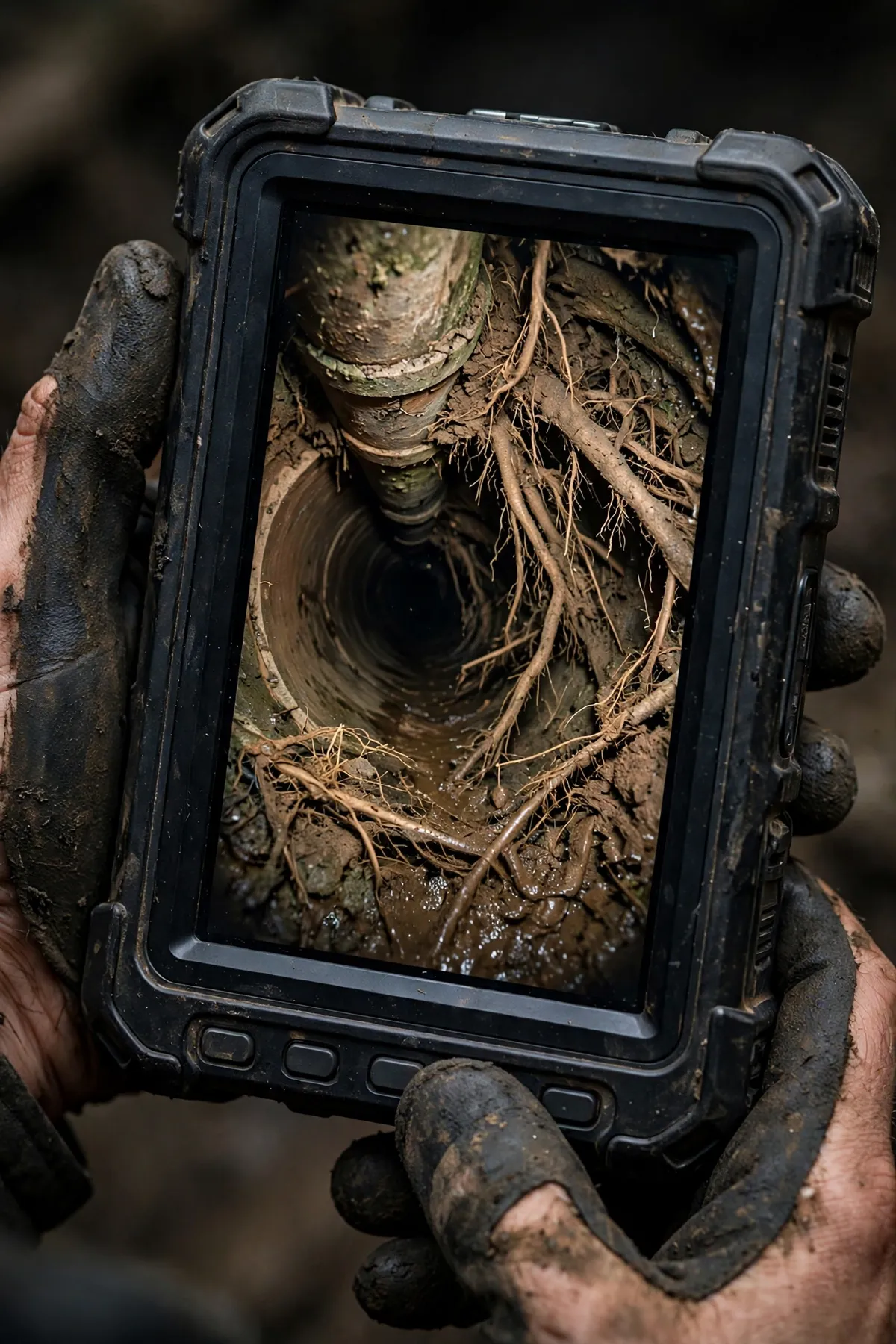
- Root intrusion at a single joint, pipe wall intact
- Light scale buildup that jets clear
Points toward replacement
- Multiple cracks or breaks along the run
- A belly holding standing water
- Heavy root mass through long sections
- Collapsed or back-pitched pipe
Honest guidance: sewer line leak detection is diagnosis, not a sales pitch. You get the video, the footage count at every defect, and the located depth — then a repair price for the option that fits what the pipe shows. Rule of thumb from California trade guidance: isolated damage can mean repair; multiple collapsed sections, severe roots, a belly, or 40-plus-year-old clay usually mean replacement. Paperwork note: a standard HO-3 policy excludes sewage backing up through drains — the FAQs below lay out backup endorsements vs. service-line coverage. If sewage is actively backing up, don't wait — stop running water anywhere and treat it as Category 3 black water: porous materials that soaked it up get removed, not dried, and mold can start within 24–48 hours. For anything urgent, emergency leak repair is the call to make.
Why it happens
Common Causes of Sewer Line Breaks
Most Whittier sewer failures come down to a short list — and after a few hundred camera runs, the pattern by material is unmistakable. Tree roots are the classic: roots chase moisture and nutrients, and a small crack or loose joint is an invitation. They enter as hairlike strands and thicken until they catch paper and waste. A myth-buster from a pro on the Terry Love plumbing forums: cutting the tree down doesn't end it — “the roots can live on for 25 years or more.” And when sectional pipe that old keeps clogging with roots, another Terry Love regular is blunt: cleaning lasts a year or two, then you're better off replacing the line.
Cast iron fails from the inside out — scaling, rust, thinning walls, eventual collapse. Clay loosens at its joints as the soil moves, and every joint is an entry point; one longtime forum contributor calls clay “the worst” of the lot. Orangeburg, the tar-impregnated fiber pipe some mid-century homes got instead, “was never intended as a permanent solution” and has largely disintegrated underground. Then the geometry failures: a belly sags from poor soil support — wastewater slows, solids settle, and clearing helps only briefly; offsets happen when sections shift from soil movement, roots, or ground shaking. For Whittier, that means the Puente Hills clay's swell-shrink cycle, mature street trees, and laterals old enough to have ridden out the 1987 quake. A camera inspection tells you which of these you're dealing with — and that's the whole point of sewer line leak detection: the repair fits the pipe, not the other way around.
Fix options
Sewer Repair Options Compared
What the camera finds decides how it gets fixed:
| Spot Repair | Trenchless Lining | Full Replacement | |
|---|---|---|---|
| What it is | Fix the one bad section | Epoxy liner cured inside the existing pipe | Old pipe out, new pipe in |
| Best when | A single break and the rest of the line is healthy | Multiple defects but the line is mostly intact | Collapsed, bellied, or severely damaged line |
| Digging | One targeted excavation | Minimal — access points only | Full trench along the line |
| Typical cost (national/CA ranges) | $2,500–$5,500 per defect | $80–$250 per linear foot | $150–$250 per foot open-cut; totals can top $25,000 with restoration |
Cost figures are national/California ranges from 2026 trade sources — Angi, Go Pro Plumbing Sacramento, Wooley Trenchless, and plumbing-united.com — not Whittier quotes. Permits/inspection can add $300–$2,000; slab-foundation access $3,000–$10,000 (plumbing-united.com).
Why it pays
Why a Camera Finds Sewer Line Trouble Better Than Digging
Sewer work used to start with a shovel. A camera and locator start with information: a waterproof camera pushed through an existing cleanout shows live video of roots, cracks, offsets, bellies, and collapses, while the transmitter in the camera head lets a surface locator mark its exact position and depth from above. As one pro on the Terry Love forums wanted it: use the locator “from above, to pin point the location, where the camera gets stopped by the roots, so they would know where to dig.” That's the whole benefit — dig in one spot, not a trench of guesses. A standard residential lateral typically takes under an hour, and you keep a copy of the footage.
The money side: a camera inspection runs $150–$300 for a basic unit, $300–$600 for HD with recording and a report, and $600–$1,500-plus for specialty cameras — national Angi 2026 figures, with most homeowners paying $271–$1,725 and a California-market guide putting inspections at $250–$600. Knowing exactly what's down there is what keeps a $2,500–$5,500 spot repair a spot repair instead of an $8,000–$20,000 full replacement: isolated damage with an intact structure can be repaired; multiple collapsed sections, bellies, or clay pipe past 40 years usually means replacement (per California plumbing guidance). And for insurance: a sewer-backup endorsement (typically $50–$250 a year) covers interior damage and cleanup, while a separate service-line endorsement (roughly $30–$50 a year) covers the buried pipe itself — two different coverages, and the camera footage is what documents which applies.
What it costs
What Sets Sewer Camera Inspection Costs
Nationally, Angi's 2026 data puts camera inspections at $271–$1,725 for most homeowners (average around $995), driven by pipe length, access difficulty, and camera type — and a California-market guide puts inspections at $250–$600. National and state-market ranges; no Whittier-specific pricing exists. The cost moves with four things. Length: under 50 feet runs $175–$250, 50–100 feet $250–$400, over 100 feet $400–$800 (Angi). Camera type: basic $150–$300, HD with recording and report $300–$600, specialty 360° or self-leveling $600–$1,500-plus. Access: no cleanout means the camera may go through a pulled toilet ($185–$450) or need a new cleanout installed ($500–$1,500).
Conditions: standing water in a belly, heavy deposits, or an offset can stop a camera — and a camera only documents the visible interior of the sections it reaches; it does not measure remaining pipe-wall thickness. A report that doesn't say which sections it couldn't reach is leaving something out: we note the access point, where the camera stopped, and which sections are which material. Smoke testing finds cracks and bad seals a camera can miss — non-toxic smoke blown in through a cleanout escapes wherever there's a crack or failed seal — and it's often the right add-on when the camera view is inconclusive.
Why us
How We Work Sewer Laterals in Whittier
We're a detection outfit: the camera goes in, the findings come out in writing and on video, and the repair decision — spot repair, trenchless lining, or full replacement — is yours to make with your contractor. Our standard is the honest-report rule: we document the access point, where the camera stopped, which sections we couldn't reach, and which sections are which material — because any report that doesn't say what it couldn't see is leaving something out. You get a copy of the footage either way. Whittier's laterals are our daily context: 1950s–70s homes sit squarely in the clay, cast iron, and Orangeburg era — clay invites roots at every joint, cast iron corrodes from the inside out, and Orangeburg was never intended as permanent and has largely disintegrated in the ground.
Mature tree roots seek the moisture at every crack and loose joint; the expansive clay around the Puente Hills swells and shrinks, putting pressure on aging pipe until it cracks or misaligns; and the 1987 Whittier Narrows quake's ground shaking is a known mechanism for offset joints. One honest line we keep: “that gets rid of the tree, but the roots can live on for 25 years or more” — removing a tree doesn't end a root problem, and we say so up front. Detection ends at the marked spot; what you do there is your call, and our report stays factual either way.
Who this helps
Who needs a camera in the lateral, and what should they walk away with?
The lateral — the buried pipe from your house to the city main — gives no meter reading and no warning bill. It just backs up, smells, or leaves a soggy patch, and by then the question is what is actually down there: cracks, offsets, bellies, root intrusion, or corrosion. We answer it with a camera, not a shovel — the live feed, the footage noted at every defect, and a sonde locate above ground — and you keep the video file and the written report. What that evidence is for depends on how you hold the property.
Inspection vs. repair vs. replacement — California ranges
- Owners of older homes with clay or cast-iron laterals. Whittier’s mid-century laterals are at the age where joints work loose in expansive clay, roots squeeze in at the seams, and cast iron scales and thins from the inside — some homes even sit on Orangeburg fiber pipe that was never a permanent material. The camera shows whether you are looking at one defect worth a spot repair or a line past 40 years that California guidance says to replace — before you pay to dig.
- Landlords dealing with repeat backups at a rental. A rental that backs up twice is not a snaking problem; it is a pipe problem that keeps billing you in callouts and unhappy tenants. The camera names the cause — a root mass at a joint, an offset, a belly holding water — and the written report documents it, so the fix you approve is the one the pipe actually needs and the spending is defensible on paper.
- Buyers who don’t want to inherit an unknown line. A lateral is the one major system a standard look at a house never sees. A camera inspection before closing replaces the unknown with footage and a written report: if the line is sound, you close knowing it; if it is not, the findings get priced against real repair, lining, and replacement ranges — negotiated before the pipe becomes yours.
Sound line or failing one, you end up knowing — with video to prove it. Call Whittier Leak Detection Pros at (562) 450-1003 to put a camera in your lateral.
Common questions
Sewer Line FAQs
Several drains slowing down at once, sewage odors in the yard or coming up through drains, gurgling toilets, an unusually lush or soggy patch of lawn, and moisture along the foundation. One slow drain is usually a local clog - when the whole house drains slowly, the problem is in the lateral.
A sewer line leak detection visit starts with a waterproof camera on a flexible push rod going in through an outside cleanout - or a pulled toilet when there is no cleanout. The technician watches the live feed for cracks, offsets, bellies, root intrusion, and corrosion while a sonde in the camera head lets a locator above ground trace the pipe's path and depth. You get the video file and a written report.
The camera documents only the visible interior of the sections it reaches - it cannot measure remaining pipe-wall thickness, so a line can look passable while its walls keep thinning. Standing water, heavy scale, or a missing cleanout can stop it partway. A Florida plumbing outfit that writes about inspection standards puts it well: any report that does not say which sections it could not reach is leaving something out.
A camera shows the inside of the pipe; smoke testing finds the cracks and failed seals a camera cannot fully explain. Non-toxic smoke is blown into the drain system through a cleanout or vent and escapes wherever there is a crack, broken joint, or failed seal. It looks like theatrical fog, leaves no residue, and municipalities use the same method to study inflow and infiltration. Dye testing confirms it: nontoxic tracing dye flushed through specific fixtures shows where the water is actually going.
Orangeburg is a tar-impregnated fiber pipe used in some mid-century homes - one trade source describes it as never intended as a permanent solution. Decades underground, it deforms and largely disintegrates. Whether a particular Whittier home has it is not something we can guess from the curb - only a camera inspection tells you what your lateral is made of.
Angi's 2026 data (2,344 verified projects) puts the average camera inspection near $995, with most homeowners paying $271 to $1,725. California figures from plumbing-united.com: $250 to $600 for the inspection, spot repairs $2,500 to $6,000, trenchless lining $5,000 to $15,000, full replacement $8,000 to $20,000. Per-foot: CIPP lining $80 to $250 and pipe bursting $60 to $200 (Go Pro Plumbing Sacramento; Wooley Trenchless). Detection is always priced separately and approved before the visit.
Usually not, and that is the expensive surprise. A standard HO-3 policy excludes water or sewage that backs up through sewers and drains - burst supply pipes are covered; sewage backing up through your drains is not. A sewer-backup endorsement, typically $50 to $250 a year with limits usually $5,000 to $25,000, covers interior damage and cleanup - but not the lateral itself. That gap is what service-line coverage fills: roughly $30 to $50 a year, limits typically $10,000 to $20,000, covering the underground line itself - though most endorsements exclude earth movement, worth knowing in quake country.
No lateral-by-lateral damage map exists from the October 1, 1987 M5.9 quake, so we will not claim what we cannot verify. What is documented: Whittier felt severe (Mercalli VIII) shaking, the quake broke water and gas mains across the city - over a thousand gas leaks - and damaged plumbing systems in Whittier homes. Ground shaking is a known mechanism for the offsets we see on camera. Any lateral laid before October 1987 has ridden out that shaking, so joints from that era earn a close look.
Sewage Smell or a Soggy Patch in the Yard?
Get the lateral camera-checked before a small break becomes a big dig. Sewer inspection in Whittier — line located, depth measured, priced up front.