Slab Leaks
Pinpoint leaks under your concrete slab with acoustic listening and thermal imaging — no jackhammer guesswork, no exploratory holes.
Slab Leak Detection in Whittier, CA →ZIP 90601 — Uptown Whittier
Uptown's historic blocks run on some of Whittier's oldest plumbing. Our leak detection in Uptown Whittier, CA finds slab leaks and hidden pipe leaks non-invasively — protecting original finishes while pinpointing the break within inches.

Local focus
Uptown is where Whittier began — a Quaker-founded town from the late 1880s, named for the poet John Greenleaf Whittier, with its historic core still centered on Philadelphia Street and Greenleaf Avenue. The 1923 National Bank of Whittier Building at 13006 Philadelphia Street — Beaux Arts, on the National Register since 1982 — anchors the historic downtown, and just north sit the Central Park and Hadley-Greenleaf historic districts: the Central Park district alone, designated in 1990, covers roughly 98 parcels of Victorian, Craftsman, and Spanish and Mediterranean Revival homes dating to the late 19th through mid-20th century. It’s also why leak detection in a historic district starts with listening, not cutting.
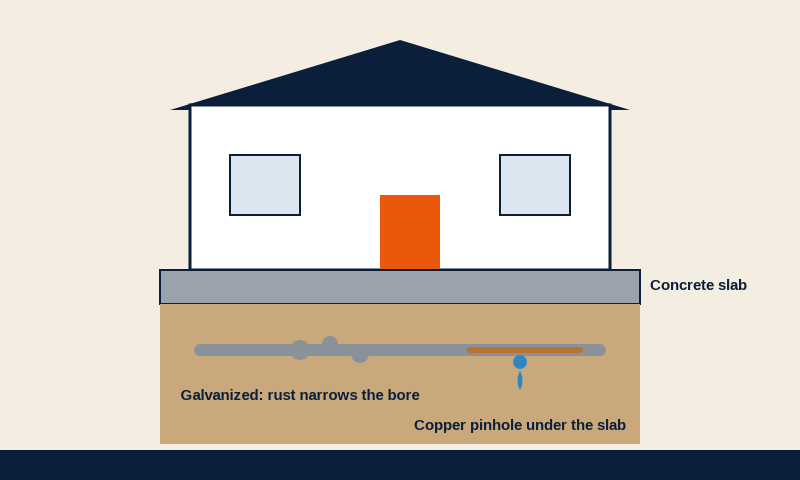
That past still flows through these pipes. Uptown homes were built across five decades of plumbing technology — original galvanized steel supply lines, early copper, and generations of partial repairs and additions layered on top. We built our leak detection Uptown Whittier service around that reality: in a historic district, you don’t open a wall until you know exactly what’s behind it.
And the cost of a wrong guess is higher here: original plaster, vintage tile, and old-growth hardwood can’t be replaced at any price — and exploratory demolition destroys them for nothing. Non-invasive leak detection works straight through those finishes. The equipment doesn’t care how old the wall is — only where the water is — and every leak detection visit here assumes more than one pipe generation may be involved.
Our most common Uptown calls: pinhole leaks in aging copper behind bathroom walls, slab-adjacent leaks where additions meet original foundations, and fixture shutoffs untouched for thirty years. Slab leak detection and emergency leak repair are both available across Uptown Whittier with same-day response.
Why leaks happen here
Most of Whittier’s housing was built before 1970 — 82.4%, per the Southern California Association of Governments’ 2019 city profile — and Uptown holds the oldest of it. Every pipe era the city ever used is still in the ground here: ground zero for all three of Whittier’s classic failure modes, and every one of them rewards early leak detection.
Galvanized steel supply lines, standard in 1940s–60s homes, corrode from the inside out over roughly 40–50 years — Uptown’s galvanized pipe is at or past that point. Early copper fails differently: Whittier’s water is reported at about 15 grains per gallon, — “very hard” per the Water Quality Association — and hard water plus municipal chloramines pits copper from the inside until pinholes open. Cast iron drains corrode the same way, which is why Uptown homes call for sewer line leak detection nearly as often as supply-side work — a thorough leak detection visit checks drains as well as supply lines.
Then there’s the soil under the slab. The October 1987 Whittier Narrows earthquake — magnitude 5.9, with severe shaking measured right here in Whittier — broke water and gas mains across town — more than a thousand gas leaks were reported — and shifted buried copper joints that have been degrading ever since. Add the expansive clays around the Puente Hills, which heave and settle with wet and dry cycles and stress buried lines further. Any Uptown pipe installed before 1987 has already survived a major quake — plus nearly four decades since.
The stakes match the age: Whittier’s median owner-occupied home value sits around $822,600 per the U.S. Census, while water damage makes up 22.6% of all homeowners claims at an average of about $15,400 (Insurance Information Institute). Figuring out which failure mode is actually yours is exactly what a leak detection visit is for — which is why leak detection in Uptown starts with the pipe’s birthday, not a sledgehammer.
Our method
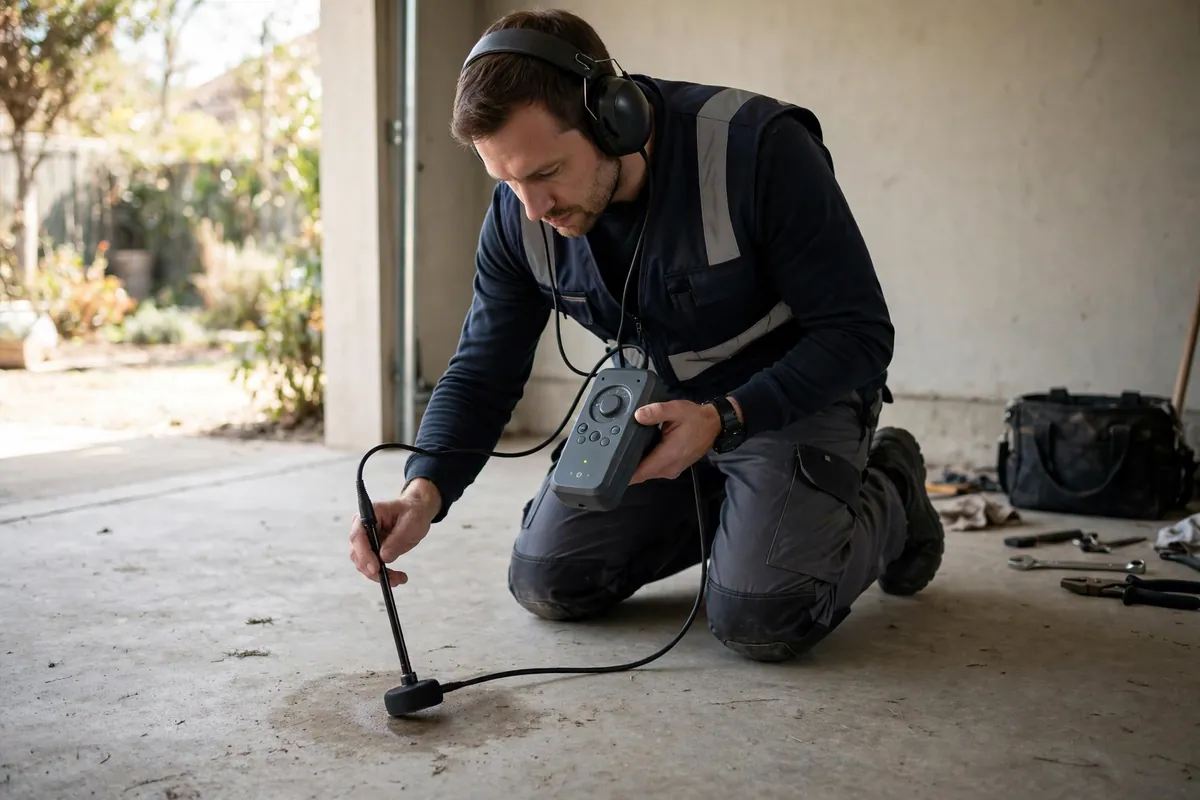
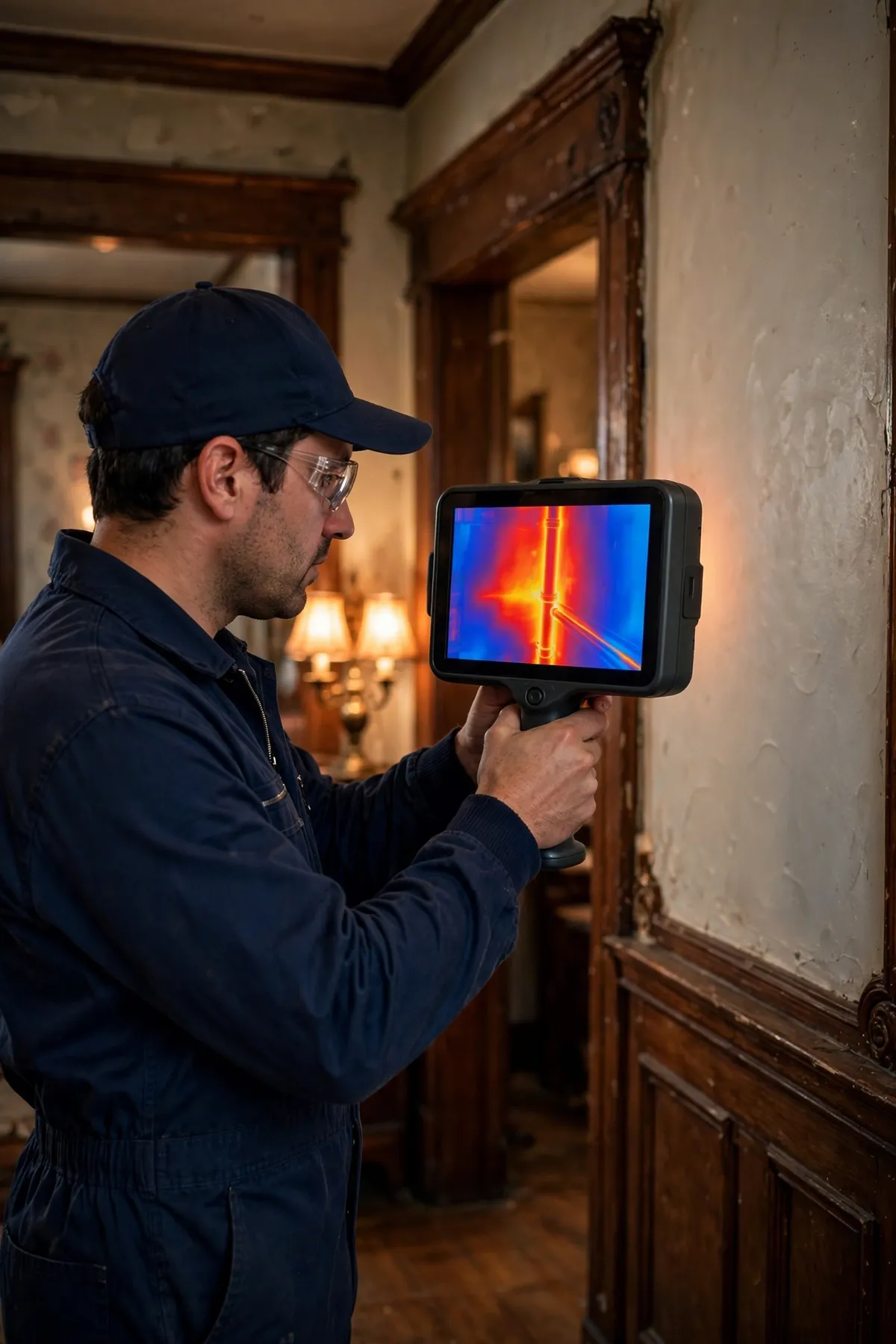
In a historic home, the order of work is everything: locate first, open something only when the location is proven. Our Uptown visits run the sequence the trade press endorses — Contractor Magazine states it plainly: find the slab leak’s exact point before any floor comes up. The kit list is meter testing, acoustic listening (a leak on metal pipe rings at 500–1,500 Hz), thermal imaging that reads the 3–6°F surface gradients leaking water leaves behind, and moisture-meter mapping that follows the water’s route — together they fix the break to within inches, and none of them cuts a thing.
That discipline matters most where the finishes can’t be replaced. Most post-war Southern California homes sit slab-on-grade — the water lines run beneath the concrete you walk on — so a leak shows up as a warm patch of floor, a damp carpet edge, or a bill that keeps climbing, never water pooling in a basement. In a Victorian or Spanish Revival home, cutting on a guess destroys material no one can remake. Our electronic leak detection instruments read the break through plaster, tile, and concrete while leaving every surface intact. As plumbers on the Terry Love forums put it, slab leaks are the worst kind to locate, since water follows the path of least resistance — what you see is rarely sitting over the break. Against blind demolition, professional detection runs to a small fraction of the cost.
We’ll also be plain about the boundary of this visit. Detection locates the leak; a plumber performs the repair — a spot repair, an overhead reroute, or a repipe. More than once, the wisest repair has been to leave the failed under-slab section where it is and reroute overhead instead of chasing pipe through concrete — one industry pro calls that route “less expensive, messy, and disruptive.” None of that is decidable until the location is exact, which is also why the detection visit stays the smallest bill in the entire job. The whole point of dedicated detection in one line: locate it exactly, repair it once.
What we do
Pinpoint leaks under your concrete slab with acoustic listening and thermal imaging — no jackhammer guesswork, no exploratory holes.
Slab Leak Detection in Whittier, CA →Burst pipe, major leak, water where it should not be — fast response across Whittier, day or night.
Emergency Leak Repair in Whittier, CA →Find leaks in the buried line from your meter to the house — acoustic tracing pinpoints it before anyone digs.
Water Line Leak Detection in Whittier, CA →Losing more water than the Whittier sun explains? Dye testing and pressure checks find pool and spa leaks fast.
Pool & Spa Leak Detection in Whittier, CA →Camera inspection locates breaks, offsets, and root intrusion in your sewer lateral — no guesswork, no trench first.
Sewer Line Leak Detection in Whittier, CA →After-hours service for offices, retail, restaurants, and HOAs — with documentation your insurer accepts.
Commercial Leak Detection in Whittier, CA →Pinpoint lateral lines, valves, and sprinkler head leaks with pressure testing and acoustic location — no digging.
Irrigation Leak Detection in Whittier, CA →Acoustic listening, thermal imaging, tracer gas, and pressure testing find hidden leaks without demolition.
Electronic Leak Detection in Whittier, CA →Combustible gas sniffers, pressure testing, and line tracing pinpoint the leak fast — plus what to do the moment you smell gas.
Gas Leak Detection in Whittier, CA →Warning signs
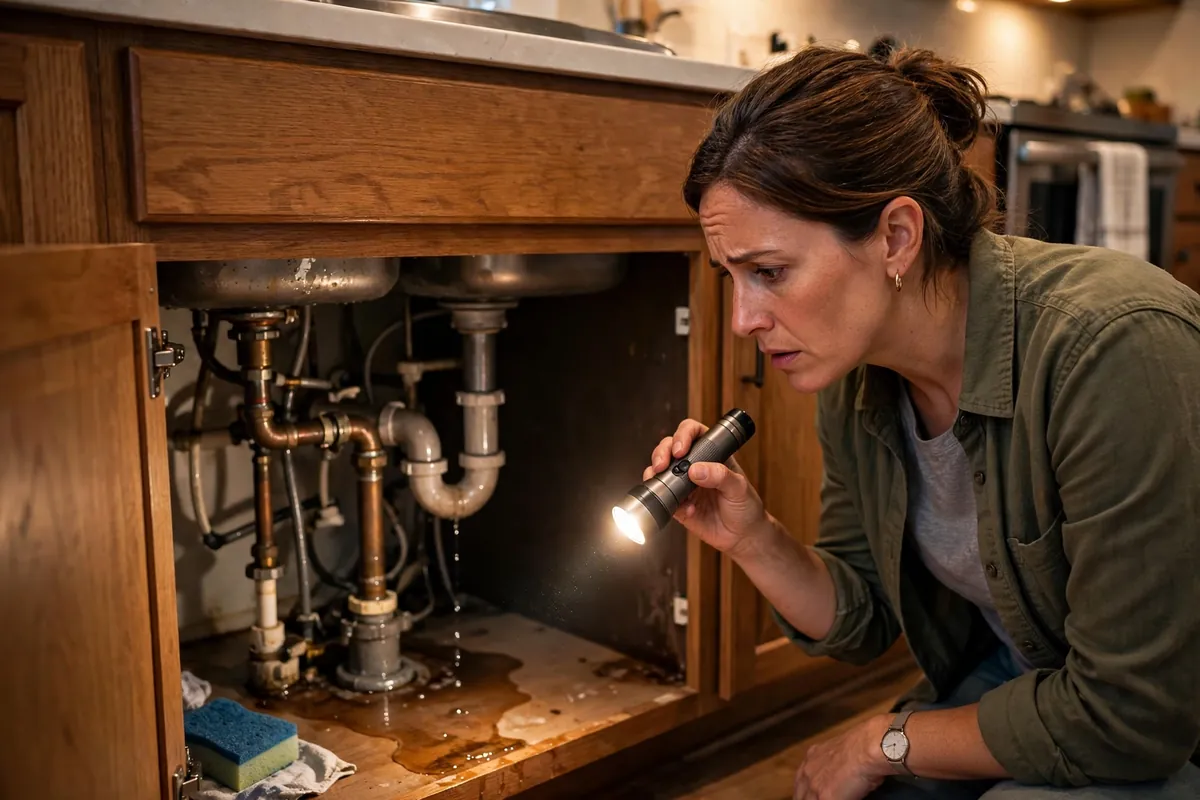
Hidden leaks announce themselves sideways. When one patch of floor feels warm underfoot, a hot-water line is usually leaking beneath the slab. A bill that climbs for no reason is the classic giveaway — California utilities bill in tiers, so a hidden leak shoves usage into higher-priced tiers that multiply what you owe. With everything off, listen for water still running; look for damp baseboards, buckling wood, and blistered paint. Spotting any of these early is the entire reason residential detection exists.
A musty smell deserves attention, not patience: the EPA and CDC note mold can begin on wet surfaces within 24–48 hours, and a slab leak holds its surroundings damp day and night. If you spot any of these signs, emergency leak repair is the quick route while a standard detection visit is the careful one. Whichever you need, instruments come out before any saw does.
Costs
Across the country, a professional detection visit typically runs $150–$600, and slab leak detection averages about $280 (2026 Angi data). Set that against the other side of the ledger: an average slab leak repair runs about $2,280, including detection (typically $630–$4,400) — roughly eight times the visit — the average water-damage claim approaches $15,400, water damage accounts for 22.6% of all homeowners claims (Insurance Information Institute), and FEMA’s standing figure puts one inch of water at around $25,000 in damage.
CostCandor, a contractor cost site, frames it this way: “Paying for precise detection is usually the cheapest money in the whole project.” The reverse math is sobering: one homeowner’s widely shared story describes an $800 fix growing into a $22,000 disaster after eighteen months of overlooking a damp patch — and the gradual-seepage claim was denied outright. Standard homeowners policies typically exclude gradual leaks, while sudden, documented failures may qualify for coverage. A detection report is what converts a denial into a payable claim — stack that against the visit, priced in the hundreds, that would have caught it.
You get our detection price before we begin — nothing gets added once the equipment is out of the van.
Service areas
Uptown’s 90601 core is our home turf, but our leak detection coverage runs citywide — from East Whittier and Friendly Hills to College Hills, Murphy Ranch, and South Whittier. Every neighborhood gets the same non-invasive leak detection method and up-front pricing — just a different ZIP code. View all Whittier service areas →
From the blog
Straight answers on costs, warning signs, and finding hidden leaks — from our leak detection Whittier team.
Common questions
They get more pipe failures overall: Uptown holds the city’s oldest housing — the Central Park district’s period of significance runs from the late 19th century to the mid-20th century — so original galvanized and early copper lines here have more decades on them than anywhere else in Whittier. Pinhole leaks, slab leaks, and failing fixture shutoffs are all more common than in newer tracts — that’s the pattern a leak detection visit is built to untangle.
That is the entire purpose of non-invasive detection. Listening gear and thermal cameras read through floors and walls while everything stays closed up. In Uptown homes, where original plaster, vintage tile, and old hardwood are worth preserving, exactness counts double — and that is what the instruments are there to deliver, the same way we work anywhere else in the city.
Countrywide, professional detection runs $150–$600 based on the methods a home needs, and slab leak detection averages about $280 (2026 Angi data). An older Uptown home sometimes adds a step — working out which of its several pipe generations is the one leaking — but your price is set before we begin, never after.
Three generations, mostly: galvanized steel supply lines (1940s–60s), which corrode from the inside out over about 40–50 years; early copper, which develops pinhole leaks in hard-water systems; and cast iron drains that corrode the same way. Decades of additions and partial repipes mean one house can hold all three — a good leak detection visit identifies which generation is actually leaking before anyone talks repair.
On October 1987, the Whittier Narrows quake — magnitude 5.9, shaking Whittier hard — snapped water and gas mains all over town, with over a thousand gas leaks reported. That day shifted buried copper joints and cracked cast iron, and those lines have been wearing down ever since. For a home built before 1987, a detection check is worthwhile even with no symptoms at all — joints moved decades ago tend to fail without warning.
A warm patch of floor, a bill climbing for no apparent reason — tiered California rates turn that climb into real money — water heard running when everything is off, damp baseboards, or a musty smell. Mold can begin within 24–48 hours on wet surfaces, so a slab leak that never dries out calls for a prompt detection visit.
Finding it is our trade — down to the inch. Detection and repair are separate jobs: after we pin the break to within inches, a plumber takes the spot repair, the overhead reroute, or the repipe. The report hands that plumber the precise spot to work from. More often than not, the cleverest repair is to leave the failed under-slab section alone and reroute overhead instead of chasing pipe through concrete — and that call is only possible once the location is exact.
Same-day service across the 90601 core and the rest of Uptown, with 24/7 response for active leaks. Ring (562) 450-1003 and we’ll confirm your arrival window and your detection price before we roll.
Non-invasive leak detection for Uptown's older homes — pinpointed within inches.