Your sprinklers run on schedule, the lawn looks fine from the curb, but the water bill keeps climbing and one corner of the yard never quite dries out. We see this pattern all the time across Whittier — a hidden irrigation leak is usually why. A proper leak detection visit finds it without digging up the whole yard on a guess. As water-monitoring firm Bluebot put it in 2026: "An undetected leak is expensive precisely because it is undramatic." A 1-gallon-per-minute leak wastes 43,200 gallons a month — barely noticeable while a zone runs, yet enough to add $50–$200/month until found.
How We Find Irrigation Leaks: Zone Isolation and Pressure Testing
Zone isolation plus pressure testing is the standard way pros pinpoint sprinkler leaks — supply lines, laterals, valves, heads — with no exploratory digging. One Texas firm's method: pressure-test and zone-isolate to pinpoint the leak "usually within an hour" — digging only where it actually is.
Start with the controller-off rule — your best first diagnostic. Hear water hissing with the controller OFF and suspect a mainline or valve-body leak; water that only appears when a zone runs points to a lateral, riser, or sprinkler head (irrigation trade field guide). That distinction tells us where to start.
Then we run each zone independently and watch for pressure drops — the pattern identifies the leaking zone without digging ("one of the most reliable methods for narrowing down a leak location before any digging begins" — greenformlandscapes.com). For the exact spot we use acoustic ground microphones, the same electronic leak detection approach used for indoor slab leaks. Honest caveat: plastic pipe and yard noise limit the signal, so pressure testing comes first (leakdetectioncolorado.com). Tracer gas covers stubborn plastic lines; a tracer wire lets electromagnetic locating map the line first.
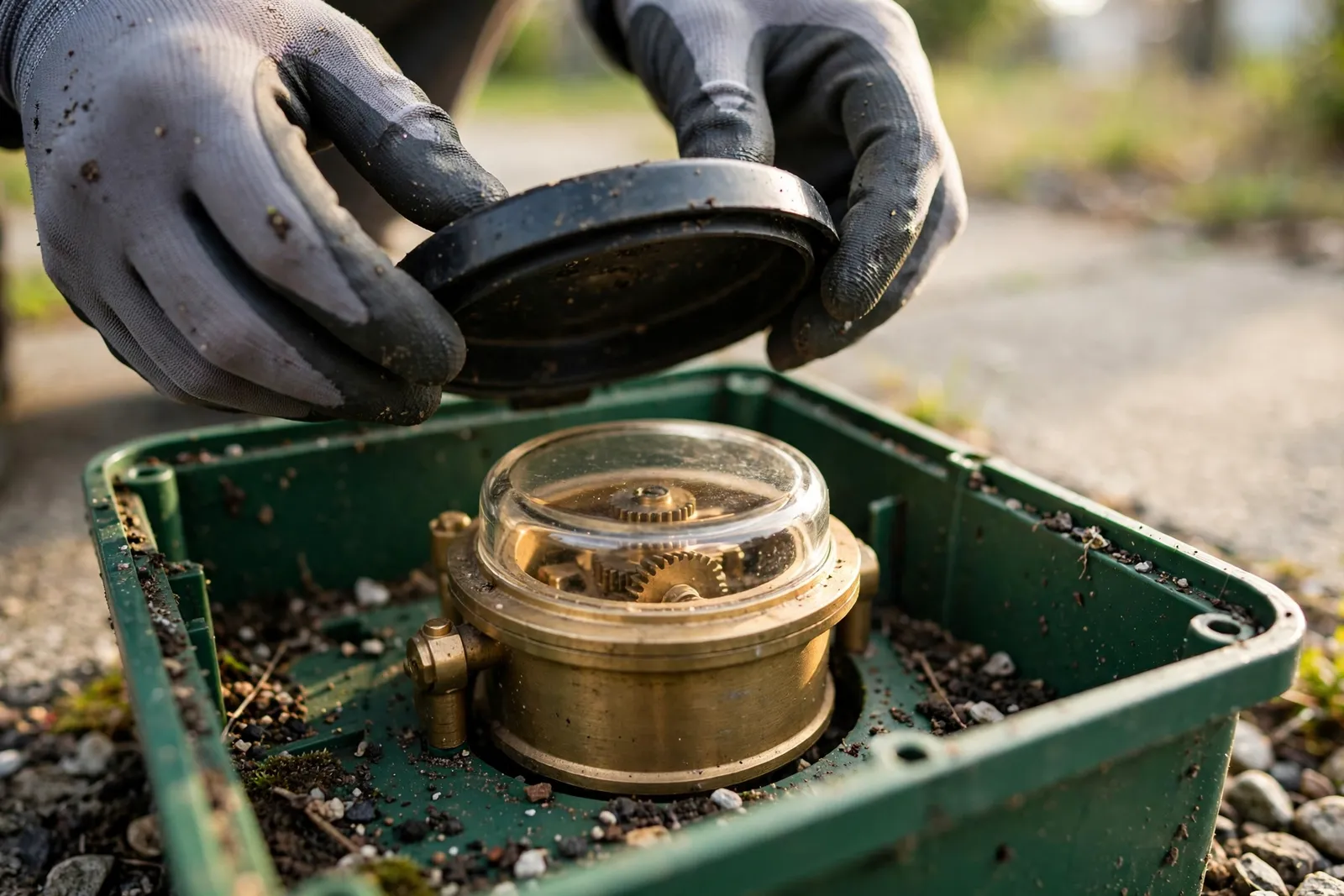
Valves get tested on their own: a weeping diaphragm or stuck valve leaks 24/7, zone on or off — we check valves independently so a bad valve is never misdiagnosed as a pipe break.
The Signs Your Sprinkler System Is Leaking
Soggy spots, dry spots, a climbing water bill — if your yard has both a swamp and a desert, water is going somewhere it should not:
- Soggy or spongy areas that never dry out. A low spot that stays wet days after the sprinklers ran — or never dries — usually means a lateral or fitting is leaking.
- Dry or brown patches in an otherwise green lawn. A broken lateral upstream starves everything downstream — dead zones in healthy turf signal a leak, not an adjustment problem.
- Water bill jumps in watering season. Compare this summer's bill to last summer's — usage up with no schedule change means the system is losing water between meter and heads.
- Low pressure on one zone. Heads that barely pop up or throw short on one zone point to a break in that zone's lateral.
- Water pooling near valve boxes or the backflow preventer. Diaphragms wear out and weep even with the zone off. A valve box full of water is worth investigating.
- Erosion or sinking soil along the pipe run. A long-term leak washes soil from around the pipe until the ground settles over it.
Whittier-specific note: most of the city ran up in the 1950s–70s, and plenty of irrigation down there is the same age — original-era poly laterals, aging valves, heads chewed by mowers for decades. That's our read from the housing stock, not a system census. Expansive clay soil shifts through wet-dry cycles, hard water clogs heads and fouls valve seals, and in drought thirsty roots follow moisture trails from tiny cracks in buried lines (Black Mountain Plumbing, San Diego) — cracked fittings become an expectation, not a surprise. That age profile is why local Whittier leak detection starts with pressure testing rather than digging.
Why Irrigation Leaks Hit Harder in Southern California
Outdoor water dominates the bill here: EPA WaterSense puts it above 30% of household water on average — up to 60% in arid regions — and up to half is lost to wind, evaporation, and runoff. A poorly maintained automatic system can waste up to 25,000 gallons a year. A yard leak isn't a footnote on your bill; for many Whittier homes it's the main event.
Drought rules raise the stakes. The Metropolitan Water District put roughly 6 million Southern Californians on once-a-week watering in 2022 (Reuters), and districts still run restricted schedules with drought surcharges. Lose a third of your water underground and your lawn gets a third less on allowed watering days — so zones run longer, feeding the cycle. From January 1, 2026, California's AB 1572 bans watering decorative "nonfunctional turf" with potable water even in non-drought years, fines up to $1,000. Single-family homes are exempt, but outdoor waste is under permanent scrutiny.
"Summer is when we see water usage spike," says John Akhoian, Founder of Rooter Hero. "A sprinkler head that breaks the day after you leave for vacation... can waste an incredible amount of water, and spike your water bill by hundreds of dollars" (PRNewswire, July 2026). Professional leak detection usually costs less than one summer of inflated bills.
Where Irrigation Leaks Happen, From Most to Least Likely
Nine times out of ten, the leak is in one of five places — ranked most to least likely, because the top spot is the one most people overlook.
- 1. Sprinkler heads. Mower damage, foot traffic, wear; clogged with dirt; cracked bodies; leaking seals — a head that won't pop up or retract means grit, a weak spring, or a fouled seal.
- 2. Valves — diaphragms, solenoids, seals. Stuck-open valves from debris in the diaphragm or failed solenoids; a persistent puddle around a valve box means a diaphragm leak or split valve body — valves are often solvent-welded into manifolds, a tricky DIY job (Terry Love forum, pro reply).
- 3. Lateral lines. Cracked from shifting soil, crushed near driveways, invaded by roots chasing moisture.
- 4. The mainline. The pressurized run from meter to valves, live 24/7 — the fastest water waster of the five, and the first suspect when you hear hissing with the controller off.
- 5. Backflow preventer and fittings. Worn seals, cracked bodies, head-connection fittings, risers, and swing joints.
That's the lineup we work through on every leak detection visit. One trap: when a zone shuts off and water seeps from the lowest head for a minute or two, that's gravity draining the lateral — low-head drainage, not a leak — fixed with check-valve heads. But indefinite flow means debris in the diaphragm or a failed solenoid: a valve problem (irrigation field guide).
Irrigation Leak or House Leak: How to Tell
High bill — but which system is guilty? The meter test settles it in fifteen minutes: turn everything off, including the controller, and watch the meter for 10–15 minutes.
Meter still moving with everything off? House plumbing or the irrigation main line — the one section pressurized 24/7. Meter still until zones run, then jumping? A lateral or zone valve.
Sharper version from a municipal guide (Regional District of Okanagan-Similkameen, BC): shut the irrigation supply valve near the backflow preventer and retest. Meter stops = irrigation leak — likely the pipe between backflow and a valve box, or a bad valve in one. Meter keeps moving = house leak. That's exactly what a leak detection visit settles first.
DIY Checks Before You Call — and Where the Pro Line Is
Start with our guide on why your water bill might be so high — it walks through the 15-minute meter test that tells you whether the leak is in the yard or the house.
The DIY-appropriate stuff takes twenty minutes: walk each zone while it runs, check spray distance and that heads rise evenly; clear clogged nozzles; swap a cracked head (parts $5–$25 — Bluebot 2026, Angi). Angi rates it skill level "simple" — ~2 hours, $15–$75. Look for geysers (broken head, easy fix), misting (pressure problem), sunken heads.
DIY with caution: cleaning a valve diaphragm — parts are "lost in the blink of an eye," and solvent-welded manifolds make it "a tricky DIY job" (Terry Love forum, pro reply).
Pro territory starts where visibility ends: zone isolation and pressure testing for underground breaks, acoustic or tracer-gas locating, mainline breaks, multi-valve work. Per LawnCareHive, pro repairs run $150–$500+, most take 1–3 hours on site, with 1–2 year labor warranty versus none on DIY. If the meter says you're losing water but you can't see where — that's when professional leak detection earns its keep.
What an Irrigation Detection Visit Costs
Nationally, a professional locate visit runs $150–$400 — the price when a manual inspection fails to find the source (Bluebot 2026, citing HomeGuide, Angi, LawnStarter surveys). Labor is $50–$115/hr, emergency calls higher. National ranges, not Whittier prices — nobody publishes Whittier-specific irrigation pricing.
Repairs: Angi 2026 average $278; LawnStarter 2026: $250 average, typically $130–$360. Head-only: $60–$110. Underground pipe section: $200–$500 (Bluebot 2026). On-site diagnostic with report ~$350 (Simmons Landscape); pre-season inspection $75–$150.
And the cost of waiting: 1 gallon per minute = 43,200 gallons a month = $50–$200/month until found (Bluebot 2026). An irrigation leak detection visit usually pays for itself in a month or two.
Why Professional Detection Beats Digging by Guesswork
The difference between a $5 head and a torn-up lawn is diagnosis. A professional irrigation leak detection visit is a sequence, not a guess: shut the supply at the backflow, run the meter test — if the meter stops, the leak is in the irrigation system between the backflow preventer and a valve box, or a valve inside a box is not closing; if it keeps moving, the leak is elsewhere (utility-issued method, RDOS BC). Then zone isolation and pressure testing narrow it to the failing zone, usually within an hour — so the only digging is where the leak actually is, not an exploratory trench across the yard (Carson Irrigation, Dallas firm).
Two rules tell us where to start before we arrive: hear water hissing with the controller OFF, and the culprit is the mainline or a valve body — that section stays pressurized around the clock. Water that only appears when a zone runs points to a lateral, riser, or head (irrigation field guides). We then listen along the actual pipe path with acoustic ground microphones and, when the route is a mystery, map it first with electromagnetic locating before anyone digs.
The math favors finding it fast. Bluebot (2026): an undetected leak is expensive precisely because it is undramatic — a 1-gpm fault is barely noticeable while a zone runs, yet it wastes 43,200 gallons a month, adding $50–$200 to the bill until found. In Whittier that math bites harder: much of the city's irrigation dates to the 1950s–70s boom and is now 50–70 years old (our read of the housing stock, not a pipe census), drought pushes thirsty roots into tiny cracks in buried lines (San Diego drought sources), and hard water clogs heads and fouls valve seals. A cracked head is a $5–$25 DIY part; when the meter test points underground, that is our territory.
What Moves Detection Cost Up or Down
National ranges, not Whittier prices: a professional locate visit runs $150–$400 when manual inspection fails (Bluebot 2026, citing HomeGuide, Angi, and LawnStarter). A diagnostic assessment with an on-site report runs about $350 (Simmons Landscape), and an annual pre-season inspection runs $75–$150. The repair side averages about $278 nationally (Angi 2026), with LawnStarter's 2026 range at $250 average, typically $130–$360 — the detection visit is small against the repair it directs.
What pushes the visit toward the high end: more zones (zone-by-zone pressure testing takes longer), an unknown pipe layout (locating equipment comes out before listening), deep burial or lines under driveways and pavers (underground pipe work runs $200–$500 and varies with depth and access, per Bluebot), concrete or tarmac cover, and multiple suspected failures. What keeps it low: surface-visible symptoms — a hissing mainline with the controller off, a valve box standing in water, a geyser head — which let us narrow the zone before we start. Labor nationally runs $50–$115 an hour, with emergency calls substantially higher (Bluebot 2026).
One honest note on the DIY math: parts for a head or diaphragm run $5–$25, and Angi rates the DIY at skill level "simple," about two hours and $15–$75. If the controller-off hissing points to a valve body, a diaphragm swap is fair game. If the meter test points underground — mainline, manifold, or lateral under pavers — professional detection ($150–$400) is cheaper than one wrong dig, and the marked spot keeps the repair to a single small hole.
Why We Are Set Up for Whittier's Irrigation Leaks
Our method on irrigation systems is the same sequence the trade uses: meter test first, then zone isolation and pressure testing to find the failing zone, then acoustic listening along the actual pipe path — and electromagnetic locating first when the pipe route is unknown. For isolated plastic lines where sound dies in the pipe, tracer gas is an option, with escaping test gas detected at the surface. We confirm before we mark: a second reading before anyone digs, and the repair needs one small hole at the marked spot — usually a square foot or two of turf, not a trench.
Whittier specifics matter here. The 1950s–70s-era systems across the city are now 50–70 years old (our read of the housing stock): original galvanized and poly laterals, aging valve diaphragms and solenoids that no longer seat, solvent-welded manifolds that make valve work a tricky DIY. Persistent drought pushes thirsty roots to follow moisture-vapor trails from tiny cracks in buried lines (San Diego drought sources), and hard-water mineral buildup clogs heads and fouls valve seals. Meanwhile outdoor water carries the strictest scrutiny in town — MWD put roughly 6 million Southern Californians on once-a-week watering in 2022, and from January 1, 2026, AB 1572 bans watering decorative nonfunctional turf with potable water (fines up to $1,000). A yard leak wastes your most expensive water under the most watching.
And here is the honest positioning: detection is not repair. When the problem is a $5 head or a check-valve fix, we will tell you — that is a homeowner job. When it is a mainline break, a manifold problem, or a leak the meter test says is underground, we locate, mark, and hand you a written finding. We do not sell same-day speed; our rule is one accurate mark instead of three wrong holes.
Frequently Asked Questions
A mainline or valve-body leak — that section stays pressurized 24/7, so a break hisses around the clock and wastes water fastest. Call a pro; we find it with acoustic ground microphones along the actual pipe path.
Usually not — that's low-head drainage: gravity drains the lateral through the lowest head for a minute or two (check-valve heads fix it). But indefinite flow, or a zone that never fully shuts off, means debris in the diaphragm or a failed solenoid — a valve problem.
Shut the irrigation supply valve near the backflow preventer, then watch the meter 10–15 minutes. Meter stops = irrigation leak — likely the pipe between backflow and a valve box, or a bad valve in one. Meter keeps moving = house leak. Fifteen minutes tells us exactly where to start.
Yes — we trace pipe paths with locating equipment before listening, working along the actual line. No as-built drawings needed; most homeowners have no idea where their laterals run, and that's normal.
No — acoustic detection finds the break before anyone digs. The repair needs one small hole at the marked spot — usually a square foot or two of turf that goes right back, not a trench across the yard.
Very likely a weeping diaphragm or a valve not fully closing. Valve boxes should be dry — a valve leaking 24/7 is one of the biggest hidden water wasters, and a straightforward fix once identified.
National figures: a professional leak detection visit runs $150–$400 when manual inspection fails (Bluebot 2026, citing HomeGuide, Angi, LawnStarter). Average total repair: about $278 (Angi 2026); LawnStarter 2026: $250 average, typically $130–$360. Underground pipe section: $200–$500. A 1-gpm leak wastes 43,200 gallons a month — $50–$200 a month until found. National ranges, not Whittier prices.
Outdoor water is a huge share of the bill here: EPA WaterSense puts it above 30% of household use — up to 60% in arid regions — and a poorly maintained system can waste up to 25,000 gallons a year. Then the rules — MWD put roughly 6 million Southern Californians on once-a-week watering in 2022, and from January 1, 2026 AB 1572 bans watering decorative nonfunctional turf with potable water (fines up to $1,000). Drought drives roots into tiny cracks in buried lines, and much of Whittier's irrigation dates to the 1950s–70s boom. Out here, a yard leak wastes your most expensive water under the most scrutiny.