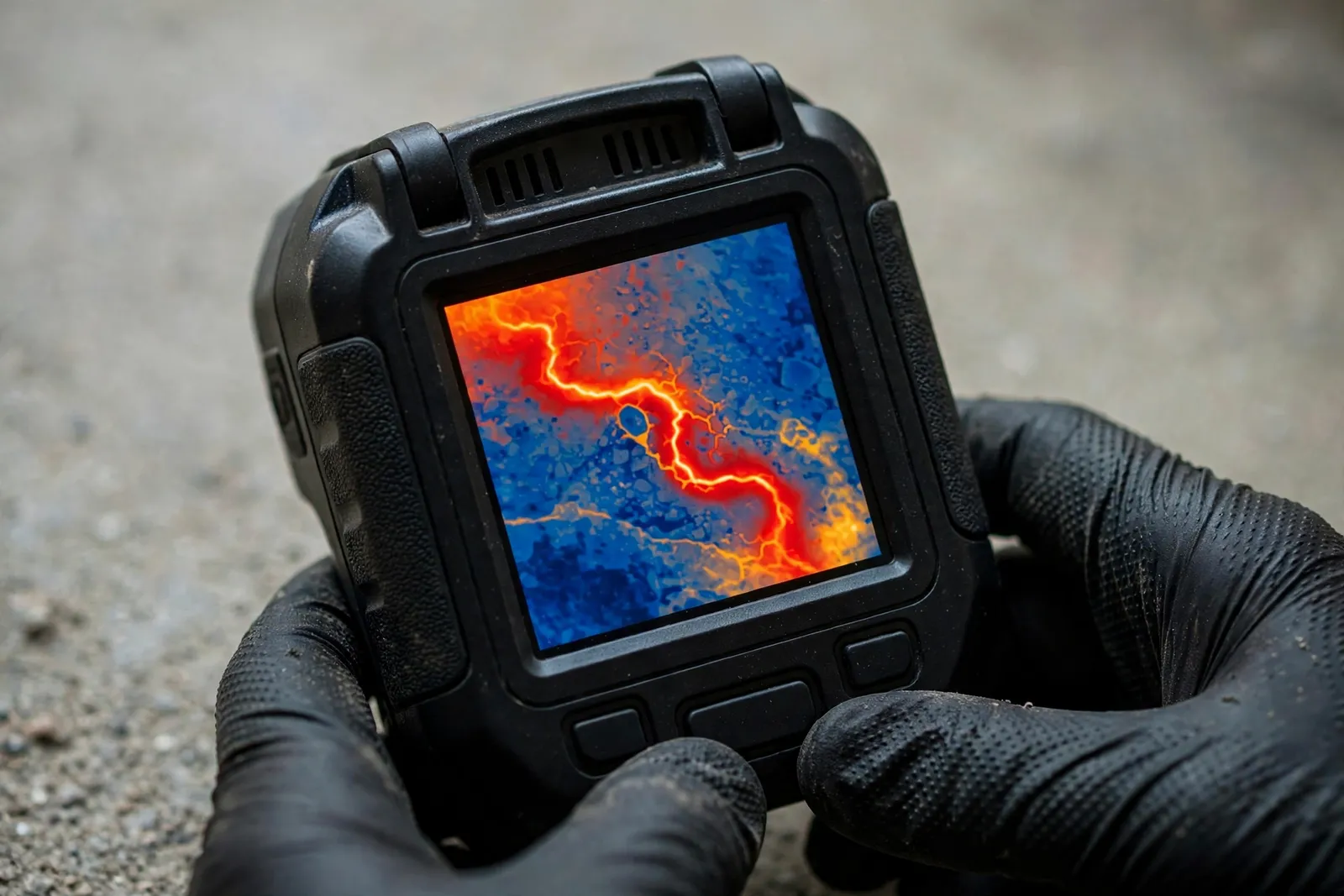
Electronic detection means finding leaks with instruments instead of demolition — no exploratory holes, no "let us open up three walls and see." We listen with acoustic microphones, read heat with thermal cameras, sniff with tracer gas, and prove which line fails with pressure gauges, then mark the spot. The technology behind electronic leak detection: what each method does, when each is the right tool, and why it beats finding leaks by breaking things.
What Is Electronic Leak Detection?
"Electronic" is the family name for the instruments that find hidden leaks without demolition — not one gadget. We measure from the surface: listening for sound, reading surface temperature, testing pressure, tracing gas.
The right call whenever the leak has no visible source — the meter says water is escaping, but no one can see where.
Acoustic Listening: Hearing the Leak Through Concrete
Acoustic listening is the stethoscope of plumbing — the first instrument on most jobs. Escaping pressurized water vibrates the pipe and soil; a ground microphone or listening stick amplifies it, and we hunt for the loudest point. For buried runs, a leak noise correlator (two sensors on the pipe) computes the break's distance from arrival-time difference.
Metal-pipe leaks sing at 500–1,500 Hz; ground-borne sound reaching the surface is mostly 30–700 Hz, since soil acts as a low-pass filter. Plastic differs: PVC leak noise sits around 70–850 Hz, and a 6-inch PVC main can drop to 10–40 Hz — at or below human hearing.
Whittier's 1950s–70s copper and galvanized stock is the 500–1,500 Hz metal pipe this method was built for — acoustic's home turf, where most of our Whittier electronic leak detection jobs start. Honest limits: plastic damps sound, tiny weeps are hardest to hear, old leaks with water blisters go nearly silent — and ambient noise fools beginners: Contractor Magazine notes a pro-grade detector "is so sensitive that all electrical appliances have to be shut off inside the house… the refrigerator sounds like a Greyhound Bus."
Thermal Imaging: Seeing Heat Through the Slab
A thermal camera cannot see through walls, and it does not see water — it reads surface temperature. A hot-water leak under a slab paints a warm plume across the concrete: an actively evaporating wet patch reads about 3–6°F cooler than dry surroundings (field work visualizes leaks at gradients of 0.4–1.5°C).
Pro moves: the shower-scan trick (run hot water upstairs, scan the ceiling below) and the before-sunup slab trace — heat the slab, arrive early, follow the warm trail back to its hottest point.
Firm limits: anyone promising it "sees through walls" is selling something. Cold-water and tiny leaks may show little or no thermal contrast; insulation, depth, and sun-loading mask the signal. As Derek DeMars puts it, "a professional typically confirms the finding with a second tool, such as a moisture meter, before recommending repairs" — that confirm-with-a-second-tool discipline is professional electronic leak detection.
Tracer Gas: Sniffing Out the Stubborn Ones
Some leaks refuse to be heard — tracer gas finds those. The line is drained and isolated, then charged at low pressure (0.5 to 1 bar) with 5% hydrogen / 95% nitrogen — forming gas. Hydrogen slips through even pinholes and rises nearly straight up; background H₂ is only ~0.5 ppm, sensitivity down to about 5×10⁻⁷ mbar·l/s.
Under 5.7% hydrogen in nitrogen the mix is nonflammable per ISO 10156 — nontoxic, noncorrosive, nothing to vent. Dave Yates's rule: "Low pressure rules the day! Start with a single low-pressure charge and don't continue to feed gas into the system." Precision: about ±1 m, verified by the move-away-and-return check.
When is it worth it? Contractor Magazine: "Tracer gas shines where acoustic struggles, on plastic lines and low-pressure situations… It is slower to set up but hard to argue with." Plastic is acoustic's blind spot — and in Whittier, hard water accelerates copper corrosion and pitting, so pinholes are the small, quiet leaks that acoustic can hear but tracer gas finishes. One documented job: tracer gas charged at 6 PM, four separate leaks pinpointed by 11 PM (building.co.uk).
Honest limits: slower than acoustic — drain, isolate, pressurize, wait. Concrete takes about an hour from five feet down; tarmac several hours; frozen clay can block it entirely; marble makes it ineffective. When speed beats precision, acoustic wins.
Pressure and Isolation Testing: Proving Which Line Failed
The fundamental first step of electronic leak detection — not a gadget, and the cheapest one. Isolate a section, pressurize with air or water, watch the gauge: a drop confirms the leak and gauges its severity. It proves the leak is real and narrows the zone.
The meter test is the $0 version: shut off every fixture, then watch the meter's leak indicator — the little red triangle or dial. If it moves, water is going somewhere it shouldn't. Then shut the house main valve: still spinning means the leak is between the meter and the house; stopped means it is inside.
Then isolate zones with inflatable test balls — bathroom by bathroom, laundry, kitchen — holding each branch ~30 minutes to find which fails: one leak, or multiple? In 1950s–70s stock, some shaken by the 1987 Whittier Narrows quake, one leak found doesn't always mean only one. For drains: pull a first-floor toilet, block the system with a ball, fill with water, watch the level — a drop means a drain-line leak under the slab. Nothing else gives you a documented gauge reading — proof of what failed, which matters for insurance.
Pipe Locating and Camera Inspection
You cannot find a leak in a pipe you cannot follow — and cameras give us eyes where microphones go deaf. For non-metallic pipe we push a battery-powered sonde (a little transmitter, typically 512 Hz — the industry-standard locating frequency) through the pipe on a fish tape or rodder; the receiver above ground reads the signal and marks the line's route and depth. Metallic lines trace directly with an induced signal.
For drains and sewers — gravity systems with no pressure and no sound — we run cameras instead: a waterproof camera on a flexible cable goes in through a cleanout for live video of cracks, roots, corrosion, offsets, bellies, and collapses, while the sonde in the camera head lets a surface locator mark each defect's exact position and depth. You should get the footage. Honest limits: a camera documents only the sections it reaches — not remaining wall thickness.
The Right Tool for the Job — and the Wrong One
Contractor Magazine's master rule: no single detection method is right for every leak. Each electronic leak detection tool's home turf — and where it should stay in the van:
| Method | Right tool for | Wrong tool for |
|---|---|---|
| Acoustic listening | Pressurized copper/steel/cast-iron lines (the 500–1,500 Hz metal Whittier is plumbed with), service lines, slab leaks. | Plastic pipe (weak, low-frequency signal), tiny weeps, very low pressure, unknown pipe material or route. |
| Thermal imaging | Hot-water slab leaks, walls/ceiling moisture mapping, flat roofs after sunset. | Cold-water/small leaks, insulated or deep lines, sun-loaded surfaces — or anyone promising it "sees through walls." |
| Tracer gas | Plastic lines, low-pressure/quiet leaks, tiny openings others miss, pinpointing to about ±1 m. | Frozen ground, marble, deep tarmac lines (hours of wait), jobs where speed beats precision. |
| Pressure / isolation testing | Proving the leak is real, house vs. service line, which zone is failing. | Expecting it to pinpoint — a triage tool, not a locator. |
| Pipe locating + camera | Mapping the route before you listen; drains/sewers (acoustic and tracer gas don't apply). | Pressurized supply lines — a camera is a different system entirely. |
Why Electronic Beats Exploratory Demolition
Exploratory demolition finds leaks by opening walls and slabs in likely spots until someone gets lucky. Electronic leak detection finds the leak first, so the repair needs exactly one opening.
The math is straightforward — and this is national math, not a Whittier quote. A specialist electronic leak detection visit runs about $150–$600 nationally (Angi's 2026 average is $280); exploratory demolition is concrete you pay to break, haul, and re-pour, plus flooring, patching, and days of disruption. Slab cutting alone runs $300–$800 and is irreversible; a reroute found by proper detection can save $500–$2,000; once mold remediation enters the picture, costs run $1,500–$6,000. Detection narrows the location to within inches — often a two-foot patch instead of half a living room. The visit isn't an extra cost on top of the repair; it is what keeps the repair small.
What an Electronic Detection Visit Looks Like
A typical electronic leak detection visit runs one to three hours: symptom walkthrough, meter and pressure checks, instrument work, and a marked location plus a written report before we leave.
The sequence: we listen to you first — symptoms, timing, what you have already checked. Then we verify at the meter that water is actually being lost (the $0 test above) and run isolation tests to narrow it to a specific line, which determines the instrument: acoustic for most supply leaks, thermal added for hot-water lines, tracer gas for the difficult ones, camera for drains. The location gets marked physically, and you receive a written report with the findings, meter readings, and photos.
On cost, plumber-published national ranges by method: visual plus meter test $150–$300, acoustic $200–$500, thermal $300–$600, tracer gas $350–$650 — usually bundled into the visit. National ranges, not Whittier prices — the honest frame, not a quote.
When Each Method Is Used
Quick reference: slab leak → acoustic first (+ thermal for hot-water lines) — the signature job in Whittier's slab-on-grade homes; wall pipe → acoustic through drywall; yard service line → locate the run, then listen along it; pool → pressure-test the plumbing plus dye; drains/sewers → camera; multiple suspected leaks → isolate each zone.
Want to try the DIY checks first? Our step-by-step guide on how to find a water leak in your house covers the meter test, dye test, and room-by-room inspection — and when to hand off to instruments.
Why the Two-Method Rule Beats Guesswork
Contractor Magazine's master rule for this work: no single detection method is right for every leak — so we confirm with a second before marking a spot. That discipline is what separates professional detection from guesswork. Thermal imaging narrows a zone fast, but as trade writer Derek DeMars puts it, thermal cameras show temperature patterns, not water itself — a professional confirms the finding with a second tool, such as a moisture meter, before recommending repairs. Tracer gas pinpoints to about ±1 m, but we verify with the move-away-and-return check before the spot is final.
It is also what separates instruments from guesswork-by-demolition. A trade-press case (building.co.uk) documents a 6 PM start: tracer gas charged, four separate leaks pinpointed by 11 PM, and next-day excavation found all four — incorrect fittings. Five hours of methodical work versus weeks of opening walls in likely spots. And acoustic listening takes a trained ear, not just a tool: Contractor Magazine notes one pro-grade detector is so sensitive that all electrical appliances have to be shut off inside the house — "the refrigerator sounds like a Greyhound Bus."
- Whittier's copper is acoustic's home turf. The city's dominant 1950s–70s pipe stock is the 500–1,500 Hz metal pipe that ground microphones and correlators were built for; corrosion pinholes in aging copper under pressure produce the classic hiss (EEWorld frequencies + verified local housing facts).
- Hard-water pinholes are the two-method case. Small, quiet, pressurized leaks — the profile where acoustic still works (pressure is present) but tracer gas finishes, as Contractor Magazine puts it: tracer gas shines where acoustic struggles.
- Slab-on-grade is the primary scenario here. Hot-side thermal tracing before sunup, acoustic under the slab, tracer gas under concrete — Whittier's slab construction makes these the main jobs, not basement work.
The result: the repair opening is one targeted hole — a marked spot within inches — instead of exploratory demolition and days of disruption.
What Moves Electronic Detection Cost Up or Down
National ranges, not Whittier prices: Angi's 2026 average for a specialist detection visit is $280, within a $150–$600 range; plumber-published US ranges by method run $150–$300 for a basic visual plus meter test, $200–$500 for acoustic, $300–$600 for thermal imaging, and $350–$650 for tracer gas — usually bundled into the visit rather than itemized. A comprehensive multi-method slab-leak detection runs $300–$800. Equipment is part of why the visit costs what it does: a municipal leak-noise correlator runs about $30,000 (Contractor Magazine), and pro thermal cameras run up to about $30,000 to buy.
What pushes cost up: tiny weeps that need tracer gas (slower setup — drain, isolate, pressurize, wait; concrete permeation takes about an hour from 5 feet), plastic pipe (weak, low-frequency signal — more sensors, closer together), deep burial or sun-loaded surfaces that mask thermal contrast, an unknown pipe route that needs locating first, and multiple suspect leaks isolated zone by zone (about 30 minutes per zone with test balls). What keeps it down: pressurized copper or steel lines — acoustic's home turf, fast to survey — and a homeowner who has already done the $0 meter test so we start at the right instrument.
One question worth asking any detection company, us included: many plumbers credit the detection fee against the repair if you use them for the fix (trade-published practice) — ask upfront. The national floor for a basic visit is roughly $150–$300; a stubborn plastic-line case needing tracer gas lands higher. Either way, it is quoted against a real finding — a marked location and a written report — not an hourly trench.
Why Our Method Stack Fits Whittier Homes
We run the trade stack in order: the meter test first (is there a leak? house or service line?), then acoustic as the workhorse on pressurized metal lines, thermal added for hot-water lines, pipe locating to map the route when it is unknown, tracer gas as the precision finisher for plastic, low-pressure, or tiny leaks, and camera for drains and sewers — a different pipe system where acoustic and tracer gas do not apply. We confirm with a second method before marking a spot, and the location is marked within inches, with meter readings, methods used, and photos in a written report.
Whittier specifics shape our choices: 1950s–70s copper under slab-on-grade puts acoustic listening squarely in its home turf; hard water drives the pinhole leaks that tracer gas finishes; expansive Puente Hills clay swells and shrinks with moisture cycles, stressing buried joints — the failure mode that favors correlator work on the service line after meter-to-house isolation; and the 1987 Whittier Narrows quake is a legitimate "why now" for leaks in quake-era stock (a plausible framing, not a statistical claim), where the acoustic-plus-tracer stack finds damage without exploratory demolition.
And the honest limits, up front: thermal imaging cannot see through walls — cold-water and tiny leaks may show little or no contrast, so every thermal finding gets a moisture-meter check; pressure testing confirms and narrows but rarely pinpoints alone, which is why instruments follow it; and a camera only documents the sections it reaches. We pick the right tool for your leak, not the fastest — and we tell you when a tool is the wrong one. Detection finds and marks; repair is a separate decision, quoted from our mark.
Want the full breakdown of every method — when acoustic beats thermal, when tracer gas is the only answer, and what each one costs? Read our guide to leak detection methods.
Frequently Asked Questions
Diagnosis first: the meter test confirms the leak is real, isolation testing narrows it to a line or zone, and that decides the method — acoustic for pressurized metal, thermal for hot-water lines, tracer gas for plastic or stubborn leaks, camera for drains.
With caveats: sound travels farther through copper than plastic — PVC leak noise sits around 70–850 Hz, and a large PVC main can drop to 10–40 Hz, near or below human hearing. For plastic, tracer gas is usually better.
It reads surface temperature, not water — cold-water and tiny leaks may show little or no contrast, and it can't see through walls. We verify every finding with a moisture meter before anyone cuts.
Yes — 5% hydrogen in 95% nitrogen, under the 5.7% threshold that makes it nonflammable per ISO 10156. Nontoxic, noncorrosive, nothing to vent, charged at low pressure (0.5 to 1 bar).
Nationally, a specialist visit runs about $150–$600 (Angi's 2026 average: $280); plumber-published US ranges by method run $150–$300 to $350–$650 — usually bundled into the visit. National ranges, not Whittier prices.
Typically marked within inches — close enough for one small, targeted opening.
No single detection method is right for every leak — Contractor Magazine's master rule. Thermal narrows a zone fast, but we confirm with acoustic or a moisture meter; tracer gas pinpoints, but we verify with the move-away-and-return check.
Yes — a marked location and a written report: meter readings, methods used, where the leak is. Yours whether we do the repair or you take it to another contractor.