Slab Leaks
Pinpoint leaks under your concrete slab with acoustic listening and thermal imaging — no jackhammer guesswork, no exploratory holes.
Slab Leak Detection in Whittier, CA →Mar Vista Heights — Midcentury Hillside
Mar Vista Heights sits above the flat of town — midcentury homes with mountain views near the Arroyo Pescadero Trailhead. Our leak detection in Mar Vista Heights, Whittier, CA finds slab leaks and failing supply lines non-invasively — pinpointing the break within inches — because early leak detection keeps a hillside home's high value from becoming a high repair bill.

Local focus
Mar Vista Heights is Whittier’s hilltop midcentury neighborhood — 1950s–70s homes with mountain views near the Arroyo Pescadero Trailhead, where a median sale price around $1,227,500 makes every house a serious asset. These are copper-and-galvanized-era homes now running on original supply lines, and original pipe at 55 to 75 years old is past the point where you guess — you locate it with leak detection. We built our leak detection Mar Vista Heights service around that reality: in a midcentury hillside neighborhood, you don’t open a slab until you know exactly what’s under it.
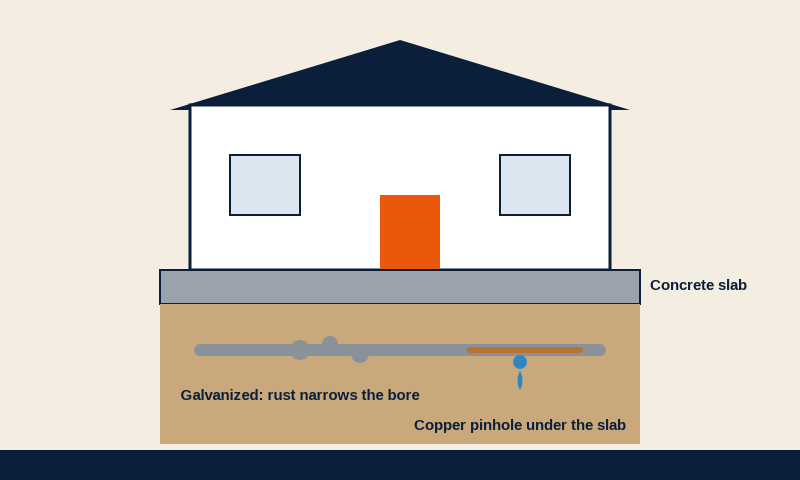
That building history lives in these pipes. Mar Vista Heights was built across two decades of plumbing technology — galvanized steel supply lines in the earliest homes, copper in most of the tract, and generations of partial repipes and remodels layered on top. One hillside home can hold two or three pipe generations at once — and only a leak detection visit can say which one is actually leaking.
And the cost of a wrong guess is higher here: at a median near $1,227,500 — well above the city’s roughly $822,600 median owner-occupied value per the U.S. Census — blind demolition in these homes is brutally expensive. Non-invasive leak detection works straight through floors and walls. The equipment doesn’t care what decade the house is — only where the water is — and every leak detection visit here assumes the pipe is original until proven otherwise.
Our most common calls here: pinhole leaks in aging copper behind bathroom walls, slab leaks under midcentury additions, and supply lines stressed by decades of clay-soil movement under hillside lots. Slab leak detection and emergency leak repair are both available here with same-day response.
Why leaks happen here
Most of Whittier’s housing was built before 1970 — 82.4%, per the Southern California Association of Governments’ 2019 city profile — and Mar Vista Heights’ 1950s–70s stock sits right in the middle of it. Every failure mode of that era is still in the ground here: ground zero for Whittier’s classic pipe problems, and every one of them rewards early leak detection.
Galvanized steel supply lines, standard in 1950s–60s homes, corrode from the inside out over roughly 40–50 years — a 1960 home’s original galvanized pipe is now about 65 years old, well past that window. Copper fails differently: Whittier’s water is reported at about 15 grains per gallon — "very hard" per the Water Quality Association — and hard water plus municipal chloramines pits copper from the inside until pinholes open. Cast iron drains corrode the same way, which is why midcentury homes here need sewer line leak detection nearly as often as supply-side work.
Then there’s the ground — and the hillside. The October 1987 Whittier Narrows earthquake — magnitude 5.9, with severe shaking in Whittier — broke water and gas mains across town, shifting buried copper joints that have been degrading ever since. Add the expansive clays around the Puente Hills, which heave and settle with wet and dry cycles — hillside lots feel that movement more than flat ones. Any Mar Vista Heights pipe installed before 1987 has already survived a major quake — plus nearly four decades since.
The stakes match the value: at a median sale price around $1,227,500, a hidden leak here threatens real equity — while water damage makes up 22.6% of all homeowners claims at an average of about $15,400 (Insurance Information Institute). Figuring out which failure mode is actually yours is exactly what a leak detection visit is for — and why leak detection pays for itself in this neighborhood.
Our method
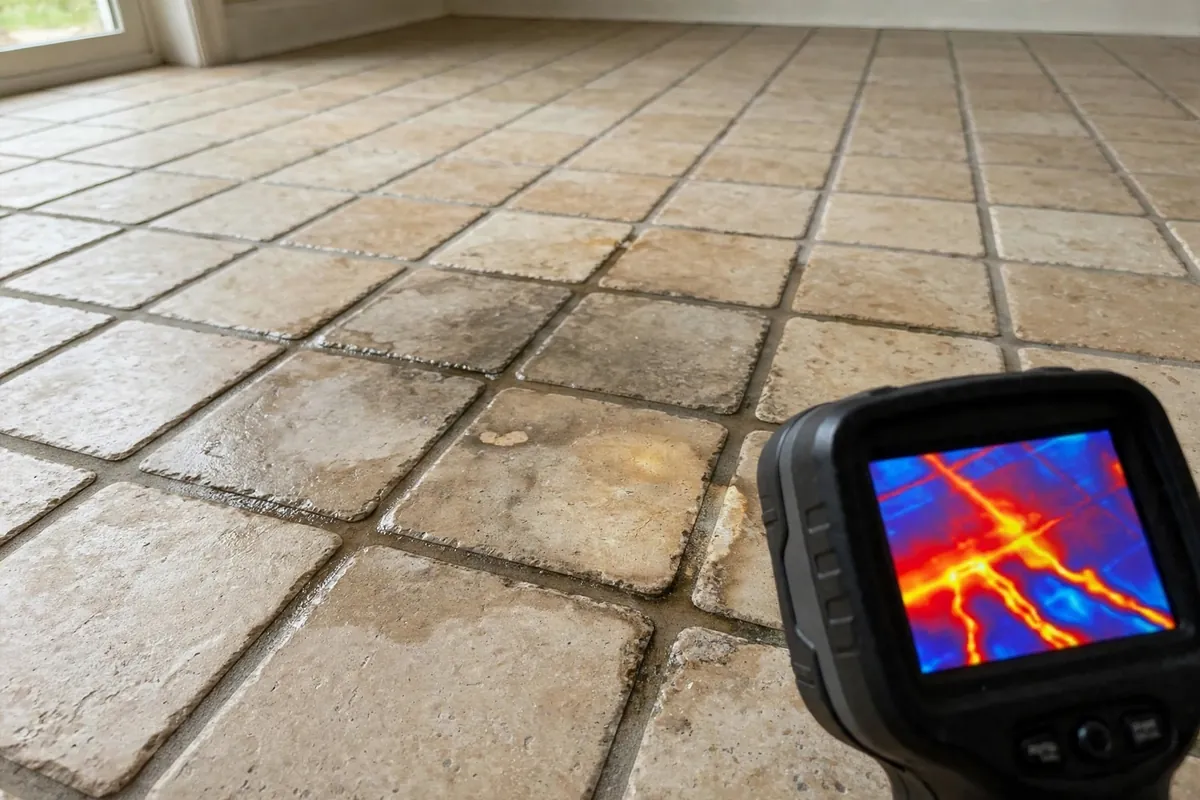
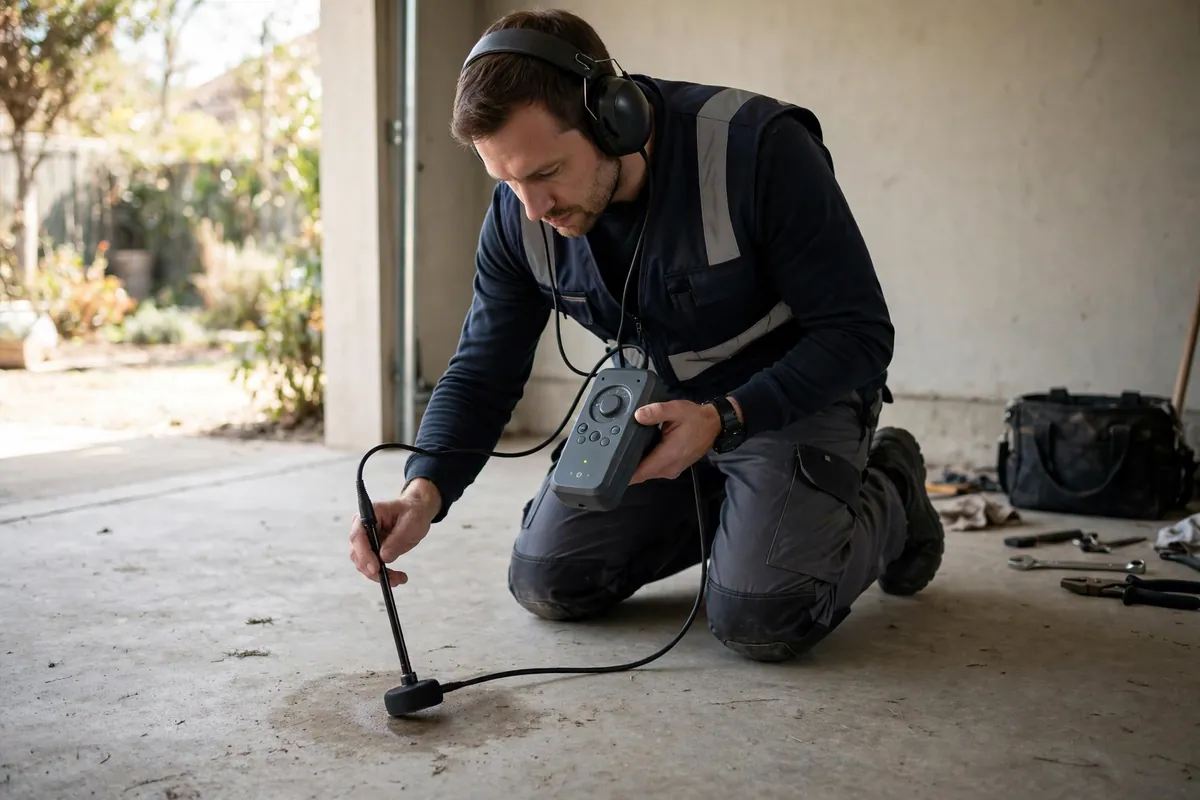
On a hillside lot, the first move is never the saw: it is the sequence. Every Mar Vista visit follows the order the trade press recommends — Contractor Magazine is explicit that you pinpoint the slab leak before you break the floor. Ours runs meter check, acoustic listening (leaks on metal pipe sound at 500–1,500 Hz), thermal imaging for the 3–6°F surface gradients hidden water leaves behind, and moisture-meter mapping to trace the water’s path — pinning the break to within inches, and no step opens anything — which is why detection, not demolition, is the right first call on a hillside home.
That discipline matters most where the slab sits on a slope. These are overwhelmingly slab-on-grade homes — water lines run under the concrete you walk on — so a leak surfaces as a warm floor spot, a damp carpet patch, or a climbing bill, never water pooling in a basement. Plumbers on the Terry Love forums call slab leaks the worst kind to locate, because water follows the path of least resistance — the visible damage is rarely above the break. Our electronic leak detection gear locates the break through tile, concrete, and finished floors — untouched. That’s why professional detection costs a fraction of blind demolition.
We’ll also be straight about where detection ends. A detection visit finds the leak; the repair is a plumber’s job — spot repair, overhead reroute, or repipe. Often the smartest fix is abandoning the failed under-slab section and rerouting overhead, which one industry pro describes as “less expensive, messy, and disruptive” than chasing pipe through concrete. Knowing the exact location first is what makes that choice possible — and what keeps the detection visit the cheapest dollar in the whole project.

What we do
Pinpoint leaks under your concrete slab with acoustic listening and thermal imaging — no jackhammer guesswork, no exploratory holes.
Slab Leak Detection in Whittier, CA →Burst pipe, major leak, water where it should not be — fast response across Whittier, day or night.
Emergency Leak Repair in Whittier, CA →Find leaks in the buried line from your meter to the house — acoustic tracing pinpoints it before anyone digs.
Water Line Leak Detection in Whittier, CA →Losing more water than the Whittier sun explains? Dye testing and pressure checks find pool and spa leaks fast.
Pool & Spa Leak Detection in Whittier, CA →Camera inspection locates breaks, offsets, and root intrusion in your sewer lateral — no guesswork, no trench first.
Sewer Line Leak Detection in Whittier, CA →After-hours service for offices, retail, restaurants, and HOAs — with documentation your insurer accepts.
Commercial Leak Detection in Whittier, CA →Pinpoint lateral lines, valves, and sprinkler head leaks with pressure testing and acoustic location — no digging.
Irrigation Leak Detection in Whittier, CA →Acoustic listening, thermal imaging, tracer gas, and pressure testing find hidden leaks without demolition.
Electronic Leak Detection in Whittier, CA →Combustible gas sniffers, pressure testing, and line tracing pinpoint the leak fast — plus what to do the moment you smell gas.
Gas Leak Detection in Whittier, CA →Warning signs
Hidden leaks announce themselves sideways. A warm spot on the floor usually means a hot-water line leaking beneath the slab. A bill that climbs for no reason is the classic giveaway — California utilities use tiered rates, so a hidden leak pushes you into higher-priced tiers that multiply it. Listen for water running with everything off; check baseboards for dampness, wood for buckling, paint for blisters. In a midcentury home, pay extra attention around original bathrooms and laundry runs, where the oldest pipe usually lives.
A musty smell is worth acting on, not waiting out: the EPA and CDC note mold can start on wet surfaces within 24–48 hours — and a slab leak keeps its surroundings wet around the clock. Spot any of these and emergency leak repair is the rapid route; a standard detection visit is the deliberate one. Either way, detection comes before the saw.
Costs
Countrywide, professional detection typically runs $150–$600, with slab leak detection averaging about $280 (2026 Angi data). Set that against the average slab leak repair at about $2,280, including detection (typically $630–$4,400) — roughly eight times the visit — the average water-damage claim near $15,400, water damage at 22.6% of all homeowners claims (Insurance Information Institute), and FEMA’s standing figure of one inch of water causing around $25,000 in damage.
CostCandor’s take, from the contractor cost world: “Paying for precise detection is usually the cheapest money in the whole project.” The other side: one homeowner’s widely shared account tells of an $800 fix becoming a $22,000 disaster after eighteen months of ignoring a damp patch — with the gradual-seepage claim denied entirely. Gradual leaks usually fall outside standard homeowners policies, while sudden, documented failures may qualify for coverage. A detection report is what turns a denial into a payable claim — where a detection visit would have found it for a few hundred dollars.
Our detection price is confirmed before we start — no surprises once the equipment comes out. That’s the promise behind every leak detection visit we run.
Service areas
Mar Vista Heights is our hillside territory, but our leak detection coverage runs citywide — from Uptown Whittier and East Whittier to Friendly Hills, College Hills, Murphy Ranch, and South Whittier. Every neighborhood gets the same non-invasive leak detection method and up-front pricing — just a different part of town, with the same professional leak detection. View all Whittier service areas →
From the blog
Straight answers on costs, warning signs, and finding hidden leaks — from our leak detection Whittier team.
Common questions
The pipes are, more than the slabs. Most Mar Vista Heights homes were built from the 1950s to the 1970s, so original copper and galvanized supply lines here are 55 to 75 years old — at or past design life. Hard-water pitting, quake-shifted joints, and hillside soil movement all stack up in midcentury tracts, so a leak detection visit here starts with the pipe’s age.
That is precisely what non-invasive detection is for. Acoustic listening, thermal imaging, and moisture mapping read through floors and walls without opening anything — pinning the break to within inches before anyone talks demolition. It’s the same non-invasive method we use across Whittier.
Across the country, professional detection runs $150–$600 depending on the methods a hillside home needs, and slab leak detection averages about $280 (2026 Angi data). A midcentury hillside home sometimes needs an extra tracing step — sorting out which pipe generation is actually leaking — but the price is always confirmed before we start.
Two generations, mostly: galvanized steel supply lines (1950s–60s), which corrode from the inside out over about 40–50 years, and copper (1960s–70s), which develops pinhole leaks in hard-water systems — plus cast iron drains that corrode the same way. Decades of remodels and partial repipes mean one house can hold all of them — which is why the leak detection visit identifies the failing generation before anyone talks repair.
In October 1987, the Whittier Narrows quake — magnitude 5.9, shaking Whittier hard — broke water and gas mains across town, with over a thousand gas leaks reported. Buried copper joints shifted that day and have been degrading ever since. For a home built before 1987, a detection check is worthwhile even with no symptoms — joints moved decades ago fail without warning.
A warm patch of floor, a bill that climbs for no reason — tiered California rates multiply the damage — water heard running with everything off, or damp baseboards and a musty smell. Mold can begin within 24–48 hours on wet surfaces, so a slab leak that stays wet around the clock deserves a prompt detection visit.
We find it precisely, and that is where our job ends. Detection and repair are separate trades: after we pin the break to within inches, a plumber takes on the spot repair, the overhead reroute, or the repipe. Your detection report gives the plumber that exact location. Often the smartest fix is abandoning the failed under-slab section and rerouting overhead rather than chasing pipe through concrete — knowing the exact location first makes that possible.
Same-day service across Mar Vista Heights, with 24/7 response for active leaks. Call (562) 450-1003 and we’ll set your arrival window up front, with the confirmed detection price included.
Non-invasive leak detection for Mar Vista Heights’ midcentury hillside homes — pinpointed within inches.