Slab Leaks
Pinpoint leaks under your concrete slab with acoustic listening and thermal imaging — no jackhammer guesswork, no exploratory holes.
Slab Leak Detection in Whittier, CA →Murphy Ranch, Whittier CA
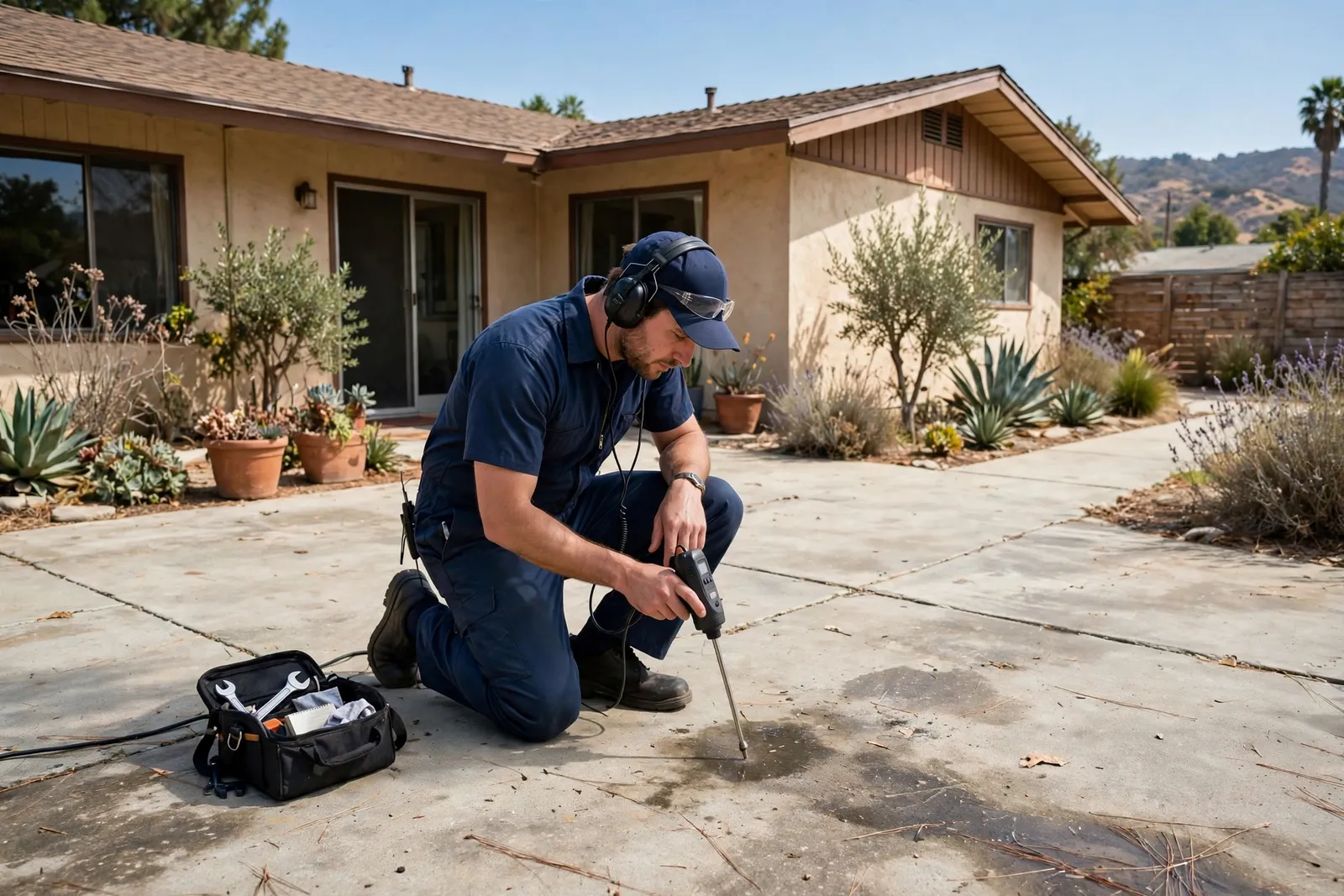
Murphy Ranch was built in the 1950s and 60s — slab-on-grade homes with copper water lines running right under the concrete. If you need leak detection Murphy Ranch Whittier homes can count on any hour, that is us: non-invasive acoustic and thermal equipment that pinpoints the break within inches, with no exploratory jackhammering.
Local focus
Murphy Ranch is the hillside pocket of Whittier wrapped around Murphy Ranch Park -- the 48-acre city park on Las Cumbres Drive (90603) with the eucalyptus-shaded trail loop, the picnic grounds, and the horse trails. The neighborhood carries the name of Simon J. Murphy, who founded the East Whittier Land and Water Company and the Murphy Oil Company and ran citrus orchards on this ground before the tracts arrived. What replaced the orchards were the classic postwar Southern California ranch homes of the 1950s, 60s, and 70s: single-story, slab-on-grade, copper supply lines run under and through the concrete.
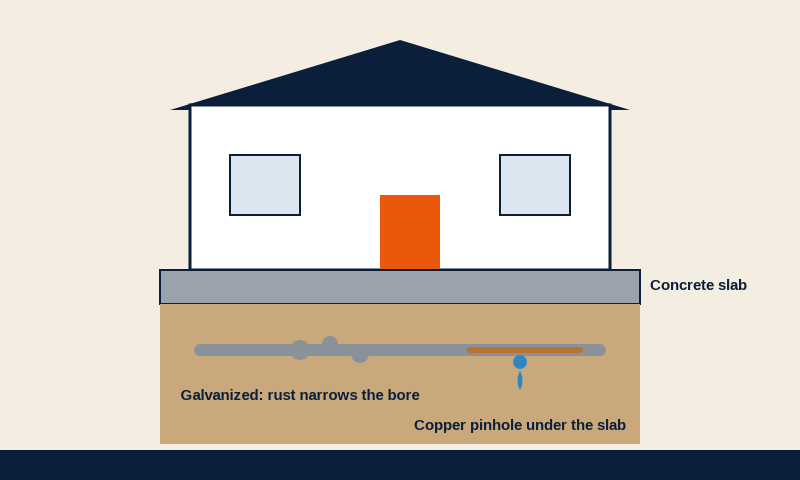
Citywide, 82.4% of Whittier's housing stock was built before 1970 (Southern California Association of Governments, 2019 city profile, from Census data) -- and Murphy Ranch sits squarely in that era. Copper under a slab is a fine system for about fifty years; at sixty and seventy, the same lines fail the way aging copper fails, pinhole by pinhole from internal pitting, water seeping into the soil under your foundation long before anything shows on the surface. Because these tracts have no basement to catch the first sign, the clues surface as a warm patch on the floor, a creeping water bill, or running water with everything off. That is why slab leak detection is the call we get most from this neighborhood.
Local forces
Three local forces are working on those old lines. First, the water: Whittier's supply runs about 15 grains per gallon -- over the 10.5 gpg line the Water Quality Association calls "very hard." Hard water plus the chloramine disinfectant in our systems pits copper pipe walls from the inside out until a pinhole opens -- the invisible cause behind most of the slab leaks we trace in Murphy Ranch.
Second, the ground: the Puente Hills sit on interbedded sand, silt, and clay with real expansion potential, and our long-dry-then-winter-rain cycle shrinks and swells that clay every year, flexing slabs and the copper buried in them, decade after decade.
Third, the 1987 Whittier Narrows earthquake -- magnitude 5.9, Mercalli Intensity VIII shaking in Whittier, water main breaks across town. Every Murphy Ranch pipe installed before October 1987 has already survived severe shaking. Add mature trees, whose roots find the joints in aging clay and cast-iron sewer laterals, and you have the full local picture: slow drains or sewage odor near a cleanout means a camera inspection before anyone digs, and our sewer line camera work shows it on screen, located and measured.
Our process
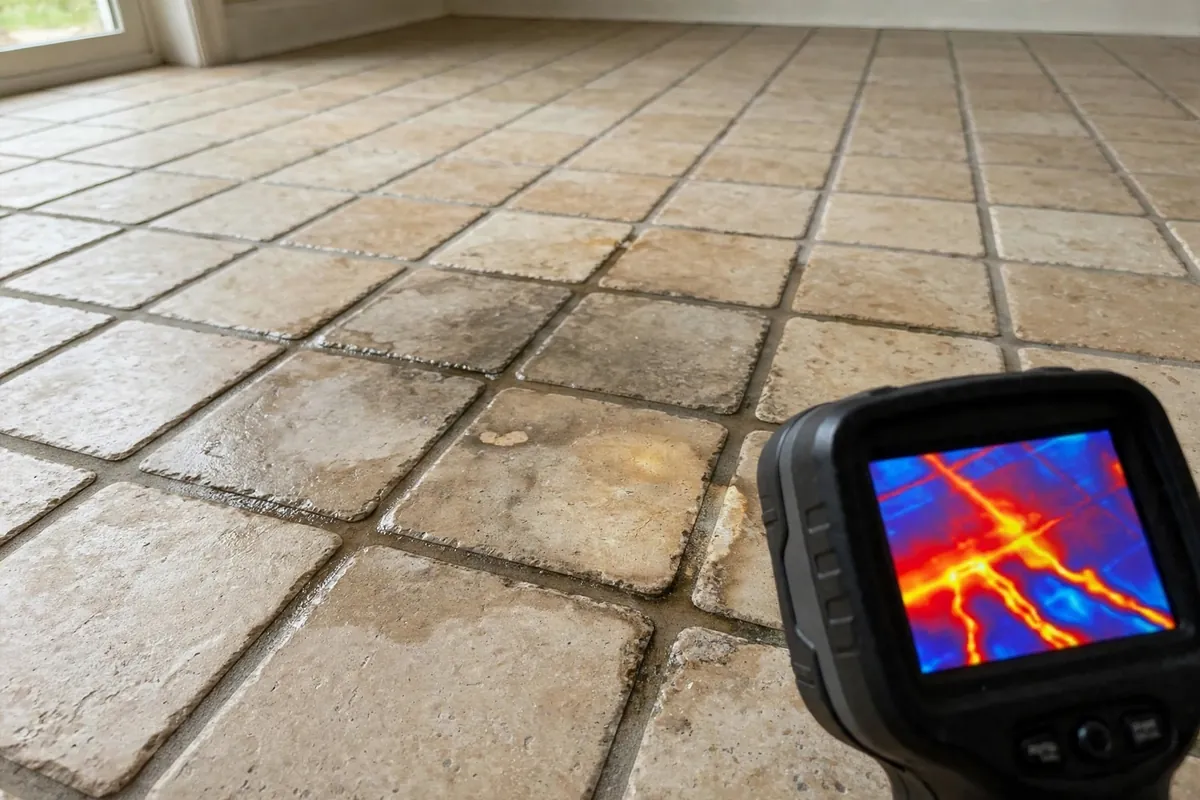
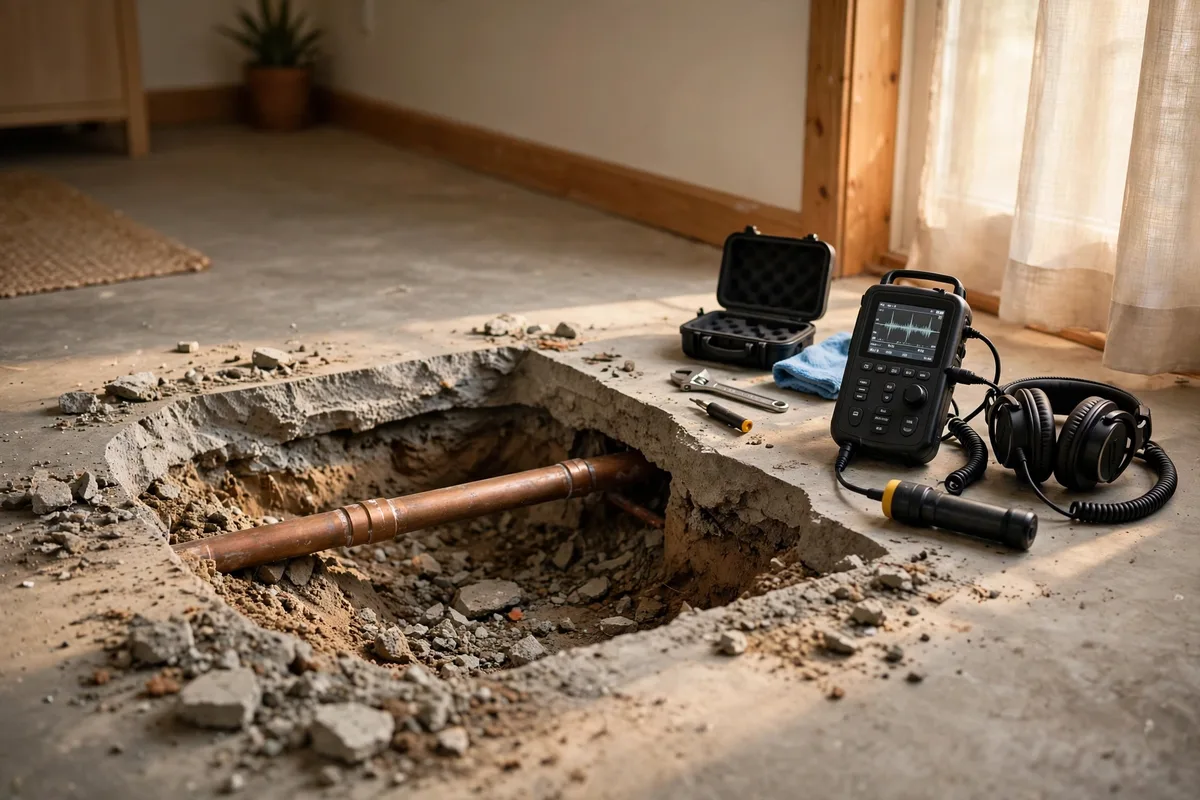
Our process is the same pro sequence we run across Whittier: a meter test with everything off confirms the leak is on your side; then we isolate -- hot side, cold side, and the buried service line separately, because a hot-water line under the slab is a different job from a yard service line. Acoustic listening follows the leak's sound along each run (metal-pipe leaks sing in the 500-1,500 Hz band), thermal imaging picks up the 3-6°F surface gradients a hot-water leak leaves in the slab, and moisture-meter mapping draws the wet zone's boundary.
Every step is non-invasive: we mark the spot within inches and hand you documented findings before any repair decision -- "pinpoint the slab leak before you break the floor," as Contractor Magazine's trade guidance puts it. One honest note: leak detection is diagnosis, not repair. The smart fix is often to abandon the broken under-slab section and reroute overhead -- "less expensive, messy, and disruptive," in one trade pro's words, than chasing pipe through concrete. For the tricky ones -- multiple leaks, plastic runs -- our electronic methods close the gap, and a burst pipe gets our emergency response around the clock.
What we do
Pinpoint leaks under your concrete slab with acoustic listening and thermal imaging — no jackhammer guesswork, no exploratory holes.
Slab Leak Detection in Whittier, CA →Burst pipe, major leak, water where it should not be — fast response across Whittier, day or night.
Emergency Leak Repair in Whittier, CA →Find leaks in the buried line from your meter to the house — acoustic tracing pinpoints it before anyone digs.
Water Line Leak Detection in Whittier, CA →Losing more water than the Whittier sun explains? Dye testing and pressure checks find pool and spa leaks fast.
Pool & Spa Leak Detection in Whittier, CA →Camera inspection locates breaks, offsets, and root intrusion in your sewer lateral — no guesswork, no trench first.
Sewer Line Leak Detection in Whittier, CA →After-hours service for offices, retail, restaurants, and HOAs — with documentation your insurer accepts.
Commercial Leak Detection in Whittier, CA →Pinpoint lateral lines, valves, and sprinkler head leaks with pressure testing and acoustic location — no digging.
Irrigation Leak Detection in Whittier, CA →Acoustic listening, thermal imaging, tracer gas, and pressure testing find hidden leaks without demolition.
Electronic Leak Detection in Whittier, CA →Combustible gas sniffers, pressure testing, and line tracing pinpoint the leak fast — plus what to do the moment you smell gas.
Gas Leak Detection in Whittier, CA →Warning signs
On a 1960s tract home, the question after a spinning meter is whether the break is under the slab or in the buried water line out in the yard. Hot-side slab leaks are the classic Murphy Ranch find: they run 24/7, warming the floor above the break, and in California's tier-priced water systems they push you into higher tiers -- so they often show up first as a bill that doubles or triples before anyone feels the warm spot.
The rest of the checklist: damp baseboards along an exterior wall, a musty hallway smell, the faint sound of running water with everything off. Shut everything off, watch the meter dial, and if it moves, water is leaving the system somewhere -- catching it early is the whole game, which brings us to the math.
The math
Nationally, professional leak detection runs about $150-$600 depending on the methods the job needs, and slab-leak location averages around $280 (Angi, 2026). The average slab leak repair runs about $2,280, including detection (typically $630–$4,400) -- roughly an eight-to-one ratio between finding it and fixing it late. We confirm the price up front before we start.
The cost of waiting is where it gets ugly: water damage is 22.6% of all homeowners insurance claims at about $15,400 a claim (Insurance Information Institute), and FEMA's standard figure is that a single inch of water causes roughly $25,000 in damage. Mold starts in 24-48 hours on wet surfaces (EPA/CDC) -- and a slab leak never lets its patch of soil dry, so the clock never stops. Gradual leaks are typically excluded as wear and tear under standard HO-3 policies, while sudden failures may be covered: finding and documenting a leak early, with a written detection report, is what separates a payable claim from a denied one.
We run same-day detection visits from our Greenleaf Avenue office across Whittier -- Friendly Hills, East Whittier, College Hills, Uptown Whittier, and South Whittier.
From the blog
Straight answers on costs, warning signs, and finding hidden leaks — from our leak detection Whittier team.
Common questions
More than newer tracts, yes. Murphy Ranch was built in the 1950s and 60s with copper water lines under slab-on-grade foundations, and pinhole corrosion in copper is a documented pattern in Southern California homes built between the 1950s and 1980s. After five or six decades of service plus Whittier's hard water, those lines are in their prime leak years.
The meter test comes first: with everything off, a moving meter confirms a leak on your side. Then we isolate, shutting valves to test the hot side, cold side, and the buried service line separately. Acoustic listening along each run tells us whether the sound is under the slab or out in the yard, so the right repair gets priced, not a guess.
Yes. In established San Gabriel Valley neighborhoods with mature landscaping, root intrusion is a frequent cause of sewer line damage. Roots enter through joints in aging laterals and grow into a mass that catches everything behind it. A camera inspection shows the intrusion on screen, located and measured, before any repair is discussed.
No. That is the whole point of detection-first work. Acoustic listening hears the leak through concrete, and thermal imaging sees temperature differences through floors and walls. We mark the spot within inches and hand you documented findings. Nothing gets opened until the repair plan is yours to approve.
Nationally, professional leak detection typically runs $150-$600 depending on which methods the job needs, with slab-leak location averaging about $280 (Angi, 2026 figures). We confirm the price up front before we start, and findings are documented for your records either way.
All of Whittier, CA, including Friendly Hills, East Whittier, Leffingwell Ranch, South Whittier, and Uptown. Our office is at 7001 Greenleaf Ave #117 in Whittier, and we run same-day detection visits across the city.
Whittier's water runs about 15 grains per gallon -- over the 10.5 gpg line the Water Quality Association calls 'very hard.' Hard water plus chloramine disinfectant pits copper pipe walls from the inside out, which is exactly how pinhole leaks start in under-slab copper. You can't soften the water inside the walls, but you can catch the first pinhole before it becomes a slab failure.
It's the most common first sign we see. A hot-water slab leak runs around the clock, and in California's tier-priced water systems it pushes you into higher tiers -- so the bill can double or triple before any warm spot appears. The meter test settles it: shut everything off, and if the dial moves, call us before the next billing cycle does.
Non-invasive leak detection for Murphy Ranch's 1950s–60s homes — marked within inches, priced up front.